A standard 20-foot dry container (FCL) loaded with sorghum in 50 kg PP bags carries a net payload of 24-25 metric tons. But the real number that matters is the maximum weight your destination country allows on a container truck - because ocean carriers, Indian port rules and road authorities at the discharge end all have different limits. This guide gives operations teams the exact figures for payload planning, bag counts, packing formats and VGM compliance before the first bag is loaded.
Sorghum in a 20ft FCL: 24-25 MT net in 50 kg PP bags (480-500 bags) under loose stuffing. Palletised loading reduces payload to 21-22 MT. Weight limits - not cubic volume - are the binding constraint. Always verify destination road weight limits before finalising the packing plan.
Ready to Import Indian Sorghum?
Get an instant FOB and CIF cost estimate including shipping and insurance.
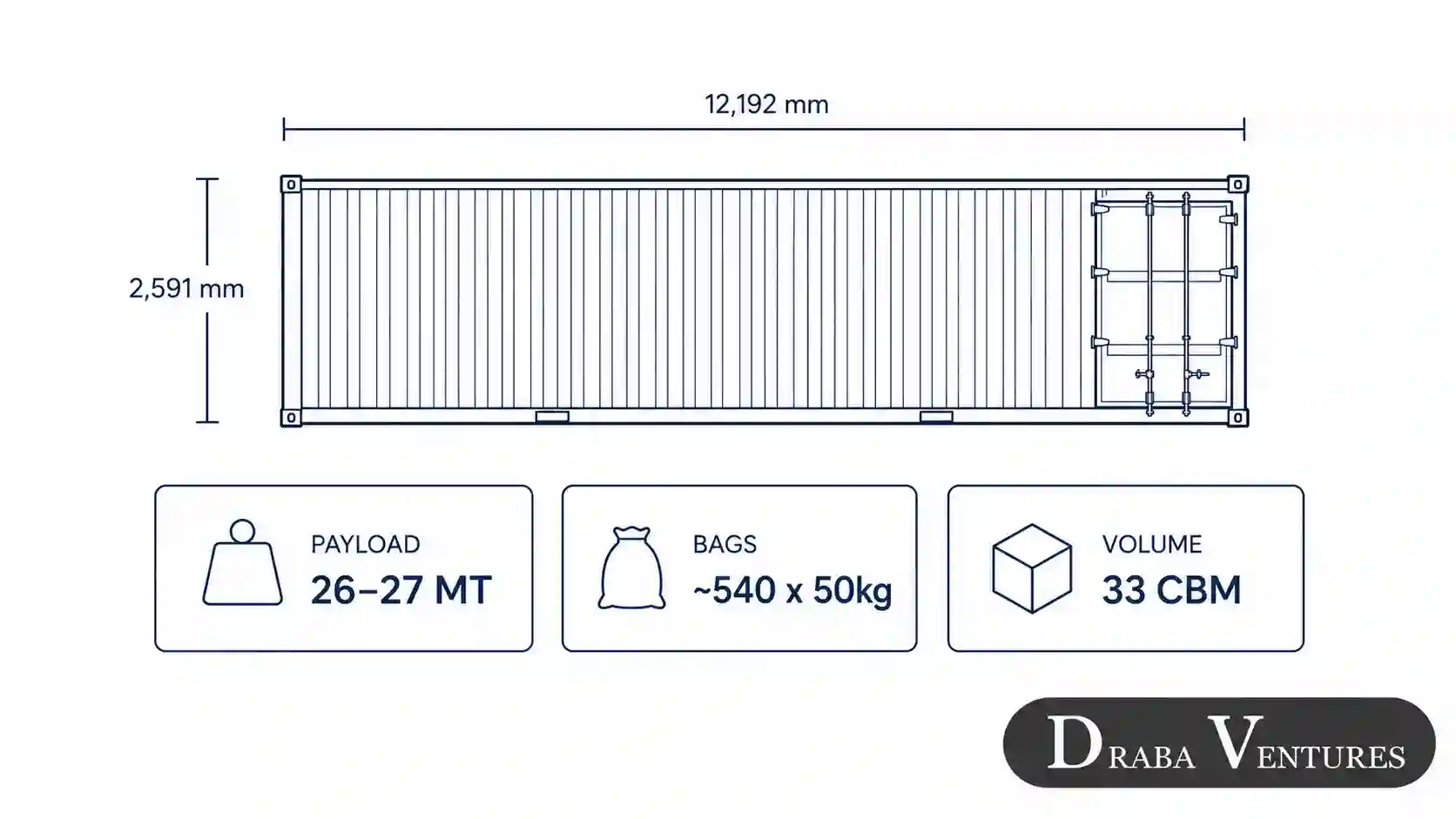
Typical 20ft FCL Payload for Bagged Sorghum
For international shipments, sorghum is most commonly packed in 50 kg or 25 kg woven polypropylene (PP) bags. A standard 20-foot dry container (FCL) can comfortably accommodate a net cargo payload of 24 to 25 metric tons (MT). This equivalent payload translates to exactly 480 to 500 bags of 50 kg each, or 960 to 1,000 bags of 25 kg each.
Loading up to 25 MT requires careful bag placement to maximize floor usage and vertical height. While 20ft containers are structurally capable of handling up to 28 MT of net cargo, shipping line policies and maritime safety standards typically restrict the maximum bulk cargo payload to 25 MT to prevent container wall bowing and handling issues at transit hubs.
Why Weight Limit Matters More Than Cubic Volume
Sorghum is a heavy, high-density grain commodity. In shipping terms, it will "weight out" long before it "cubes out." A standard 20ft dry container offers a volumetric capacity of approximately 33 cubic meters (cbm). However, loading 25 MT of bagged sorghum occupies only about 65% to 70% of the container's physical volume.
Because the container reaching its maximum weight limit happens before filling its physical space, there is no logistical benefit to booking 40ft containers for bagged sorghum unless road weight limits at the destination require a lighter, spread-out load. In fact, shipping a 40ft container with the same weight is often more expensive due to higher ocean freight and terminal handling charges.
50 kg Bag Count Calculation
Calculating the exact bag count is a straightforward mathematical exercise but crucial for documentation accuracy. If the sales contract specifies a net weight of 24.00 MT, the calculation is 24,000 kg divided by 50 kg per bag, resulting in exactly 480 bags. For a maximum payload of 25.00 MT, the container will hold exactly 500 bags.
Exporters must ensure that the bag count declared on the Bill of Lading (B/L) and Packing List matches the physical load. Customs officials at both export and import ports routinely verify bag counts during physical audits, and any discrepancy can lead to clearance delays, inspections, and amendment penalties.
Loose Stuffing vs Palletized Loading
Importers must choose between loose stuffing and palletized loading when negotiating logistics terms. Loose stuffing involves manually stacking the PP bags directly onto the container floor in an interlocking pattern. This method maximizes the container payload capacity, allowing the full 24-25 MT of cargo to be loaded.
Conversely, palletized loading places bags onto wooden or plastic pallets, which are then forklifted into the container. While palletization dramatically speeds up unloading times and reduces bag breakage at the receiver's warehouse, it reduces the net payload by 2 to 3 tons (yielding only 21-22 MT) due to the physical space and weight of the pallets themselves.
Gross Weight and Road Limit Controls
While ocean carriers may accept a 25 MT cargo weight, overland road regulations in the importing country represent a critical constraint. Many nations enforce strict axle weight limitations for container trucks. For example, the United States and several European countries restrict the total gross weight of containerized cargo on roads, meaning importers can often only load 19 to 20 MT of sorghum per 20ft container.
Importers must verify these destination weight limits with their local customs brokers before placing orders. Overweight containers arriving at the port of discharge face heavy fines, may be refused transit by road hauliers, or require expensive cross-docking to split the load into two separate trucks.
Loading Checklist for Operations Teams
An efficient loading operation ensures cargo safety and smooth customs processing. Before stuffing begins, the container must be thoroughly inspected for water leaks, holes, pests, and off-flavors. Kraft paper or plastic lining should cover the container floor and walls to protect the bags from friction and condensation.
Bags must be stacked in an interlocking grid structure to prevent shifting during ocean transit. Once loaded, the shipping coordinator must verify the container weight using certified weighbridges to issue the mandatory Verified Gross Mass (VGM) certificate before port entry, followed by the application of high-security bolt seals.
Buyer Reference Table
| Packing format | Approximate bags | Typical net weight | Operational note |
|---|---|---|---|
| 50 kg PP bags | 480-500 bags | 24-25 MT | Most common for bulk FCL trade |
| 25 kg PP bags | 960-1000 bags | 24-25 MT | More handling, useful for distribution |
| Palletized 50 kg | Lower than loose stuffing | Varies by pallet plan | Cleaner discharge, lower payload |
| Bulk liner | Buyer-specific | Depends on acceptance | Requires destination capability |
The safe payload is not only a container question. It also depends on road limits, port gate rules, carrier acceptance and the container tare weight shown on the equipment.
Operations teams should confirm the verified gross mass before dispatch. Overweight correction after port arrival is expensive and can delay vessel connection.
Procurement Checklist Before You Ask for PI
- Confirm whether the cargo is white, yellow, red or feed-grade sorghum.
- State the end use: brewery, poultry feed, food processing, starch, distribution or industrial use.
- Ask for moisture, broken percentage, foreign matter, admixture and infestation status in writing.
- Confirm bag size, bag type, marking, container payload and shipment month.
- Request the expected document set before payment terms are finalized.
- Verify HS code, destination rules and importer obligations with your customs broker.
Never assume the container payload from the shipping line acceptance alone. Always verify the maximum gross weight on the container door placard and cross-check against destination road weight limits before finalising the packing list. Overweight corrections after port arrival cost more than getting the plan right before stuffing begins.
Internal Authority Links
Frequently Asked Questions
What is the main buying decision in How Many Tons of Sorghum Fit in a 20ft Container??
What should an importer include in a sorghum RFQ?
Which HS code should buyers use for sorghum imports?
Can Draba Ventures quote FOB and CIF sorghum shipments?
How does this page avoid keyword cannibalization?
Request a Sorghum Export Quote from Draba Ventures
Send product grade, quantity in MT, destination port, preferred Incoterm, payment preference and target shipment window. Our team will respond with a structured FOB or CIF quote.
Request a QuoteHS code note: this page uses 10070090 as the working sorghum trade entity. Final classification should be checked with the buyer's customs broker before import filing.
