FOB and CIF are not just pricing terms - they define who carries the risk, who controls the freight and what happens when something goes wrong at sea. Most first-time sorghum importers default to CIF because it feels safer, but experienced buyers often prefer FOB because it gives them control over freight rate negotiation and marine insurance. This guide explains the real cost difference, the risk transfer point for each Incoterm, and how to choose the right term for your import situation.
FOB vs CIF for sorghum: FOB gives the buyer control over freight and insurance - better when you have an established freight forwarder. CIF is simpler for first-time importers - the exporter arranges ocean freight and insurance, and you receive one total landed cost. Typical CIF premium over FOB for India-West Africa route: $35-55/MT (freight + insurance). For India-UAE/Saudi: $18-28/MT.
Ready to Import Indian Sorghum?
Get an instant FOB and CIF cost estimate including shipping and insurance.
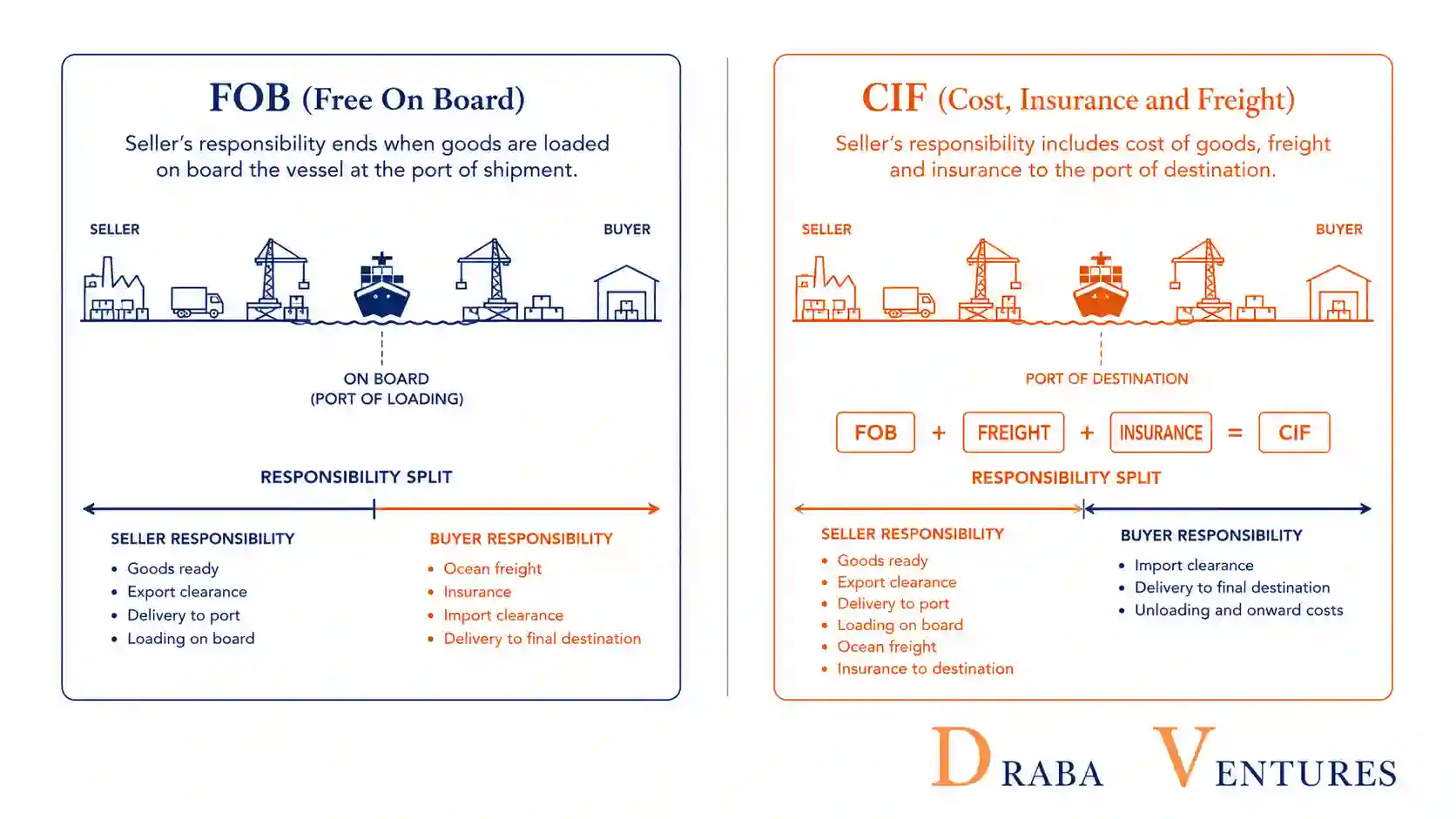
FOB vs CIF in Sorghum Procurement
Selecting the appropriate Incoterm is a critical decision in sorghum procurement that defines the distribution of costs, risks, and logistical responsibilities between the buyer and the exporter. The two most common options are FOB (Free On Board) and CIF (Cost, Insurance, and Freight). Sourcing teams must analyze their internal logistics capacity and ocean freight booking relationships before deciding on the term. A misaligned choice can lead to unexpected expenses, container delays at destination ports, or disputes over cargo damage.
For buyers, understanding where the physical risk transfers is just as important as knowing who pays the ocean freight carrier.
Seller Responsibility Under FOB
Under FOB terms, the seller's responsibility ends when the sorghum cargo is successfully loaded onto the vessel at the designated Indian port of departure (such as Mundra or Nhava Sheva). The seller is responsible for inland transportation from the mandi to the cleaning facility, color sorting, packaging, port-level terminal handling, export customs clearance, and loading charges. Once the grain crosses the vessel's rail, the risk of loss or damage and all subsequent costs, including ocean freight and insurance, transfer to the buyer.
This means any delays in vessel arrival or container storage charges at the port after loading cut-off fall under the buyer's financial responsibility.
Seller Responsibility Under CIF
Under CIF terms, the seller's responsibility extends much further. In addition to executing all domestic logistics, cleaning, and customs clearance in India, the seller must book and pay for the ocean freight to carry the cargo to the buyer's specified port of destination (such as Jebel Ali or Mombasa). The seller must also secure marine insurance covering the cargo transit risk. However, while the seller pays for the freight and insurance, the risk of cargo damage transfers to the buyer as soon as the grain is loaded at the port of departure.
This structure is highly useful for buyers who prefer to consolidate all transport costs into a single billing line from the exporter.
Risk Transfer and Insurance Control
A key distinction that buyers often overlook is that under CIF, the risk transfer point does not match the cost delivery point. Even though the exporter pays the freight to the destination port, the risk of transit damage (e.g., container sweat or sea-water contamination) passes to the buyer at the loading port. Sourcing teams should inspect the marine insurance policy provided by the seller to ensure it is written by a reputable underwriter and covers the full CIF value plus 10%, with appropriate terms for agricultural cargo.
Securing a comprehensive Institute Cargo Clauses (A) policy provides the buyer with the highest level of coverage against maritime transit risks.
How to Compare Quotes Correctly
Buyers must compare quotes on an apples-to-apples basis. An FOB quote will always appear significantly cheaper than a CIF quote because it excludes ocean freight and insurance. To evaluate quotes correctly, buyers should calculate their own ocean freight and marine insurance costs for FOB shipping and add them to the exporter's FOB price. This creates a "landed cost estimate" that can be directly compared against the exporter's CIF quote, revealing which option offers the best value.
Buyers should also check destination port terminal handling charges, which are usually paid by the consignee regardless of the Incoterm.
When Buyers Should Choose Each Incoterm
FOB is generally the preferred choice for large-scale institutional buyers and multi-national trading houses that maintain volume contracts with major shipping lines and can secure lower freight rates. Sourcing desks with limited logistics networks, or those importing smaller, irregular shipments, should choose CIF. CIF simplifies the process by shifting the coordination of shipping container availability and maritime freight booking to the exporter, allowing the buyer to focus on destination customs clearance.
By delegating freight booking to an experienced exporter, buyers minimize the risk of dealing with local port-level equipment shortages in India.
Buyer Reference Table
| Commercial term | Buyer should define | Why it matters |
|---|---|---|
| MOQ | Minimum MT or FCL count | Avoids impractical RFQs |
| Incoterm | FOB or CIF destination | Defines responsibility |
| Validity | Quote expiry date | Controls market movement |
| Payment | TT, LC, SBLC or mixed terms | Controls release risk |
Procurement Checklist Before You Ask for PI
- Confirm whether the cargo is white, yellow, red or feed-grade sorghum.
- State the end use: brewery, poultry feed, food processing, starch, distribution or industrial use.
- Ask for moisture, broken percentage, foreign matter, admixture and infestation status in writing.
- Confirm bag size, bag type, marking, container payload and shipment month.
- Request the expected document set before payment terms are finalized.
- Verify HS code, destination rules and importer obligations with your customs broker.
Always confirm grade, packing, shipment month and document requirements in writing before requesting a Proforma Invoice. Draba Ventures responds to structured RFQs with a detailed FOB or CIF quote within 24 hours.
Internal Authority Links
Frequently Asked Questions
What is the main buying decision in FOB vs CIF Pricing for Sorghum Imports?
What should an importer include in a sorghum RFQ?
Which HS code should buyers use for sorghum imports?
Can Draba Ventures quote FOB and CIF sorghum shipments?
How does this page avoid keyword cannibalization?
Request a Sorghum Export Quote from Draba Ventures
Send product grade, quantity in MT, destination port, preferred Incoterm, payment preference and target shipment window. Our team will respond with a structured FOB or CIF quote.
Request a QuoteHS code note: this page uses 10070090 as the working sorghum trade entity. Final classification should be checked with the buyer's customs broker before import filing.
