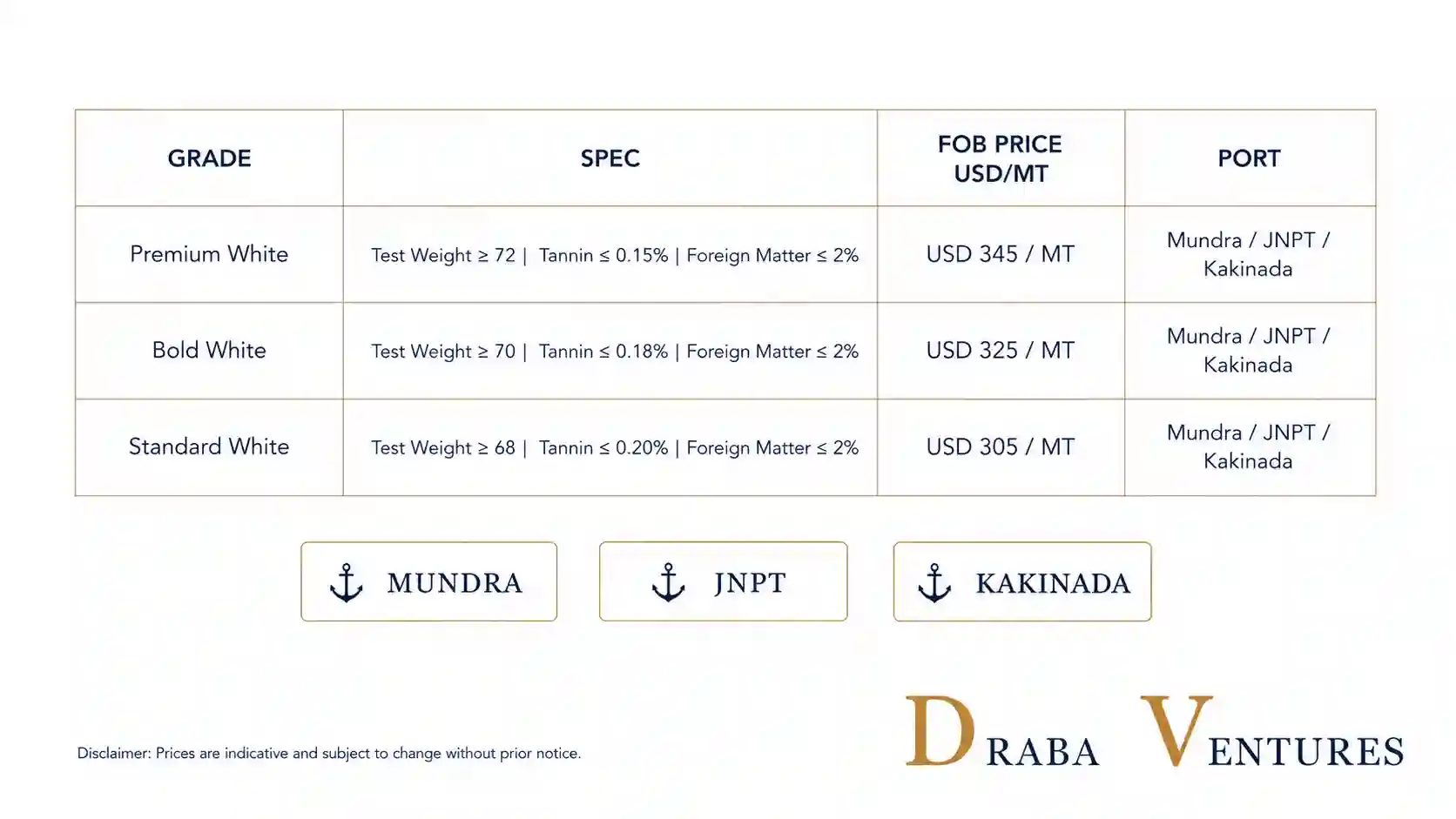
Indian sorghum FOB prices in 2026 range from approximately $230 to $310 per metric ton at Indian load ports, depending on grade (white food-grade vs yellow feed-grade), cleaning level (basic vs Sortex), packing format (25 kg vs 50 kg PP bags), loading port and shipment month. This guide breaks down how FOB price is built from mandi to vessel, what drives seasonal movement, and how buyers can compare quotes correctly to avoid hidden cost surprises at the destination port.
Indian sorghum FOB price 2026: White food-grade jowar (50 kg PP bags, Mundra) trades at approximately $270-$310/MT; yellow/red feed-grade at $230-$265/MT. Prices dip 8-12% during Rabi peak harvest (April-June). Always compare at the same port, packing format and validity period - cleaning and documentation are not always included in the headline rate.
Ready to Import Indian Sorghum?
Get an instant FOB and CIF cost estimate including shipping and insurance.
What FOB Sorghum Price Means
A Free On Board (FOB) sorghum price represents the cost of the commodity delivered onto the shipping vessel at the designated Indian port of loading. For international buyers, a standard FOB quote from India covers the raw grain cost at the farm gate, mandi aggregation commissions, primary cleaning, grading, packaging, inland transport to the port, customs clearance, and terminal handling charges (THC). Sourcing teams must ensure their supplier provides a fully transparent FOB breakdown so they can verify that all port-level fees are fully prepaid, avoiding shipping delays at the loading port.
For buyers, understanding the boundary of FOB is crucial; once the container is loaded past the ship's rail, all ocean freight, destination customs, and transport fees shift to the buyer's account.
FOB Price Build-Up from Mandi to Port
The final FOB price is built up from several distinct cost components. It starts with the mandi auction price, which varies depending on quality and location. Added to this are mandi taxes, brokerage fees, and local transport to the cleaning facility. Sieve cleaning, color sorting, bagging, and warehousing constitute the processing layer. Finally, long-distance road or rail transport moves the cargo from interior crop belts (like Solapur or Dharwad) to major ports (like Mundra or Nhava Sheva), where customs documentation, phytosanitary certification, and container loading complete the build-up.
Each milestone in this build-up must be managed efficiently to avoid cost overruns that could eat into the exporter's margin or compromise delivery times.
Cleaning and Bagging Cost Layers
Export-quality sorghum requires thorough post-harvest processing. Machine cleaning to remove dust, stones, and light grains typically costs between $15 to $25 per Metric Ton. If the contract specifies Sortex (color-sorted) quality for premium food applications, this adds another $20 to $35 per Ton due to processing waste and electricity costs. Packaging choice also impacts the price; packing in standard 50kg PP bags is the most economical option, while packing in 25kg paper bags or 1 Metric Ton bulk bags adds significant packaging and handling charges.
Standardizing on 50kg bags generally provides the fastest container loading rates and aligns well with standard terminal handling practices.
Loading Port Influence
The choice of Indian loading port directly influences the final FOB quote. Nhava Sheva (Mumbai) and Mundra (Gujarat) are the primary container ports for North and West Indian sorghum export, offering frequent sailings and efficient customs processing. Sourcing from South Indian belts may favor Chennai or Tuticorin. Sourcing desks should check the distance from the aggregation warehouse to the port; longer inland hauls significantly increase trucking costs, which are directly reflected in the FOB price.
Using Mundra Port often yields better logistics rates for cargo aggregated in Rajasthan or northern Maharashtra due to direct rail corridors.
Seasonal Price Movement
Sorghum pricing is highly cyclical, hitting its lowest levels during the peak harvest arrivals. For Rabi white sorghum, prices are typically most competitive between April and June. Sourcing during this window allows buyers to lock in lower commodity base rates. Conversely, during the monsoon and winter months, prices rise due to dwindling stocks and increased warehouse storage costs. Sourcing desks can manage seasonal price fluctuations by booking annual quantity contracts during harvest peaks with scheduled forward shipping dates.
Sourcing during peak harvest also guarantees that buyers receive fresh grain with the lowest possibility of historical weevil damage.
How Buyers Should Compare FOB Quotes
When comparing FOB quotes from multiple Indian exporters, buyers should look beyond the headline price per Metric Ton. A lower quote may exclude essential elements like third-party inspection fees (SGS/Intertek), phytosanitary certificates, or port-level terminal handling charges. Buyers should request a detailed checklist confirming that the FOB price includes all pre-shipment documentation, fumigation under methyl bromide or phosphine, and transport to the vessel's hook, ensuring there are no hidden fees that could delay container release.
Comparing quotes line-by-line ensures that contract quality meets the physical requirements of destination feed or milling plants.
Buyer Reference Table
| Commercial term | Buyer should define | Why it matters |
|---|---|---|
| MOQ | Minimum MT or FCL count | Avoids impractical RFQs |
| Incoterm | FOB or CIF destination | Defines responsibility |
| Validity | Quote expiry date | Controls market movement |
| Payment | TT, LC, SBLC or mixed terms | Controls release risk |
Procurement Checklist Before You Ask for PI
- Confirm whether the cargo is white, yellow, red or feed-grade sorghum.
- State the end use: brewery, poultry feed, food processing, starch, distribution or industrial use.
- Ask for moisture, broken percentage, foreign matter, admixture and infestation status in writing.
- Confirm bag size, bag type, marking, container payload and shipment month.
- Request the expected document set before payment terms are finalized.
- Verify HS code, destination rules and importer obligations with your customs broker.
Always compare FOB quotes at the same port, same packing format and same quote validity period. A $10/MT cheaper quote that excludes fumigation, phytosanitary certification or port handling charges will cost more at the destination. Ask for a line-by-line breakdown before signing the sales contract.
Internal Authority Links
Frequently Asked Questions
What is the main buying decision in Indian Sorghum FOB Price Guide 2026?
What should an importer include in a sorghum RFQ?
Which HS code should buyers use for sorghum imports?
Can Draba Ventures quote FOB and CIF sorghum shipments?
How does this page avoid keyword cannibalization?
Request a Sorghum Export Quote from Draba Ventures
Send product grade, quantity in MT, destination port, preferred Incoterm, payment preference and target shipment window. Our team will respond with a structured FOB or CIF quote.
Request a QuoteHS code note: this page uses 10070090 as the working sorghum trade entity. Final classification should be checked with the buyer's customs broker before import filing.
