Indian sorghum has two harvest seasons - Kharif and Rabi - each producing different grade profiles at different times of year. Export buyers who plan procurement around the harvest calendar get better prices, fresher grain and more negotiating leverage than those who buy off-season. This guide gives procurement teams the exact harvest and availability windows, how FOB prices move by season, and which season to target for white food-grade versus feed-grade requirements.
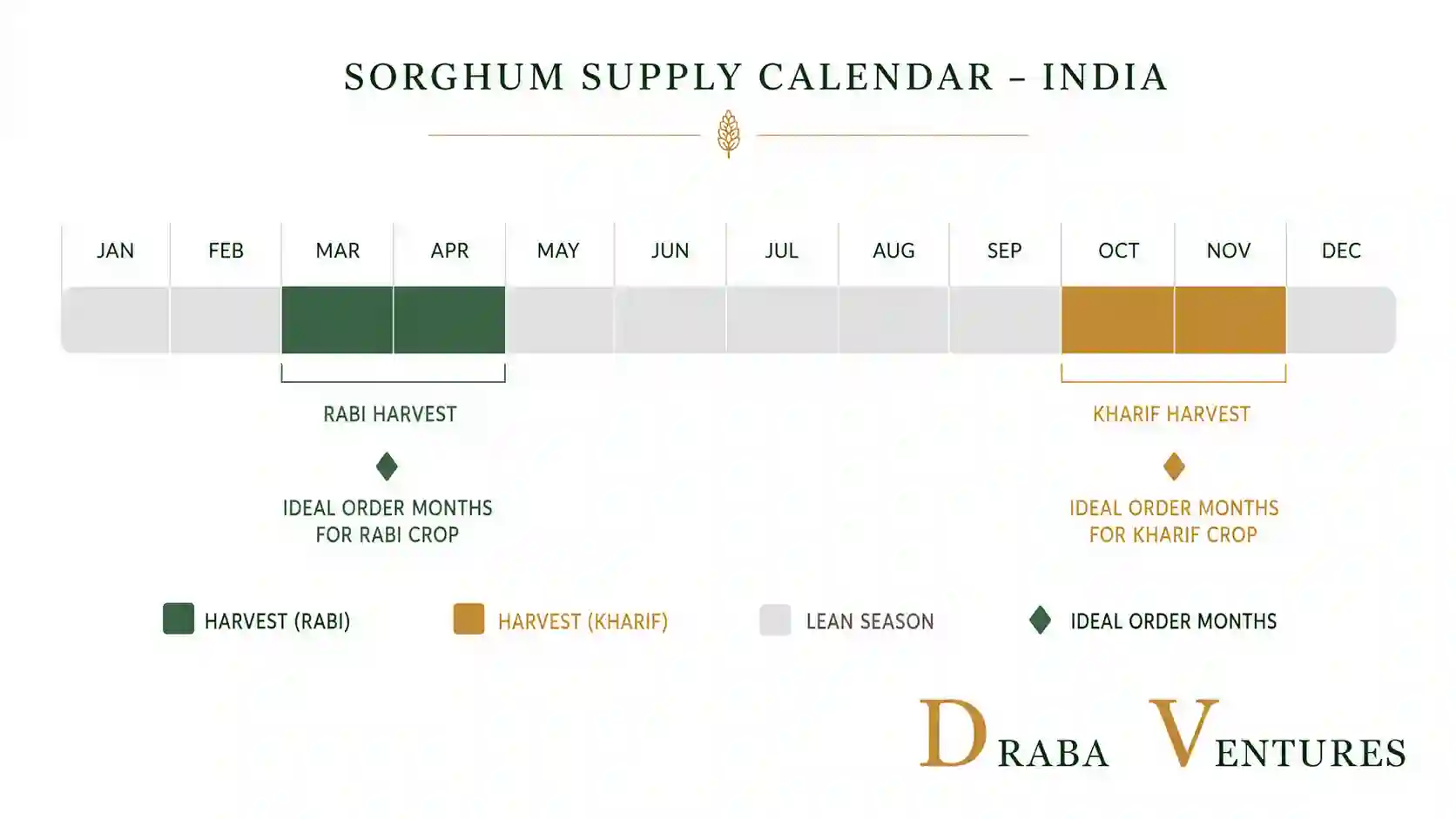
Indian sorghum harvest calendar: Kharif crop - sown June-July, harvested October-December - mixed/feed grade, higher moisture. Rabi crop - sown October-November, harvested March-May - white food-grade, lower moisture, higher density. Best FOB pricing window: April-June (Rabi peak arrival). Off-season premium: 8-15% higher FOB in September-October before Kharif arrives.
Ready to Import Indian Sorghum?
Get an instant FOB and CIF cost estimate including shipping and insurance.
Why Harvest Timing Changes Procurement Options
Harvest timing is the single most critical factor determining the cost, quality, and moisture content of exported Indian sorghum. India has two main growing seasons: the Kharif (monsoon) crop, harvested from October to November, and the Rabi (winter) crop, harvested from March to April. Sourcing grain during the peak of these harvest windows allows procurement teams to secure fresh, high-luster grain at competitive prices. Sourcing outside these windows increases costs due to warehousing overheads and elevates the risk of grain deterioration or insect infestation.
For buyers, selecting the right window ensures optimal physical properties. Grains sourced directly during peak harvests exhibit brighter color and require less post-harvest sorting to remove defective seeds.
Main Buying Windows for Export Buyers
For international buyers, the primary buying window opens immediately after harvest consolidation. For the Rabi crop-which yields premium white sorghum-the optimal procurement window runs from late March to June. For the Kharif crop, which produces substantial quantities of feed-grade and yellow sorghum, the best sourcing window is from November to January. Sourcing within these periods ensures maximum mandi arrivals, allowing exporters to select uniform lots and run sorting machinery at full capacity without facing supply shortages.
Buying within these windows also secures stable prices, as supply levels are at their annual peak, preventing regional brokers from driving up the market rate.
Post-Harvest Drying and Cleaning Lead Time
Harvested sorghum cannot be loaded directly into shipping containers. Farm-level grain contains high moisture (often 15% to 18%) and organic debris. After mandi procurement, the grain must undergo sun-drying or mechanical drying to bring moisture down to the export standard of 12% to 13%. Following drying, the lot is processed through pre-cleaners, de-stoners, and gravity separators to eliminate foreign matter. This processing cycle adds 7 to 10 days to the export lead time, which buyers must factor into their vessel scheduling and L/C validity dates.
This drying process is essential for export, preventing container condensation and mold formation during long maritime transits to global destinations.
Sample Approval Timing
Given the quality fluctuations that occur during harvest arrival spikes, sample approval must be timed precisely. Buyers should request samples only after the exporter has aggregated and pre-cleaned at least 50% of the target contract volume. Drawing samples too early from raw farmer lots will not represent the final cargo, while waiting too late can delay shipment schedules. Once the pre-shipment sample (PSS) is approved, it serves as the benchmark against which the container loading and final quality inspection are measured.
Having a documented and signed PSS approval protects both parties in case of minor appearance variations during final port-level customs checks.
Seasonal Availability Risks
Procuring sorghum outside the harvest window carries significant quality risks. Sorghum is highly hygroscopic, absorbing moisture from humid warehouses during the monsoon season (June to September). This moisture reabsorption can trigger aflatoxin growth and invite weevil infestation. Additionally, as the season progresses, older stocks undergo grain weathering, turning a dull cream or gray color. Buyers planning off-season purchases must require fumigation certificates and double-check moisture levels before authorizing cargo dispatch.
To control these risks, we conduct monthly warehouse inspections and implement strictly controlled aeration protocols for stored grain reserves.
How to Plan Repeat FCL Supply
To maintain a continuous supply of multiple Full Container Loads (FCLs) throughout the year, buyers should establish long-term contract structures during the peak Rabi harvest in April. Rather than booking spot shipments, buyers can contract an annual volume with monthly split shipments. This allows the exporter to secure and warehouse the total crop under controlled conditions when price and quality are optimal, mitigating the risk of off-season price spikes and ensuring consistent physical grain parameters for every container.
This approach also guarantees shipping line allocation, ensuring regular cargo movement even during high-demand container logistics seasons.
Buyer Reference Table
| Origin factor | Procurement relevance | Buyer action |
|---|---|---|
| Harvest window | Determines availability and freshness | Plan inquiry timing |
| Aggregation | Controls repeat supply | Confirm FCL capacity |
| Cleaning access | Improves export consistency | Request process details |
| Sample approval | Verifies real lot profile | Approve before PI |
Procurement Checklist Before You Ask for PI
- Confirm whether the cargo is white, yellow, red or feed-grade sorghum.
- State the end use: brewery, poultry feed, food processing, starch, distribution or industrial use.
- Ask for moisture, broken percentage, foreign matter, admixture and infestation status in writing.
- Confirm bag size, bag type, marking, container payload and shipment month.
- Request the expected document set before payment terms are finalized.
- Verify HS code, destination rules and importer obligations with your customs broker.
Always confirm grade, packing, shipment month and document requirements in writing before requesting a Proforma Invoice. Draba Ventures responds to structured RFQs with a detailed FOB or CIF quote within 24 hours.
Internal Authority Links
Frequently Asked Questions
What is the main buying decision in Indian Sorghum Harvest Calendar for Export Buyers?
What should an importer include in a sorghum RFQ?
Which HS code should buyers use for sorghum imports?
Can Draba Ventures quote FOB and CIF sorghum shipments?
How does this page avoid keyword cannibalization?
Request a Sorghum Export Quote from Draba Ventures
Send product grade, quantity in MT, destination port, preferred Incoterm, payment preference and target shipment window. Our team will respond with a structured FOB or CIF quote.
Request a QuoteHS code note: this page uses 10070090 as the working sorghum trade entity. Final classification should be checked with the buyer's customs broker before import filing.
