Karnataka and Maharashtra together account for over 60% of India's sorghum output, but they produce different grades at different harvest times for different buyer markets. Choosing origin - not just country - matters for quality consistency, seasonal availability and logistics cost. This guide maps the key growing districts in both states, the grade profiles they produce, the harvest windows buyers can plan around, and the load ports that serve each region most efficiently.
Karnataka vs Maharashtra sorghum: Karnataka (Bidar, Raichur, Bellary, Kalaburagi) produces premium Rabi white jowar from black cotton soil - peak March to May. Maharashtra (Solapur, Osmanabad, Latur, Nanded) produces both Kharif and Rabi sorghum - white and mixed grades - with peak Rabi harvest from February to April. Karnataka origin commands a small premium for food-grade and brewery applications.
Ready to Import Indian Sorghum?
Get an instant FOB and CIF cost estimate including shipping and insurance.
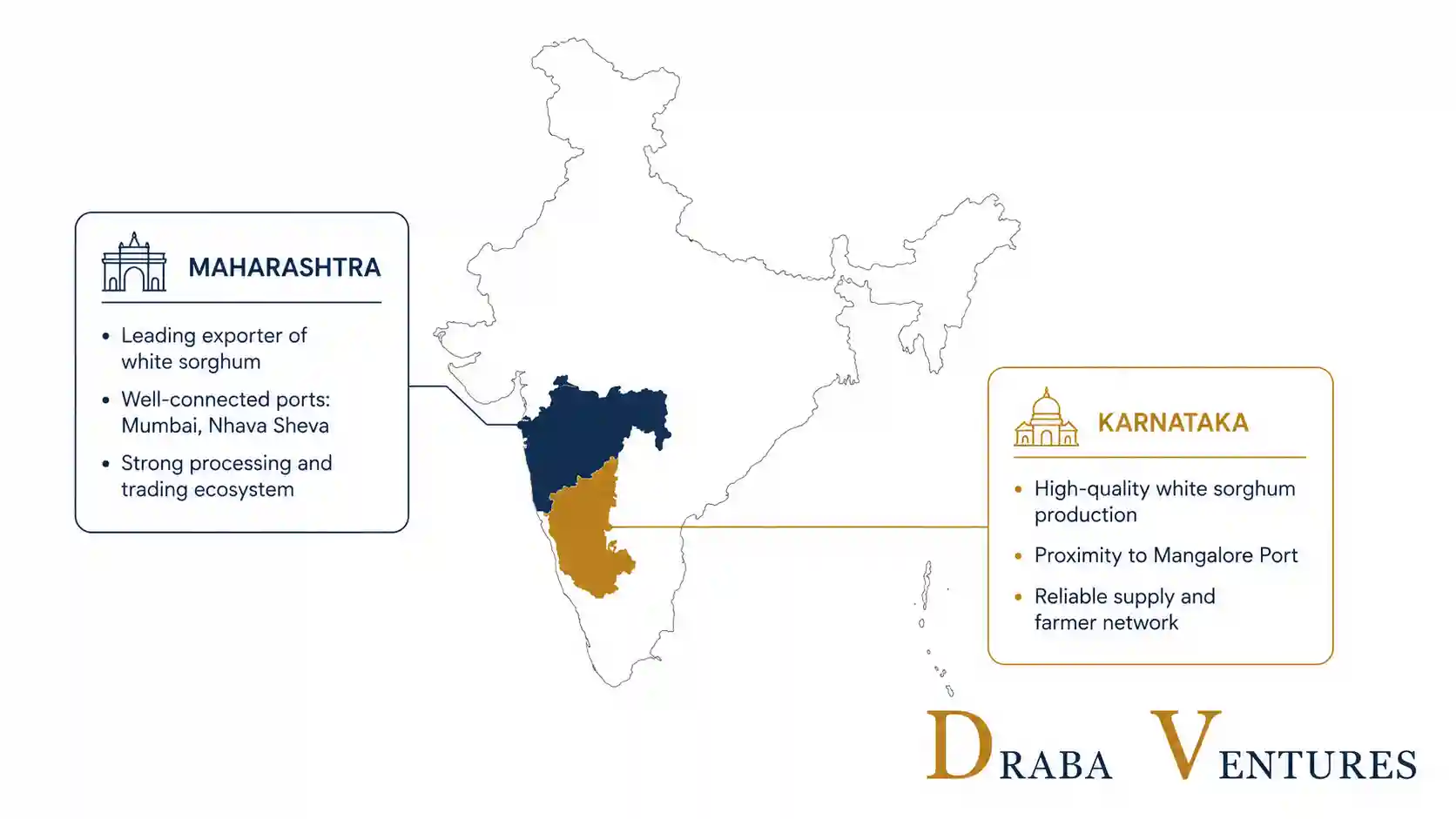
Why Regional Belt Selection Matters
India's sorghum production is highly concentrated in specific regional belts, primarily in the states of Maharashtra and Karnataka. Sourcing sorghum for export requires understanding the variations in grain characteristics, soil composition, and microclimates between these two leading regions. Sourcing teams cannot simply buy "Indian Sorghum" without specifying the regional origin, as it directly impacts bulk density, grain size, protein levels, and grain color consistency, which are critical for international buyers.
Furthermore, regional logistics dictate shipping efficiency. Belts in Maharashtra have closer proximity to Nhava Sheva (JNPT) port in Mumbai, whereas Karnataka's northern belts can optimize routing through both Goa/Mangalore ports or JNPT depending on container availability. Selecting the right belt ensures the balance of crop quality, logistics costs, and shipment speed.
Karnataka Sorghum Sourcing Profile
Karnataka's sorghum belt, concentrated in northern districts like Vijayapura, Bagalkote, Dharwad, and Koppal, is renowned for producing exceptionally high-quality white sorghum (specifically the Maldandi variety). The region's agronomic conditions yield grains with excellent luster, bold size, and low tannin content, making Karnataka sorghum highly preferred by food-grade importers and gluten-free flour manufacturers in the Middle East and Europe.
Sourcing from Karnataka offers buyers access to grains with high bulk density and a clean, appealing visual profile. The local farmers employ traditional crop management practices on dry, fertile lands, producing grains that require minimal chemical processing to meet international food safety requirements.
Maharashtra Jowar Sourcing Profile
Maharashtra is the largest producer of sorghum in India, with key belts in Solapur, Sangli, Ahmednagar, and Jalgaon. Solapur is known as the "Sorghum Bowl" of Maharashtra. The region produces massive volumes of both Rabi (winter) and Kharif (monsoon) crops. Maharashtra's sourcing profile is characterized by massive aggregation capacity, making it the ideal origin for bulk feed-grade sorghum and industrial starch processing contracts.
Because of Maharashtra's vast acreage and developed agricultural infrastructure, it offers competitive pricing for large-scale procurement. Industrial buyers looking for thousands of metric tons for animal feed or alcohol breweries find Maharashtra to be the most reliable origin for consistent, high-volume supply chains.
Aggregation and Cleaning Access
Sourcing from these belts requires robust local logistics and aggregation infrastructure. Sourcing agents must have direct access to local agricultural markets (APMC mandis) and modern Sortex cleaning plants. Having state-of-the-art cleaning and sieving installations near the growing belts in Karnataka (like Sindhanur or Vijayapura) or Maharashtra (like Solapur) allows exporters to process the grain immediately post-harvest, reducing handling costs and ensuring consistent export grades.
Draba Ventures maintains direct links with local farmer cooperatives and operates cleaning facilities in Karnataka, enabling complete quality control from the mandi floor to the shipping container, ensuring zero contamination by foreign matter.
Seasonality by State
Sourcing timelines are dictated by regional crop cycles. Maharashtra's Kharif harvest occurs around October-November, offering fresh supplies of feed-grade sorghum, while its premium Rabi crop is harvested in February-March. Karnataka's Rabi harvest, which yields the highly sought-after bold white grains, peaks in March-April. Sourcing during these peak harvest windows guarantees buyers access to the freshest grain with the lowest moisture profiles and the most competitive pricing.
Understanding these seasons allows procurement managers to plan their annual buying calendars, locking in contract prices when the mandis are flooded with new crop, thereby avoiding off-season premium costs and quality degradation.
Buyer Questions for Origin Verification
To verify origin transparency and crop quality, international buyers should ask their exporters key agronomic questions: "From which specific district mandi was this lot aggregated?", "Is the grain from the Rabi or Kharif crop cycle, and what is its tested moisture content?", "Can you provide photos of the grain lot pre-cleaning and post-Sortex processing?", and "What is the bulk density in g/L of the current batch?"
A transparent exporter should supply mandi procurement slips, local warehouse receipts, and pre-shipment lab reports. This level of verification protects the buyer against grain blending, ensuring that premium Maldandi white sorghum isn't mixed with lower-grade monsoon grains during transit.
Buyer Reference Table
| Origin factor | Procurement relevance | Buyer action |
|---|---|---|
| Harvest window | Determines availability and freshness | Plan inquiry timing |
| Aggregation | Controls repeat supply | Confirm FCL capacity |
| Cleaning access | Improves export consistency | Request process details |
| Sample approval | Verifies real lot profile | Approve before PI |
Procurement Checklist Before You Ask for PI
- Confirm whether the cargo is white, yellow, red or feed-grade sorghum.
- State the end use: brewery, poultry feed, food processing, starch, distribution or industrial use.
- Ask for moisture, broken percentage, foreign matter, admixture and infestation status in writing.
- Confirm bag size, bag type, marking, container payload and shipment month.
- Request the expected document set before payment terms are finalized.
- Verify HS code, destination rules and importer obligations with your customs broker.
Always confirm grade, packing, shipment month and document requirements in writing before requesting a Proforma Invoice. Draba Ventures responds to structured RFQs with a detailed FOB or CIF quote within 24 hours.
Internal Authority Links
Frequently Asked Questions
What is the main buying decision in Karnataka vs Maharashtra Sorghum Belts for Export Buyers?
What should an importer include in a sorghum RFQ?
Which HS code should buyers use for sorghum imports?
Can Draba Ventures quote FOB and CIF sorghum shipments?
How does this page avoid keyword cannibalization?
Request a Sorghum Export Quote from Draba Ventures
Send product grade, quantity in MT, destination port, preferred Incoterm, payment preference and target shipment window. Our team will respond with a structured FOB or CIF quote.
Request a QuoteHS code note: this page uses 10070090 as the working sorghum trade entity. Final classification should be checked with the buyer's customs broker before import filing.
