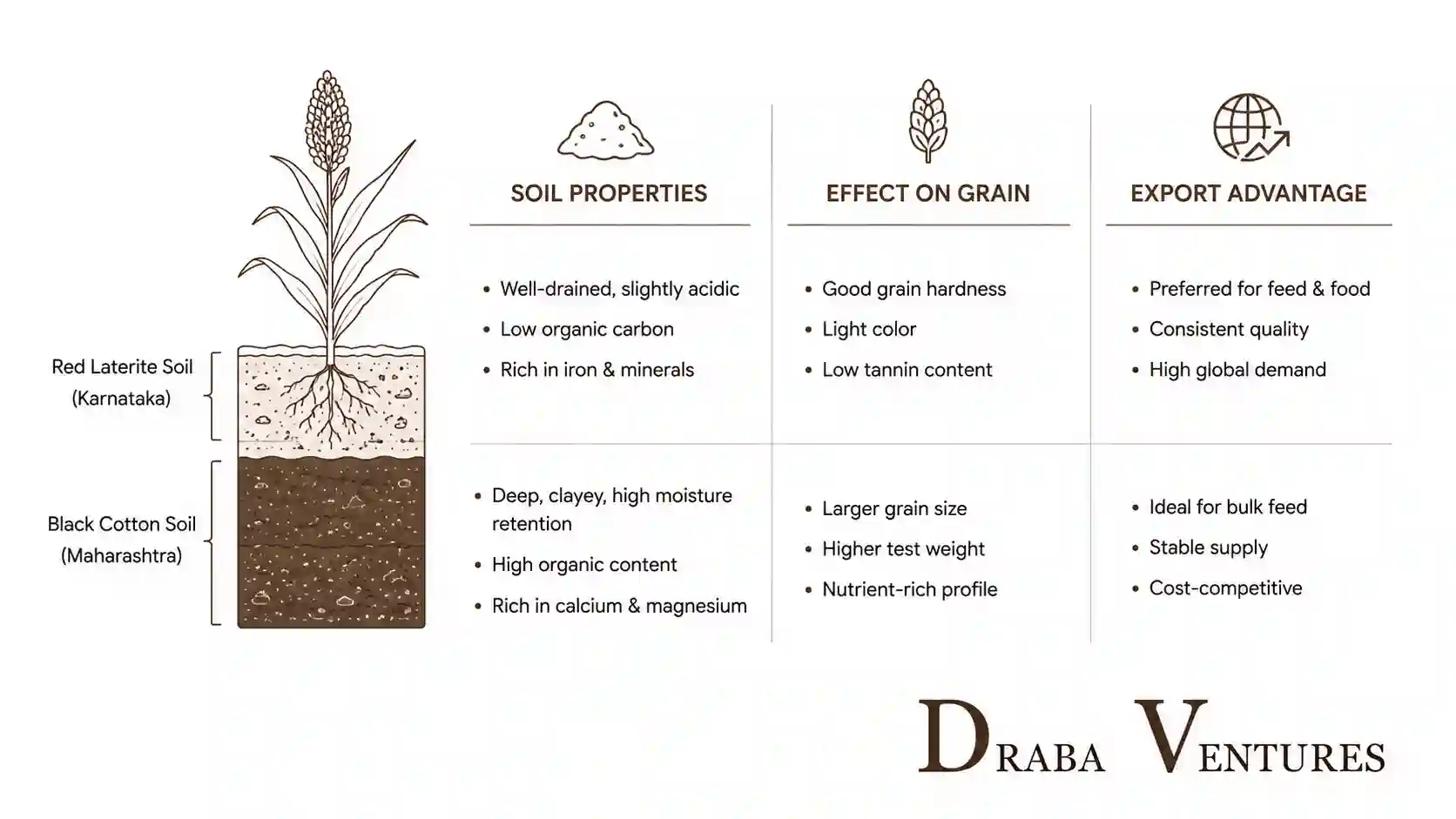
Black cotton soil (Vertisol) is the dominant agricultural soil across Maharashtra and Karnataka's sorghum belts - and it has a direct, measurable impact on the density and starch content of harvested grain. Buyers who understand this connection can use origin information to predict grain quality and avoid specification surprises. This guide explains how soil type affects bulk density in Indian sorghum, why Karnataka Rabi jowar consistently achieves higher density than monsoon-grown grain, and how to use this knowledge in procurement.
Black cotton soil (Vertisol) effect on sorghum: dense, moisture-retentive soil produces heavier, denser grains with higher starch content. Karnataka Rabi white jowar from Vertisol zones typically achieves bulk density 720-760 g/L, compared to 680-720 g/L for Kharif grain from lighter soils. Request the growing region and season when evaluating a sample.
Ready to Import Indian Sorghum?
Get an instant FOB and CIF cost estimate including shipping and insurance.
Why Soil Type Matters to Export Buyers
The agronomic foundation of any agricultural crop directly influences its physical characteristics, and sorghum is no exception. For international grain procurement teams, understanding the soil type of the growing belt is essential for predicting quality. Sorghum cultivated in deep black cotton soils (vertisols) exhibits distinct physical and chemical properties compared to crops grown in red sandy loams. Soil composition affects water availability, root development, nutrient uptake, and ultimately the starch accumulation and density of the harvested sorghum grain.
For buyers, these scientific factors translate directly to commercial value. Grains grown in nutrient-dense soil require less chemical fertilization, resulting in lower chemical residue levels, which is a major advantage when complying with strict EU or USDA import regulations.
Black Cotton Soil and Water Retention
Black cotton soils, prevalent in the sorghum-growing regions of Maharashtra and northern Karnataka, are famous for their high clay content (often exceeding 50%) and exceptional water retention capacity. During the monsoon, these soils swell and retain massive volumes of water. As the dry winter season (Rabi) approaches, the soil slowly releases this moisture, providing a steady water supply to the sorghum plants without requiring intensive irrigation. This slow-release moisture profile is critical during the grain-filling stage, allowing the plant to develop bold, fully-formed seeds.
This natural irrigation mechanism ensures that even during periods of dry spells, the sorghum plant is not subjected to severe drought stress, preventing premature grain abortion and ensuring a highly consistent grain size distribution across the entire harvest lot.
Grain Filling and Density Signals
The water retention profile of black cotton soil directly supports the grain filling process. During the milk and dough stages of sorghum growth, the plant requires consistent moisture to synthesize and store starch in the endosperm. When water is abundant yet controlled, as in vertisol soils, grain filling progresses to completion. This results in heavier, rounder grains with higher test weights. Conversely, soil with poor moisture retention can cause premature crop drying, leading to shriveled grains with low starch content and poor bulk density.
A complete grain filling process also reduces the proportion of hollow or semi-formed grains, which are easily broken during post-harvest handling and machine cleaning, thereby minimizing the percentage of brokens in the final export pack.
Bulk Density as a Procurement Indicator
For export buyers, bulk density (measured in grams per liter or pounds per bushel) is a primary quality indicator. Grains with high bulk density pack tighter in shipping containers, maximizing container payload (typically achieving 24 to 25 Metric Tons per 20ft container). Furthermore, high density indicates a high starch-to-fiber ratio, which is highly valued by feed nutritionists, alcohol distilleries, and starch manufacturers. Sorghum harvested from black cotton soil belts consistently meets or exceeds the export threshold of 720 to 740 g/L.
When density is high, shipping costs per metric ton are minimized since buyers can utilize the full weight capacity of the container before reaching the volume limit, resulting in significant savings on ocean freight.
How Buyers Should Confirm Density
Buyers should not rely solely on the geographic origin to guarantee grain density. Standard procurement contracts should mandate test weight verification at the loading port. This is verified by third-party inspectors using standardized grain grading equipment (such as the Winchester bushel meter). Buyers must request the test weight results to be explicitly detailed on the pre-shipment quality certificate, along with moisture content, to ensure that the grain density meets the contract specifications.
In addition to test weights, requesting sieve analysis results helps confirm that the grain size is uniform, as a high presence of under-sized grains can negatively impact milling yields and processing efficiency at the destination facility.
Origin Intelligence Without Overclaiming
While black cotton soil provides the ideal agronomic environment, crop quality is also influenced by seed variety, fertilizer application, and harvesting conditions. Professional exporters compile comprehensive origin intelligence, tracking the crop from specific talukas and mandis. Buyers should choose suppliers who can provide traceability logs, confirming that the sorghum was indeed sourced from the fertile vertisol belts of Solapur, Vijayapura, or Dharwad, rather than being mixed with grains from poor soil regions.
Traceability documentation (such as APMC mandi receipts and transport waybills) provides the buyer with audited proof of origin, satisfying regulatory requirements for origin-marked food labeling in premium global markets.
Buyer Reference Table
| Origin factor | Procurement relevance | Buyer action |
|---|---|---|
| Harvest window | Determines availability and freshness | Plan inquiry timing |
| Aggregation | Controls repeat supply | Confirm FCL capacity |
| Cleaning access | Improves export consistency | Request process details |
| Sample approval | Verifies real lot profile | Approve before PI |
Procurement Checklist Before You Ask for PI
- Confirm whether the cargo is white, yellow, red or feed-grade sorghum.
- State the end use: brewery, poultry feed, food processing, starch, distribution or industrial use.
- Ask for moisture, broken percentage, foreign matter, admixture and infestation status in writing.
- Confirm bag size, bag type, marking, container payload and shipment month.
- Request the expected document set before payment terms are finalized.
- Verify HS code, destination rules and importer obligations with your customs broker.
Always confirm grade, packing, shipment month and document requirements in writing before requesting a Proforma Invoice. Draba Ventures responds to structured RFQs with a detailed FOB or CIF quote within 24 hours.
Internal Authority Links
Frequently Asked Questions
What is the main buying decision in Black Cotton Soil Impact on Sorghum Density?
What should an importer include in a sorghum RFQ?
Which HS code should buyers use for sorghum imports?
Can Draba Ventures quote FOB and CIF sorghum shipments?
How does this page avoid keyword cannibalization?
Request a Sorghum Export Quote from Draba Ventures
Send product grade, quantity in MT, destination port, preferred Incoterm, payment preference and target shipment window. Our team will respond with a structured FOB or CIF quote.
Request a QuoteHS code note: this page uses 10070090 as the working sorghum trade entity. Final classification should be checked with the buyer's customs broker before import filing.
