Container sweat - moisture condensation on the inner walls and ceiling of a shipping container - is the most common cause of mould development in sorghum shipments on long ocean voyages. It is entirely preventable with the right moisture management at origin and the right desiccant loading plan. This guide gives operations teams and logistics managers the exact moisture thresholds, desiccant quantities and container preparation steps to eliminate sweat damage in sorghum FCL shipments.
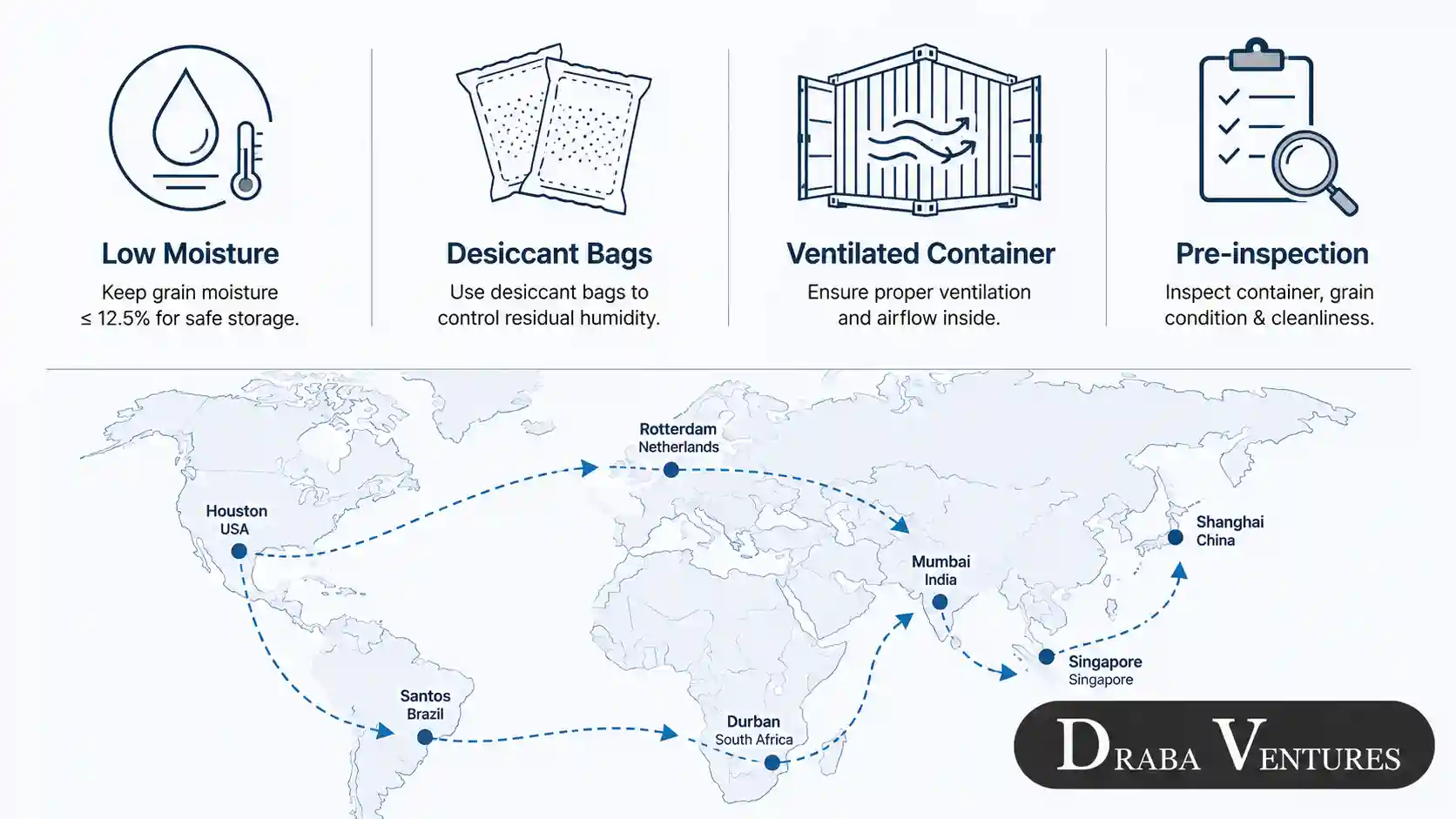
Container sweat prevention for sorghum: export only at moisture ≤12.5% for white food-grade, ≤13.5% for feed-grade. Load minimum 1 kg of calcium chloride desiccant per MT of grain (or 2 desiccant poles per container side wall). Use kraft paper lining on the floor. Avoid loading during rain. Seal containers within 2 hours of stuffing completion.
Ready to Import Indian Sorghum?
Get an instant FOB and CIF cost estimate including shipping and insurance.
What Container Sweat Means for Grain Cargo
Container sweat, also known as cargo sweat or container condensation, is a significant threat during maritime grain transit. It occurs when warm, moisture-laden air inside a shipping container comes into contact with the cooler metal surfaces of the container walls or ceiling. The air temperature drops below its dew point, causing gaseous water vapor to liquefy into droplets that drip directly onto the cargo.
For bagged agricultural shipments like sorghum, this dripping moisture accumulates on the upper layers of bags, leading to water stains, mold development, and seed germination. Left unchecked, a minor condensation issue can ruin entire shipments, resulting in rejection at the port of destination and costly insurance claims.
Why Sorghum Cargo Faces Condensation Risk
As a organic commodity, sorghum naturally contains and releases moisture. Even at a safe export moisture limit of 12% to 14%, a 25-ton cargo load contains several tons of water locked inside the grain. During transit, this moisture is slowly released into the air space through grain respiration, which increases as the container temperature rises.
When the cargo is subjected to temperature changes, the air's moisture-holding capacity fluctuates. This natural respiration cycle acts as a continuous source of humidity within the sealed container. If the exporter fails to implement proper moisture barriers, the trapped humidity will inevitably condense on the cold steel surfaces during the voyage.
Indian Port Climate and Temperature Transitions
Sorghum exported from India is typically loaded at major coastal ports like Mundra, Kandla, or Chennai, where the ambient climate is often hot and highly humid. Sealing a container in these tropical conditions traps high-humidity air inside the container from day one.
As the vessel transits towards cooler climates, the external temperature drops. The steel walls of the container adjust to the cold sea air much faster than the dense mass of sorghum inside, creating a steep temperature gradient. This rapid cooling of the container skin triggers dew point condensation, causing water to pool along the ceiling and panels.
Gulf and African Route Risk Profile
The primary shipping lanes for Indian sorghum, heading to the Middle East Gulf ports or West African destinations, present challenging maritime climates. These routes feature intense daytime solar heating followed by rapid cooling at night, causing the container ceiling temperature to swing by up to 30°C in a single 24-hour cycle.
These constant temperature fluctuations drive repeated evaporation and condensation cycles inside the cargo space. Without active mitigation, the top layer of sorghum bags will absorb this water, causing the grain to clump, heat up, and ferment, destroying its value for food, brewing, or animal feed processing.
Desiccant, Kraft Liner and Ventilation Strategy
Mitigating container sweat requires a multi-layered logistics strategy. First, operators must install high-absorption clay or calcium chloride desiccant bags. These bags, hung from the container's ceiling lashings, can absorb up to 200% of their weight in moisture, actively lowering the relative humidity inside the box.
Second, the container floor and walls must be fully lined with dry Kraft paper or cardboard panels. This lining prevents the outer PP bags from touching the cold steel walls where condensation forms. Finally, ensuring that container ventilation channels are clear and using moisture-barrier bulk liners can keep the cargo dry during long sea voyages.
Loading-Day Moisture Discipline
The absolute defense against container sweat is strict moisture control prior to stuffing. Sorghum must be verified to have a moisture level of 13% or lower before it is approved for export packaging. Sourcing teams must reject any bags that show signs of dampness from warehouse storage or transit to the port.
Furthermore, cargo stuffing should never take place during rain or in foggy, high-humidity conditions. Operations teams should monitor weather forecasts closely, ensuring that the containers are stuffed, sealed, and gated-in under dry, stable weather to prevent trapping ambient wet air inside the container.
Buyer Reference Table
| Operational item | Buyer question | Risk if ignored |
|---|---|---|
| Container plan | What is the bag count and net MT? | Overweight correction or short loading |
| Document cut-off | When must final docs be ready? | Missed vessel connection |
| Free days | How many days at destination? | Demurrage and detention cost |
| Cargo protection | What liner or desiccant plan is used? | Mold, condensation or claims |
Procurement Checklist Before You Ask for PI
- Confirm whether the cargo is white, yellow, red or feed-grade sorghum.
- State the end use: brewery, poultry feed, food processing, starch, distribution or industrial use.
- Ask for moisture, broken percentage, foreign matter, admixture and infestation status in writing.
- Confirm bag size, bag type, marking, container payload and shipment month.
- Request the expected document set before payment terms are finalized.
- Verify HS code, destination rules and importer obligations with your customs broker.
Always confirm grade, packing, shipment month and document requirements in writing before requesting a Proforma Invoice. Draba Ventures responds to structured RFQs with a detailed FOB or CIF quote within 24 hours.
Internal Authority Links
Frequently Asked Questions
What is the main buying decision in How to Prevent Container Sweat in Sorghum Shipments?
What should an importer include in a sorghum RFQ?
Which HS code should buyers use for sorghum imports?
Can Draba Ventures quote FOB and CIF sorghum shipments?
How does this page avoid keyword cannibalization?
Request a Sorghum Export Quote from Draba Ventures
Send product grade, quantity in MT, destination port, preferred Incoterm, payment preference and target shipment window. Our team will respond with a structured FOB or CIF quote.
Request a QuoteHS code note: this page uses 10070090 as the working sorghum trade entity. Final classification should be checked with the buyer's customs broker before import filing.
