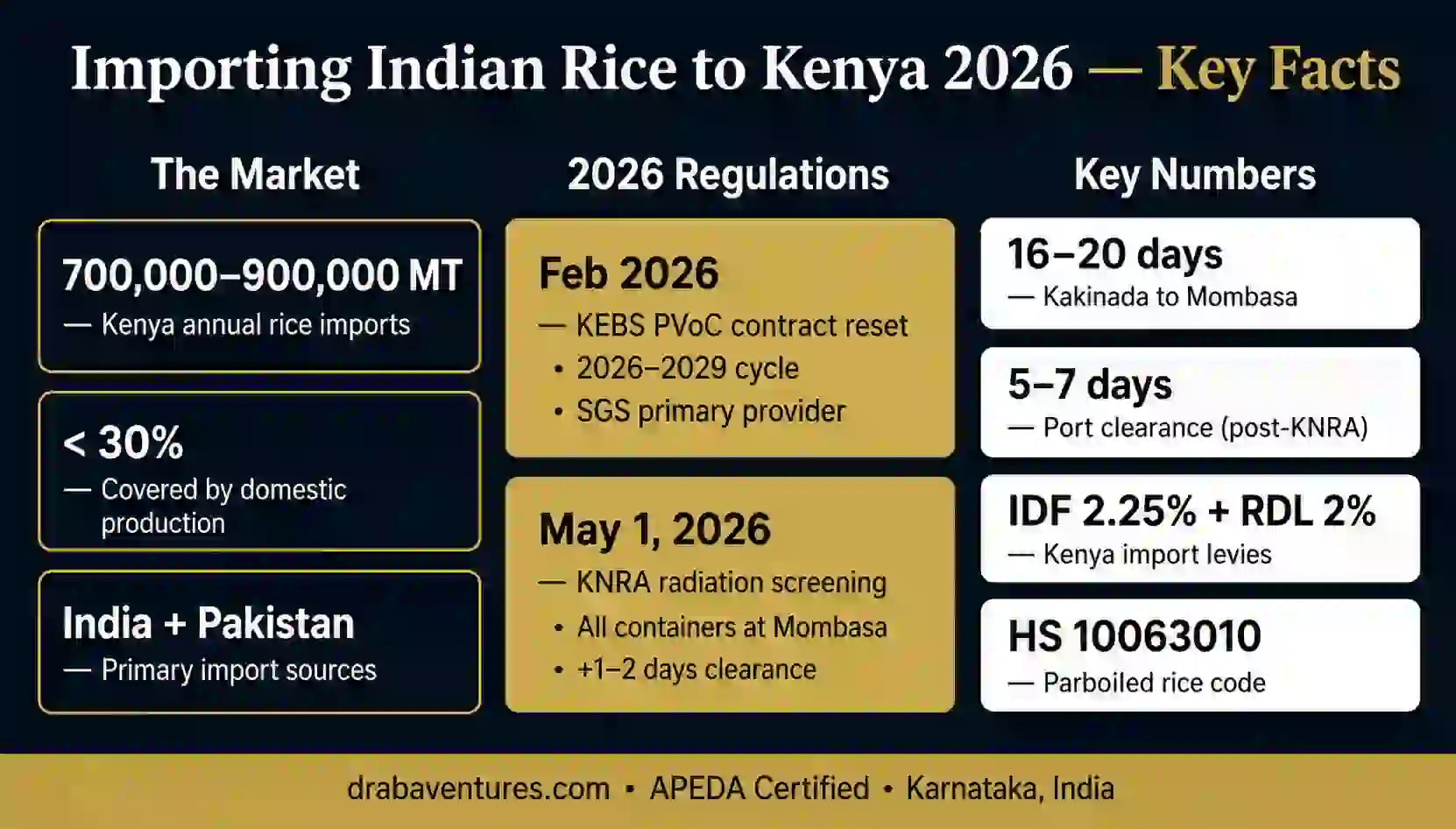
Indian IR-64 Parboiled Rice (HS Code 10063010, 100% Sortex cleaned, 14% max moisture) is Kenya's dominant rice import. Transit from Kakinada to Mombasa is 16-20 days. Two critical 2026 regulatory updates: KEBS PVoC inspection contracts reset in February 2026 (2026-2029 cycle, SGS is primary India-based provider), and KNRA radiation screening at Mombasa Port is mandatory from May 1, 2026.
1. Market Demand: Why Indian Rice Dominates Kenya
Kenya imports approximately 700,000-900,000 metric tonnes of rice annually. Domestic production covers less than 30% of consumption. The gap is filled almost entirely by imports, with India and Pakistan as the two dominant sources.
Indian rice holds a structural cost and quality advantage in Kenya. IR-64 Parboiled Rice from Karnataka and Andhra Pradesh consistently undercuts Pakistani IRRI-6 on FOB price by $8-15 per metric tonne, while matching or exceeding it on Sortex quality and golden colouring - the two attributes Kenyan wholesale buyers prioritise.
Three forces drive demand in 2026:
- Urban population growth. Nairobi and Mombasa's combined urban population exceeded 7 million in 2025. Rice consumption in urban Kenya is 3-4x higher than rural, and it is rising annually.
- The Mombasa Gateway effect. A significant share of rice landing at Mombasa is re-exported to Uganda, South Sudan, Rwanda, DRC, and Burundi via the Northern Corridor. Large Kenyan distributors buy 3-5 FCLs per order specifically for regional redistribution. This inflates Kenya's apparent import demand well beyond domestic consumption.
- Diaspora and premium retail growth. Nairobi's Westlands, Karen, and Kilimani districts host a substantial Indian and South Asian diaspora. RNR Samba Masuri and Sona Masoori are gaining shelf space in Naivas Supermarket, QuickMart, and specialty stores targeting this segment.
Live price data: Check current FOB rates for IR-64 Parboiled, RNR Samba Masuri, and Sona Masoori on our Market Intelligence Hub - updated monthly with Agmarknet-verified data.
Rice Varieties for the Kenyan Market
2. 2026 Regulations: KEBS PVoC and KNRA Screening
2A. KEBS PVoC Program - 2026-2029 Contract Cycle
The Kenya Bureau of Standards (KEBS) operates the Pre-export Verification of Conformity (PVoC) programme. Every consignment of rice destined for Kenya must be inspected at origin by a KEBS-accredited inspection agency before shipment. The inspection issues a Certificate of Conformity (CoC). Without a valid CoC, your cargo will not clear customs at Mombasa.
February 2026 update - contract reset. KEBS's inspection contracts expired and were renewed in February 2026, establishing the new 2026-2029 inspection cycle. For Indian exporters, SGS is the primary accredited PVoC service provider under the new cycle. Bureau Veritas and Intertek also hold accreditation but SGS has the widest port coverage across Indian loading ports.
Action required before shipment: Contact SGS India (or your accredited agency) to schedule a pre-shipment inspection. Inspection must occur before container sealing. Lead time for inspection booking: 3-5 working days minimum. Do not load without a confirmed inspection date.
Standard operating procedure for PVoC compliance:
Apply for Inspection D-10 before loading
Submit application to SGS India with commercial invoice, packing list, and product specifications. Include HS code 10063010 and moisture certificate.
Physical Inspection at Origin D-5 to D-3
SGS inspector visits the warehouse/loading facility. Tests moisture content, grain length, broken percentage, Sortex cleanliness, and packaging integrity.
Certificate of Conformity (CoC) Issued D-2 to D-1
If the consignment passes inspection, SGS issues the CoC. This document is linked to your specific invoice number, container number, and shipping quantity. It cannot be transferred to another shipment.
Include CoC in Shipping Documents At loading
The CoC must be part of the original document set presented at Mombasa. Send it by DHL along with the Bill of Lading, phytosanitary certificate, and commercial invoice. Do not rely on electronic copies alone for customs clearance.
Customs Verification at Mombasa On arrival
Kenya Revenue Authority (KRA) verifies the CoC against the cargo manifest. Consignments without a valid CoC are subject to Destination Inspection - a slower, more expensive process that triggers demurrage charges.
2B. KNRA Radiation Screening - Mandatory from May 1, 2026
New requirement - May 2026: The Kenya Nuclear Regulatory Authority (KNRA) now mandates radiation screening for all containerised cargo arriving at Mombasa Port, effective May 1, 2026. This applies to rice, grains, and all agricultural commodities without exception. Containers are scanned at the port gate. Clearance typically adds 1-2 working days to the standard customs process.
What this means in practice for Indian rice importers:
- No additional documentation required from the exporter. Radiation screening is conducted by KNRA at the port - it is not a pre-shipment requirement. However, ensure your phytosanitary certificate and fumigation certificate are current, as KNRA officers sometimes request these during the screening process.
- Budget for extra port time. Standard customs clearance at Mombasa is 3-5 days. With KNRA screening, plan for 5-7 days. Adjust your free time calculations with your shipping line accordingly - most lines grant 7-14 days free time before demurrage begins.
- No cargo has failed screening for rice. Indian rice does not carry radiation risk. The screening is a blanket port security measure, not a commodity-specific food safety test. Failure rates for food commodities are effectively zero. The concern is delay, not rejection.
3. Logistics: India to Mombasa
Loading Ports from India
Two Indian ports serve the Kenya route efficiently:
| Indian Port | Location | Transit to Mombasa | Best For | Main Shipping Lines |
|---|---|---|---|---|
| Kakinada Port | Andhra Pradesh | 16-20 days | IR-64, parboiled, non-basmati | MSC, CMA CGM |
| Mundra Port | Gujarat | 18-22 days | All rice varieties, spices | MSC, Maersk, CMA CGM |
| Chennai Port | Tamil Nadu | 18-22 days | Parboiled, Sona Masoori, RNR | MSC, Evergreen |
| JNPT (Nhava Sheva) | Maharashtra | 20-25 days | Basmati, premium varieties | Maersk, Hapag-Lloyd |
Kakinada is the recommended port for IR-64 parboiled and non-basmati rice destined for Kenya. It is closest to the Andhra Pradesh and Karnataka production belts, reduces inland freight costs, and shaves 2-4 days off transit time compared to Mundra. For Draba Ventures shipments from Sindhanur (Karnataka), Kakinada and Chennai are the primary loading ports.
Shipping Lines on the India-Mombasa Route
- MSC: Most direct service. Weekly sailings from Kakinada and Mundra. Largest vessel capacity - preferred for bulk FCL shipments.
- CMA CGM: Reliable East Africa service. Good coverage from Chennai. Competitive free time allowances (10-14 days at Mombasa).
- Maersk: Premium service with reliable tracking. 7 days free time standard. Good for importers who need document precision.
- Evergreen: Budget option with longer transit. Suitable for price-sensitive shipments where speed is not critical.
Mombasa Port Free Days and Demurrage
Standard free time at Mombasa Port is 7-14 days depending on the shipping line and service contract. After free time expires:
- Days 1-7 after free period: $50-80 per day
- Days 8-14: $100-150 per day (progressive rate)
- Beyond 14 days: $150-200+ per day
With the new KNRA radiation screening adding 1-2 days to clearance, select shipping lines with 10+ free days where possible. CMA CGM currently offers up to 14 days on the East Africa service - confirm this at booking.
4. Compliance: The Kenya 2026 Document Checklist
The following documents are required for every rice shipment from India to Kenya. All originals must arrive at Mombasa before or with the vessel - not after. Delays in document receipt are the primary cause of demurrage charges for Kenyan importers.
✓ Kenya Rice Import Document Checklist - 2026
Railway Development Levy (RDL): Kenya imposes an RDL of 2% of CIF value on all imports. This is a Kenyan buyer cost - it is not part of the Indian exporter's FOB or CIF price. Budget for it alongside IDF (2.25% CIF) when calculating your total landed cost. For a 25 MT container of IR-64 CIF Mombasa at $380/MT, the RDL alone is approximately $190. See the full cost breakdown in Section 6.
5. Quality Standards: What Kenya Buyers Specify
Kenyan wholesale buyers have become increasingly specific in their quality requirements, driven by competition from Pakistani IRRI-6 and premium Thai 100% B rice. Indian exporters who do not meet the specification below will struggle to maintain repeat business.
Standard IR-64 Parboiled Specification for Kenya
| Parameter | Kenya Buyer Standard | Reject Threshold |
|---|---|---|
| Sortex Cleaning | 100% Silky Sortex Cleaned | Below 95% - visible black/red grains = rejection |
| Moisture Content | Maximum 14% | Above 14.5% - fungal risk, rejected at port |
| Broken Grains % | 5% max (premium) / 15% (standard) | Above 20% - price deduction or rejection |
| Grain Colour | Uniform golden amber (parboiled) | Mixed colour, dark spots - cosmetic rejection |
| Polishing | Silky polished - smooth surface | Rough/chalky surface - perceived as low-grade |
| Foreign Matter | 0.1% maximum | Visible stones, husk, insects - immediate rejection |
| Chalky Grains | 2% maximum | Above 5% - perceived as under-processed |
| HS Code | 10063010 | Wrong HS code triggers customs reclassification |
Why "Silky Sortex Cleaned" matters in Kenya. Pakistani IRRI-6 has a reputation among Kenyan traders for inconsistent Sortex quality - occasional black and red grain contamination. Indian IR-64 from APEDA-certified exporters like Draba Ventures is consistently 100% Sortex cleaned. This is the primary quality differentiation that Kenyan buyers cite when switching from Pakistani to Indian suppliers. Protect this advantage by never compromising on Sortex specification.
RNR Samba Masuri and Sona Masoori for Kenya Premium Market
RNR Samba Masuri from Sindhanur, Karnataka is gaining traction in Nairobi's premium retail segment. Its natural aroma, medium grain, and digestibility profile match what the South Asian diaspora community in Nairobi looks for. Sona Masoori's low-starch, lightweight profile is increasingly marketed as a "health rice" in QuickMart and Naivas premium aisles.
For detailed specifications on RNR and Sona Masoori, see our dedicated guide: RNR Samba Masuri and Sona Masoori for Kenya and East Africa.
6. Cost Breakdown: CIF Mombasa for 1 × 20ft FCL
The following is a representative cost breakdown for 1 × 20ft FCL (approximately 25 MT) of IR-64 Parboiled Rice, 5% broken, 100% Sortex, shipped CIF Mombasa from Kakinada.
Note: Customs duty varies based on EAC origin status and applicable preferential rates. Confirm the applicable rate with your Kenya Revenue Authority (KRA) clearing agent before finalising import calculations. These figures are indicative for May 2026 and will vary with freight rate fluctuations.
For live FOB price data on IR-64 Parboiled, RNR Samba Masuri, and Sona Masoori, visit our Market Intelligence Hub - updated monthly with verified export pricing.
7. The Mombasa Gateway: Re-export to East Africa
Mombasa is not just Kenya's import port - it is the primary trade gateway for five landlocked countries: Uganda, South Sudan, Rwanda, DRC, and Burundi. Rice that enters Mombasa regularly continues inland via two primary routes.
Northern Corridor - Mombasa to Kampala
Distance: approximately 1,700 km. Transit time by road: 3-5 days. This corridor carries the highest rice re-export volume, primarily to Uganda and South Sudan. Kenyan distributors who operate on this corridor typically buy 3-5 FCLs per order from India to justify the logistics economics of the inland route.
Central Corridor - Mombasa to Kigali / Bujumbura
Less common for rice but growing. Rwanda's rapid urbanisation is creating demand for affordable rice - Indian parboiled rice is gaining ground against local production.
EAC Trade Advantages
Under the East African Community (EAC) common market, goods with a valid Certificate of Origin confirming EAC origin can move between member states with reduced or zero intra-EAC tariffs. Rice originating from India does not qualify for EAC origin - but once imported and duty-paid in Kenya, it can be re-exported to Uganda or Rwanda with standard transit documentation. Kenyan distributors who re-export build this cost into their margin structure.
For a dedicated guide to the re-export opportunity, see: Mombasa Gateway: Re-exporting Indian Rice to Uganda and South Sudan.
8. Payment Terms for Kenyan Importers
Standard payment terms between Indian exporters and Kenyan importers operate on two models:
Letter of Credit (LC at sight). Recommended for first-time transactions. The importer's Kenyan bank (e.g., KCB, Equity, NCBA, Standard Chartered Kenya) issues the LC. On presentation of compliant documents, the Indian exporter's bank releases payment. Processing time for an LC from a Kenyan bank: 3-7 working days. For detailed guidance, see: Letter of Credit for Rice Import - Step by Step Guide.
Telegraphic Transfer (TT) - 30% advance + 70% against documents. Once a trading relationship is established (typically after 2-3 successful LC transactions), many buyers move to 30% advance payment on order confirmation and 70% TT payment against scanned copies of shipping documents. This is faster and cheaper than LC but requires trust.
Draba Ventures accepts both LC at sight and TT arrangements. For first orders from Kenyan buyers, LC at sight is standard operating procedure. Contact our trade desk at drabaventures.com/contact or WhatsApp +91 99165 50010.
9. How to Place Your First Order from India
Request a Proforma Invoice
Contact Draba Ventures via WhatsApp (+91 99165 50010) or email ([email protected]). Specify variety (IR-64 parboiled / RNR / Sona Masoori), quantity (MT), packaging (25kg or 50kg), and destination port (Mombasa). We respond with a Proforma Invoice within 24 hours.
Verify Exporter Credentials
Check our IEC number on the DGFT portal (dgft.gov.in) and APEDA registration on apeda.gov.in. Both are public records. Standard operating procedure for any new Indian supplier relationship.
Open Letter of Credit
Instruct your Kenyan bank to open an LC in favour of Draba Ventures Private Limited. LC terms: at sight, irrevocable, documents as per our standard checklist.
PVoC Inspection and Loading
We coordinate SGS inspection at the Kakinada/Chennai facility. On passing inspection, the container is loaded and sealed. CoC issued within 48 hours of successful inspection.
Documents Dispatched by DHL
Full document set (B/L, CoC, phytosanitary certificate, certificate of origin, fumigation certificate, commercial invoice, packing list) dispatched by DHL within 48 hours of vessel departure. Tracking number shared immediately.
Mombasa Clearance and Delivery
Your clearing agent presents documents to KRA. After KNRA radiation screening and customs inspection, the container is released on presentation of the Delivery Order. Expected clearance: 5-7 days from vessel arrival (including KNRA screening time).
Frequently Asked Questions
What rice varieties are most in demand in Kenya from India?
What is the KEBS PVoC program and what changed in February 2026?
What is the KNRA radiation screening at Mombasa and when did it start?
What is the transit time from India to Mombasa?
What are the IDF and RDL fees and who pays them?
Can Mombasa-landed rice be re-exported to Uganda or South Sudan?
Ready to Source Indian Rice for Kenya?
Draba Ventures is APEDA certified, IEC licensed, and has handled PVoC-compliant shipments to East Africa. We manage the full document set including CoC coordination with SGS. First orders via LC at sight.
