IR-64 Parboiled Rice for Kenya: HS Code 10063010, 100% Silky Sortex Cleaned, Moisture ≤14%, Broken 5% (premium) or 15% (standard), uniform golden colour, polished silky surface. FOB Kakinada: approximately $340-370/MT for 5% broken (May 2026). CIF Mombasa adds $70-90/MT. Minimum order: 1 × 20ft FCL (~25 MT). PVoC inspection via SGS required before shipment.
Core Specifications - IR-64 Parboiled for Kenya
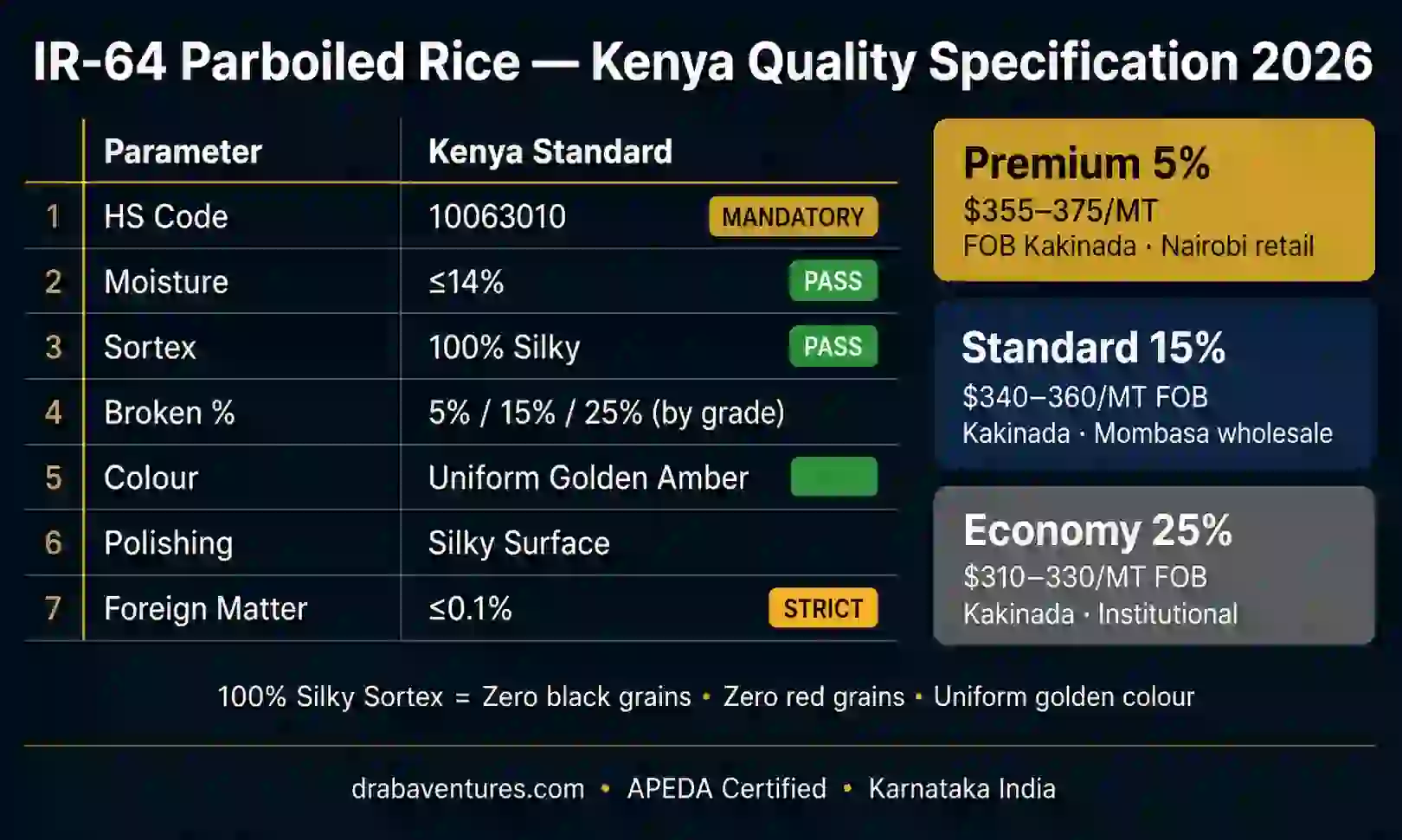
What "100% Silky Sortex Cleaned" Actually Means
Kenyan buyers consistently specify "Silky Sortex Cleaned" as a non-negotiable quality requirement. Many Indian exporters use the term loosely. This section defines precisely what it means and why it matters commercially.
Sortex Cleaning
Sortex cleaning refers to optical sorting - every grain passes through an automated Sortex machine that uses cameras and air jets to eject discoloured grains. For IR-64 Parboiled Rice destined for Kenya, 100% Sortex means:
- Zero black grains: Grains with dark spots or full black colouring are ejected. Black grains are the single most common quality complaint from Kenyan buyers about Pakistani IRRI-6.
- Zero red grains: Red-hulled or partially de-husked grains are removed. Presence of red grains signals poor milling quality.
- Zero chalky grains above threshold: Chalky (opaque white) grains above 2% are ejected. Excess chalky grains indicate under-processed rice - a quality degrade in the Kenyan market.
- Foreign material removed: Stones, husk fragments, and non-grain material are eliminated.
Silky Polishing
After milling and Sortex cleaning, the rice is run through a polishing machine with water or oil misting. Silky polishing produces a smooth, consistent surface on each grain - giving the rice its characteristic sheen. This is what creates the "premium look" Kenyan supermarket buyers and wholesale traders demand. Non-silky polished rice appears dull, chalky, or rough-surfaced - immediately visible to an experienced trader at Nairobi's Gikomba or City Market.
How to verify: When requesting a sample from any Indian supplier, specify you require "100% Silky Sortex Cleaned" explicitly in your purchase order and sample request. On receipt of the sample, spread the rice on a white sheet and check for black grains, red grains, and dull/chalky surface. Any of these present means the supplier is not delivering 100% Sortex standard.
Available Grades for the Kenyan Market
FOB prices are indicative for May 2026. For live rates, visit our Market Intelligence Hub or request a current proforma invoice via WhatsApp.
Full Technical Specification - Kenya Standard
| Parameter | Kenya Buyer Standard | Pass / Warn / Fail | Notes |
|---|---|---|---|
| HS Code | 10063010 | MANDATORY | Must be on all documents - wrong code triggers reclassification |
| Moisture Content | ≤14.0% | ≤14% PASS | Above 14.5% = rejection risk at KEBS inspection |
| Broken Grains | 5% / 15% / 25% | By grade | Must match purchase order specification exactly |
| Sortex Quality | 100% Silky Sortex | MANDATORY | Zero black grains, zero red grains visible |
| Polishing | Silky polished | MANDATORY | Smooth surface, consistent sheen on each grain |
| Grain Length (raw) | 6.0mm minimum | Long grain | Below 5.8mm = medium grain - different classification |
| Foreign Matter | ≤0.1% | Strict | Stones, husk, insects = immediate rejection by KEPHIS |
| Chalky Grains | ≤2% | Monitor | Premium grade requires ≤1% |
| Colour | Uniform golden amber | Visual check | Mixed colour batches rejected in Nairobi retail |
| Packaging | 25kg / 50kg PP woven | Standard | New bags, clean stitching, correct weight labelling |
| Label Requirements | Product of India, weight, grade | Mandatory | Country of origin must be on each bag per KEBS |
IR-64 India vs Pakistani IRRI-6 vs Thai 100% B
Kenyan buyers evaluate three primary sources: Indian IR-64 parboiled, Pakistani IRRI-6 parboiled, and Thai 100% B grade. Here is a direct comparison on the factors that matter to Kenyan wholesale buyers:
| Factor | 🇮🇳 Indian IR-64 | 🇵🇰 Pakistani IRRI-6 | 🇹🇭 Thai 100% B |
|---|---|---|---|
| FOB Price (5% broken) | $340-370/MT | $350-385/MT | $430-480/MT |
| Sortex Consistency | High - APEDA certified | Variable - inconsistent lots | High - Thai standard |
| Black Grain Complaints | Rare - near zero | Common - known issue | Rare |
| Transit to Mombasa | 16-20 days (Kakinada) | 18-24 days (Karachi) | 20-26 days (Bangkok) |
| PVoC / CoC Process | Standard - SGS India well established | More complex - some accreditation gaps | Standard - SGS Thailand |
| Price vs Quality Value | Best - price competitive with Pak, quality competitive with Thai | Price competitive, quality risk | High quality, high price |
| Kenyan Buyer Preference | Preferred for bulk wholesale | Declining due to quality complaints | Premium niche only |
Indian IR-64 occupies the optimal price-quality position for the Kenyan wholesale market. It competes on price with Pakistan while delivering Thai-level Sortex consistency from APEDA-certified exporters. This is the core commercial argument driving the shift from Pakistani to Indian supply in Nairobi and Mombasa wholesale channels.
Packaging Options for Kenya
50kg PP Woven Bags - Wholesale Standard
50kg PP woven bags are the standard format for Kenya's wholesale market - Nairobi's Gikomba, Wakulima Market, and Mombasa bulk distributors all trade in 50kg. Approximately 480-520 bags fit a 20ft FCL (24-26 MT net). Lower packaging cost per tonne. Preferred by institutional buyers, NGOs, and large distributors.
25kg PP Woven Bags - Retail and Re-export
25kg PP woven bags are preferred for retail distribution and re-export to Uganda, South Sudan, and Rwanda. Easier to handle for single traders. Higher packaging cost per tonne ($15-20 extra/MT) but commands 5-8% price premium at retail. Approximately 960 bags per 20ft FCL.
Private Label (Custom Branding)
Draba Ventures offers private label packaging for Kenyan importers. Supply your logo and brand name - we print BOPP laminated bags in India with your branding. Minimum order: 1 × 20ft FCL. Available for both 25kg and 50kg formats. Lead time for design to production: 5-7 working days. Private label is the primary tool to differentiate from competitors at Kenyan retail - the identical rice with your brand commands 10-15% price premium over generic bagged rice.
PVoC Compliance Specifically for IR-64 Parboiled
Every shipment of IR-64 Parboiled Rice to Kenya requires a Certificate of Conformity (CoC) from an accredited KEBS PVoC inspection agency. Under the February 2026 contract reset, SGS is the primary accredited PVoC provider for Indian exporters.
For IR-64 Parboiled Rice, the SGS inspection checks:
- Moisture content (must be ≤14% - tested with moisture meter)
- Broken grain percentage (physical sampling and sieving)
- Foreign matter (visual and weight check)
- Sortex quality (visual inspection of sample - black/red grain count)
- Packaging integrity (bag stitching, weight accuracy, labelling)
- HS code verification (must state 10063010 on invoice)
For a full guide to the KEBS PVoC process, see: KEBS PVoC 2026-2029: Complete Guide for Rice Importers.
FOB to CIF Mombasa - Cost Breakdown
For the full landed cost at Nairobi including IDF, RDL, port charges, and customs duty, see the complete cost breakdown in the Kenya Rice Import Pillar Guide.
Live FOB prices for IR-64 Parboiled updated monthly: Market Intelligence Hub →
Frequently Asked Questions
What does 100% Silky Sortex Cleaned mean for IR-64 rice exported to Kenya?
What is the correct HS code for IR-64 parboiled rice exported to Kenya?
What is the current FOB price of IR-64 parboiled rice from India to Kenya?
Why does Kenya prefer Indian IR-64 over Pakistani IRRI-6?
Can I get private label packaging for IR-64 parboiled for Kenya?
Get IR-64 Parboiled Rice for Kenya
100% Silky Sortex Cleaned. Moisture ≤14%. SGS PVoC coordinated. Full documentation. CIF Mombasa or FOB Kakinada. Private label available from 1 FCL.
