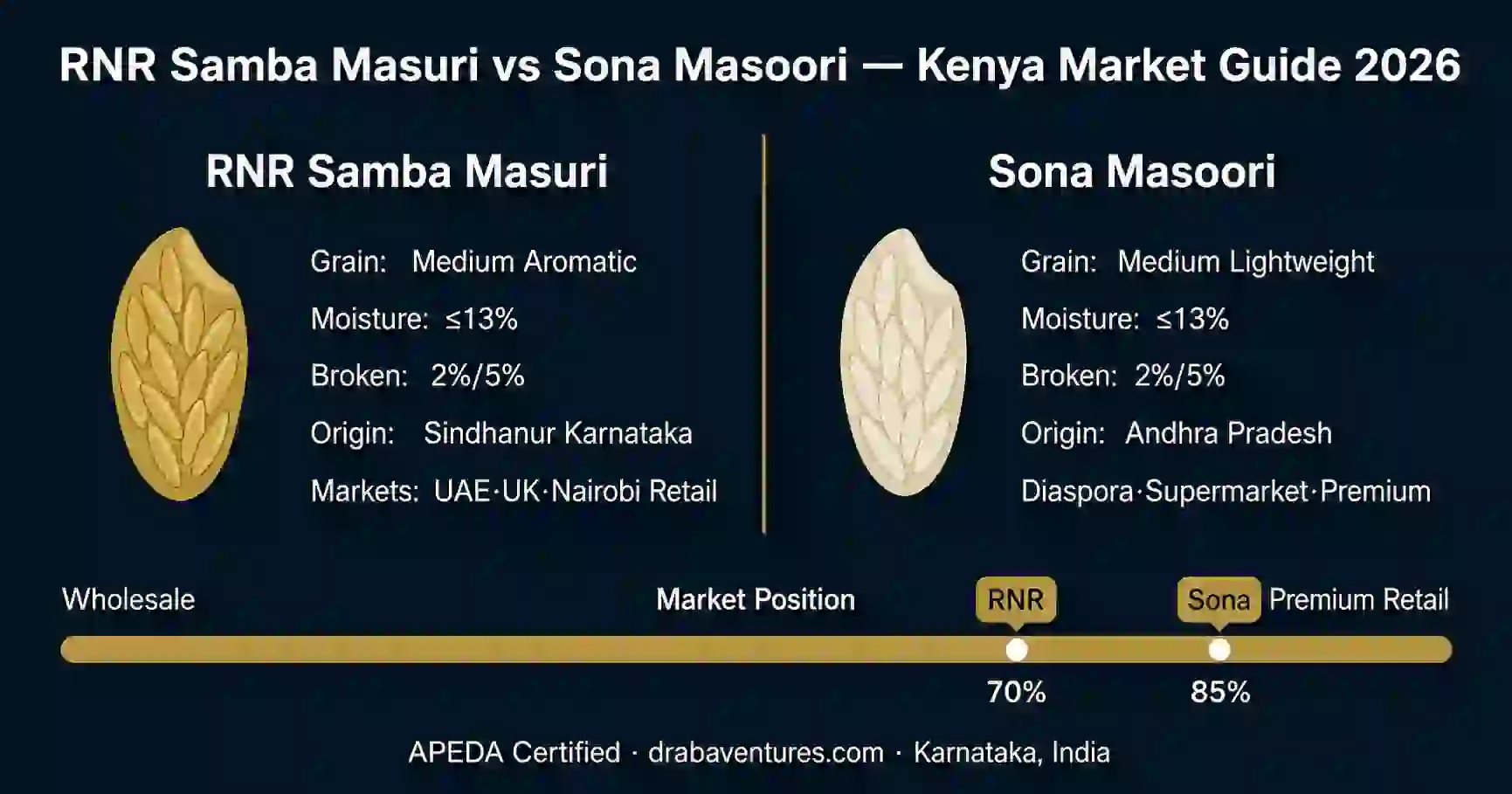
RNR Samba Masuri and Sona Masoori are medium-grain premium non-basmati varieties commanding 10-15% premium over IR-64 Parboiled in the Kenyan retail market. Both serve Nairobi's growing South Asian diaspora segment and health-conscious urban consumers. FOB Kakinada: RNR Raw ~$380-420/MT, Sona Masoori Raw ~$370-410/MT (May 2026). HS Code: 10063090 (raw) or 10063010 (parboiled). PVoC inspection via SGS required before shipment.
The Kenya Premium Rice Opportunity
Kenya's rice market is not a single segment - it is two distinct segments operating side by side. The mass market is dominated by IR-64 Parboiled Rice (HS Code 10063010) in 50kg wholesale bags, traded through Mombasa and Nairobi bulk distributors. This is the volume game.
The premium retail segment is different. Nairobi has a South Asian (Indian, Pakistani, Sri Lankan) diaspora community of approximately 80,000-100,000 people concentrated in Westlands, Karen, and Kilimani. This community shops at Naivas Supermarket, QuickMart, Carrefour (Junction, Garden City), and specialty stores like Zucchini and Healthy U. They are not buying 50kg PP woven bags. They are buying 5kg and 10kg BOPP laminated retail packs. And they are not buying IR-64 Parboiled. They are buying what they grew up eating: RNR Samba Masuri and Sona Masoori.
This is the segment that is growing fastest in Nairobi. Urban Kenyan consumers - not just the diaspora - are increasingly switching to lighter, more aromatic varieties as disposable income rises and health awareness grows. RNR Samba Masuri's natural aroma and low glycaemic profile, and Sona Masoori's lightweight digestibility, are marketing points that translate directly into shelf turnover at Nairobi's modern trade.
RNR Samba Masuri vs Sona Masoori - Side by Side
RNR Samba Masuri - Deep Dive
RNR Samba Masuri (BPT 5204) is grown in the Sindhanur-Raichur agricultural belt of northern Karnataka - the same region where Draba Ventures is based. This is directly significant: our supply chain for RNR is the shortest possible. Paddy is procured directly from local farmers, processed at nearby rice mills, and moved to Kakinada or Chennai for export.
Why RNR Works for the Kenyan Market
- Natural Samba aroma. When cooked, RNR releases a distinctive Samba fragrance. This is not added flavouring - it is the natural variety character. The South Asian diaspora in Nairobi recognises and pays a premium for this. It is the closest non-basmati variety to the rice many Kenyan-Indian families grew up eating in South India.
- Lightweight and digestible. Lower starch content than IR-64 makes it easier to digest. This is increasingly marketed as a wellness attribute in Nairobi's modern trade, where health-conscious positioning is growing rapidly.
- Private label opportunity. RNR in a well-designed 5kg BOPP bag, branded specifically for the Kenyan market, commands retail pricing of KES 750-950 per 5kg (approximately $5.80-$7.40). The margin for an importer-distributor operating in Nairobi's modern trade at these price points is significantly higher than bulk IR-64.
RNR Available Forms for Kenya
| Form | Process | Broken % | Moisture | HS Code | FOB Kakinada |
|---|---|---|---|---|---|
| RNR Raw | Fully milled, white | 2% / 5% | ≤13% | 10063090 | $380-420/MT |
| RNR Parboiled | Fully parboiled, golden | 5% / 15% | ≤13.5% | 10063010 | $370-405/MT |
| RNR Steam | Steam treated, premium | 2% / 5% | ≤13% | 10063090 | $390-430/MT |
Sona Masoori - Deep Dive
Sona Masoori is grown primarily in Andhra Pradesh and Telangana. It is medium-grain, lightweight, and low-starch - traits that make it genuinely distinct from IR-64 in cooking texture. Cooked Sona Masoori is softer and fluffier than IR-64, with significantly lower stickiness. It is the primary everyday rice for South Indian household cooking.
Why Sona Masoori Works for the Kenyan Premium Market
- Health positioning. Sona Masoori is naturally lower in starch than most non-basmati varieties. In Kenya's urban modern trade, this is a legitimate premium positioning - not a marketing fiction. QR-code linked nutritional information on the bag can substantiate this claim at the shelf level.
- Biryani and pilau use. The Kenyan Indian diaspora uses Sona Masoori for biryani and pilau. These are high-margin, high-frequency dishes in Nairobi restaurants and home kitchens. Restaurant buyers - catering to diaspora clientele - are a reliable repeat-purchase channel.
- Expanding beyond diaspora. Urban Kenyan consumers aged 25-40 are actively experimenting with premium rice varieties. Sona Masoori's "Indian origin, premium quality" positioning is gaining traction in Naivas and Carrefour supermarket listings in Nairobi.
Sona Masoori Available Forms for Kenya
| Form | Process | Broken % | Moisture | HS Code | FOB Kakinada |
|---|---|---|---|---|---|
| Sona Masoori Raw | Fully milled, white | 2% / 5% | ≤13% | 10063090 | $370-410/MT |
| Sona Masoori Parboiled | Fully parboiled, golden | 5% / 15% | ≤13.5% | 10063010 | $360-395/MT |
| Sona Masoori Steam | Steam treated | 2% / 5% | ≤13% | 10063090 | $380-420/MT |
Market Channels in Kenya
Nairobi Modern Trade Supermarkets Growing Fast
Naivas Supermarket, QuickMart, Carrefour (Junction, Garden City, Sarit Centre), and Chandarana FoodPlus. These chains are actively expanding their Indian rice range in 5kg and 10kg packs. Listing requirement: consistent monthly supply, KEBS CoC, and retail-ready packaging with Swahili and English labelling. Average shelf price: KES 750-950 per 5kg.
Westlands & Karen Specialty Stores Established
Zucchini, Healthy U, and independent Indian grocery stores in Westlands, Parklands, Karen, and South B. These stores cater directly to the South Asian diaspora and have been stocking RNR and Sona Masoori for years. Typical pack size: 5kg and 10kg. Price-insensitive segment - brand and quality matter more than price.
Indian & South Asian Restaurants Established
Nairobi has a significant South Asian restaurant scene - Indian, Pakistani, and Sri Lankan restaurants in the CBD, Westlands, and Lavington. These restaurants source 25kg bags of RNR or Sona Masoori monthly, prioritising cooking texture and aroma consistency. A single restaurant can consume 2-5 bags per week.
Indian Diaspora E-Commerce & WhatsApp Distribution Growing
An emerging channel: Kenyan-Indian community groups on WhatsApp and Indian diaspora-focused e-commerce platforms (Jumia, direct-from-importer ordering). Importers who supply branded RNR in 5kg packs can use these channels for direct community distribution with minimal retail margin loss.
Packaging for the Kenyan Retail Market
Packaging is the single biggest differentiator for RNR and Sona Masoori in Kenya. Unlike IR-64 in 50kg wholesale bags, these varieties are sold retail and packaging quality directly determines shelf placement and consumer purchase intent.
Private Label for Kenya retail: Draba Ventures produces private label BOPP laminated bags in 5kg and 10kg for Kenyan importers who want to build their own brand. Include your brand name, logo, and country of origin. Minimum 1 × 20ft FCL. Design to production: 5-7 working days. This is the most effective tool to build consumer loyalty and defend your margin at Nairobi supermarkets.
PVoC Compliance for RNR and Sona Masoori
Both RNR Samba Masuri and Sona Masoori require the same KEBS PVoC compliance process as IR-64. The key difference is the HS Code:
- Raw (white milled) RNR and Sona Masoori: HS Code 10063090 - Rice, other than parboiled
- Parboiled RNR and Sona Masoori: HS Code 10063010 - Rice, parboiled
Ensure the correct HS code is on every document - commercial invoice, packing list, certificate of origin, and SGS PVoC application. Using 10063010 for a raw (non-parboiled) variety, or vice versa, triggers customs reclassification at Mombasa and delays clearance by 2-5 days.
For the full step-by-step KEBS PVoC process, see: KEBS PVoC 2026-2029: Complete Guide for Indian Rice Exporters.
FOB to CIF Mombasa - Cost Comparison
The premium over IR-64 at CIF Mombasa is approximately $400-850 per FCL. At Nairobi retail price points of KES 750-950 per 5kg (vs KES 550-700 for IR-64 equivalent), the importer's margin on RNR and Sona Masoori is substantially higher than on IR-64 bulk.
For live FOB pricing on all rice varieties, visit our Market Intelligence Hub.
Frequently Asked Questions
What is RNR Samba Masuri rice and why is it gaining demand in Kenya?
What is the difference between RNR and Sona Masoori for the Kenyan market?
What HS codes apply to RNR and Sona Masoori exported to Kenya?
Can I get private label packaging for RNR or Sona Masoori for Kenyan retail?
What is the FOB price of RNR Samba Masuri rice for Kenya in 2026?
Source RNR & Sona Masoori for Kenya
Karnataka origin. APEDA certified. Private label available. PVoC/SGS coordinated. CIF Mombasa or FOB Kakinada. First orders via LC at sight from 15 MT.
