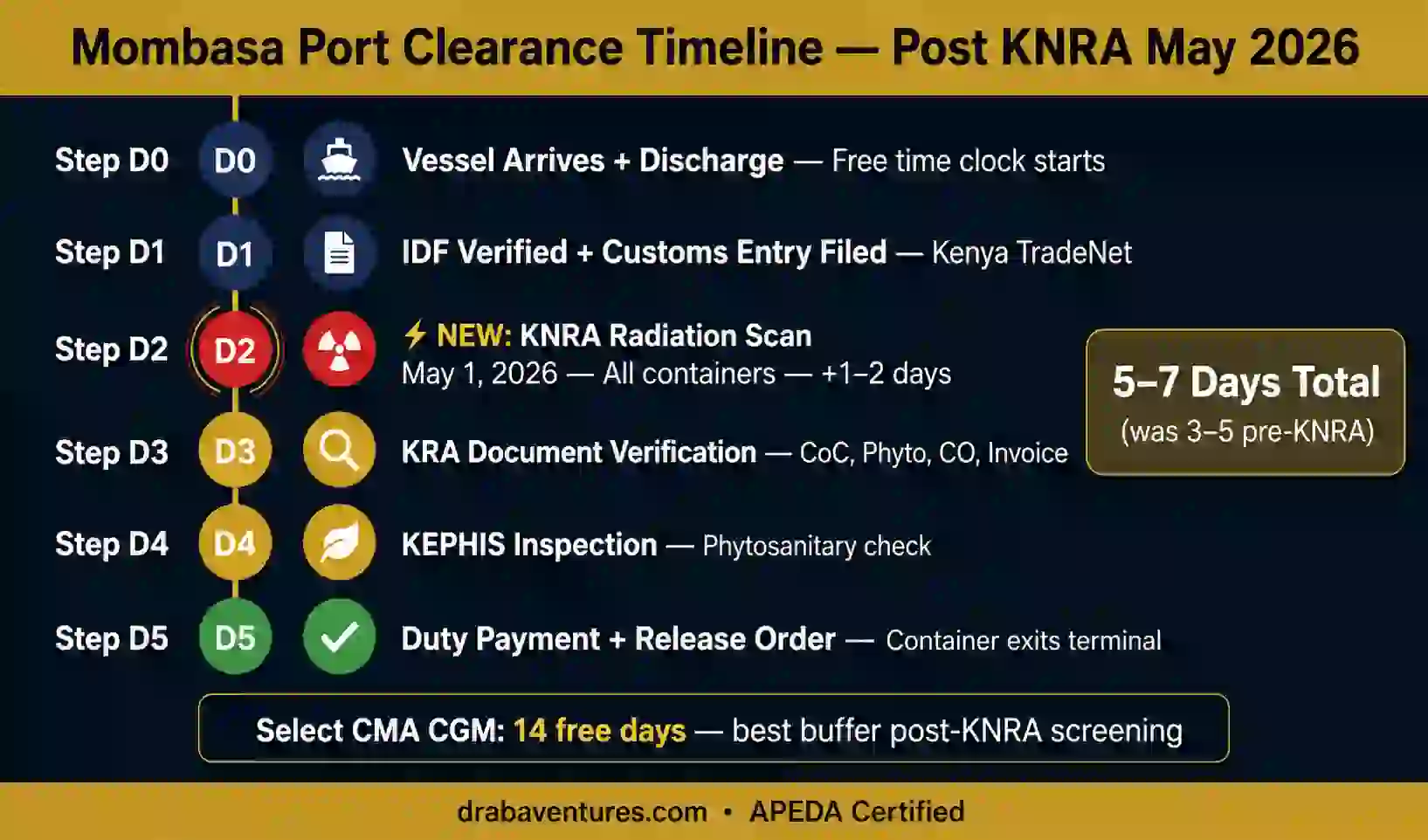
As of May 1, 2026, all containerised cargo at Mombasa Port undergoes mandatory radiation screening by the Kenya Nuclear Regulatory Authority (KNRA). For Indian agricultural exports - rice, spices, groundnuts, onions, produce - the risk of rejection is effectively zero. The only operational impact is additional clearance time of 1-2 working days. Plan for 5-7 days total port clearance instead of the previous 3-5. Adjust free time agreements with your shipping line accordingly.
What is the KNRA Radiation Screening Requirement?
The Kenya Nuclear Regulatory Authority (KNRA) is the government body responsible for regulating nuclear and radiation safety in Kenya. Under its mandate to prevent illicit trafficking of radioactive material, KNRA implemented mandatory radiation portal monitoring at Mombasa Port effective May 1, 2026.
Every container entering the Mombasa Port container terminal passes through a radiation portal monitor (RPM) - a gate-style scanner - during the port entry process. The scan takes seconds per container. The result is either clearance (green signal) or a secondary manual inspection (alarm/flag).
Effective date: May 1, 2026. All containerised imports at Mombasa Port - regardless of origin, commodity, or importer - are subject to KNRA radiation screening. This is not a pilot programme. It is now standard operating procedure at Kenya's primary port of entry.
Who Does This Affect?
Every Indian exporter shipping to Kenya via Mombasa is affected - without exception. The screening applies to all containerised cargo regardless of commodity type. The following Draba Ventures product categories are all subject to KNRA screening:
No Indian food commodity has radiation risk. KNRA screening targets illicit radioactive material - nuclear waste, smuggled isotopes, industrial radiation sources. Agricultural commodities from India carry no such material. Alarm rates on food cargo are effectively zero. The operational impact is timeline only, not safety.
How KNRA Screening Changes Your Clearance Timeline
Vessel Arrives at Mombasa Port
Container is discharged from vessel and moved to the container terminal yard. Shipping line notifies consignee and freight forwarder. Free time clock begins from discharge date.
Cargo Manifest Lodged + IDF Verified D1
Kenya Revenue Authority (KRA) verifies the Import Declaration Form (IDF) against the cargo manifest. Your clearing agent initiates the customs declaration (entry) process via Kenya TradeNet.
KNRA Radiation Scan NEW - D2 to D3
Container moves through the KNRA radiation portal monitor at the terminal gate. Scan is automatic and takes seconds. If green signal: proceeds directly to customs document verification. If alarm (rare): secondary manual inspection by KNRA officer - adds 4-8 additional hours. For food cargo, alarm rate is near-zero.
KRA Customs Document Verification D3 to D4
Customs officers verify CoC (KEBS PVoC), phytosanitary certificate, certificate of origin, and commercial invoice. Complete and consistent documentation ensures green channel (fast track). Incomplete documents trigger physical inspection - adds 2-3 days.
KEPHIS Phytosanitary Inspection D4 to D5
Kenya Plant Health Inspectorate Service (KEPHIS) conducts a physical inspection of the rice consignment - sampling for pests, disease, and compliance with import permit conditions. This runs concurrently with KRA verification where possible.
Duty Payment + Release Order D5 to D6
Customs duty, IDF fee, and RDL are paid. KRA issues the release order. Container exits terminal. Delivered to importer's warehouse. Total clearance time with KNRA screening: 5-7 days from vessel arrival.
Adjusting Your Free Day Strategy
Before May 2026, standard clearance at Mombasa was 3-5 days. Most importers operated comfortably within a 7-day free time agreement with their shipping line. That margin no longer exists.
Standard operating procedure post-May 2026:
| Shipping Line | Standard Free Days | Recommended Post-KNRA | How to Request Extension |
|---|---|---|---|
| CMA CGM | 14 days (East Africa service) | ✅ Sufficient as-is | No action needed |
| MSC | 7 days | ⚠️ Tight - request 10+ | Request at booking or via local agent |
| Maersk | 7 days | ⚠️ Tight - request extension | Extension available on request, fee may apply |
| Evergreen | 7-10 days | ⚠️ Marginal - confirm | Confirm with local Mombasa agent at booking |
| Hapag-Lloyd | 7 days | ⚠️ Tight - negotiate 10+ | Pre-negotiate at booking for East Africa |
Demurrage costs at Mombasa: Days 1-7 after free period: $50-80/day. Days 8-14: $100-150/day. Beyond 14 days: $150-200+/day. On a standard 25 MT FCL of rice, even 5 days of demurrage costs $400-750 - erasing the margin on a typical shipment. Negotiate free time upfront. Do not assume 7 days is enough anymore.
Documentation: What KNRA Requires
KNRA radiation screening does not require any new documents from the Indian exporter. The screening is automated - containers pass through the portal monitor as part of the standard port gate process. However, document completeness remains critical because KNRA staff occasionally cross-reference documents when a container flags for secondary inspection.
Ensure your full document set is dispatched by DHL and received by your Kenyan clearing agent before vessel arrival:
✓ Document Set - Mombasa Port Clearance (Post-May 2026)
Does KNRA Screening Apply to Non-Rice Products?
Yes - every single containerised commodity from India is subject to KNRA radiation screening at Mombasa Port. This includes all of Draba Ventures' export product range:
- Agricultural commodities: All rice varieties (IR-64, RNR Samba Masuri, Sona Masoori, Basmati), groundnuts, wheat, sugar, sorghum, pulses
- Spices: Turmeric, cumin seeds, red chilli, coriander, garam masala
- Fresh produce: Onions, potatoes, mangoes, grapes, green chilies, bananas
- Industrial goods and electronics: Apply the same 5-7 day clearance planning post-KNRA
The clearance timeline adjustment (plan for 5-7 days instead of 3-5 days) is a universal requirement for all shipments to Mombasa from May 2026 onwards. Brief your Kenyan buyers on this change if they are calculating their own receivable timelines.
Action Items for Indian Exporters
Three immediate changes to your export operations are required:
1. Renegotiate free time on all active shipping line agreements. Request a minimum of 10 days free time at Mombasa on any East Africa bookings. CMA CGM currently offers 14 days on East Africa as standard - use this as leverage when negotiating with MSC and Maersk.
2. Dispatch documents earlier. Documents must reach the Kenyan clearing agent at least 5 days before the vessel arrives - not on arrival day. This allows the clearing agent to pre-file the customs entry and ensures all documents are in order before the KNRA scan triggers the customs verification sequence.
3. Brief your Kenyan buyers on the updated clearance timeline. If your buyer is planning their warehouse inventory on the assumption of 3-5 day clearance and they are now experiencing 6-7 days, they will attribute the delay to the exporter. Proactively communicate the KNRA change now.
Draba Ventures handles this for you. For all shipments from Draba Ventures to Mombasa, we coordinate document dispatch via DHL no later than the day of vessel departure, share tracking numbers immediately, and brief buyers on expected clearance timelines including KNRA screening. Contact our trade desk at drabaventures.com/contact or WhatsApp +91 99165 50010.
Frequently Asked Questions
Does KNRA radiation screening apply to rice specifically, or all cargo?
Will my Indian rice be rejected by KNRA screening?
What documents does KNRA require from the Indian exporter?
How do I avoid demurrage because of the extra clearance time?
Does KNRA screening affect the KEBS PVoC process?
Shipping to Kenya in May 2026?
Draba Ventures manages complete documentation for all Mombasa-bound shipments - CoC coordination with SGS, DHL dispatch before vessel departure, and buyer timeline briefings. We handle the compliance so you focus on the business.
