9 mandatory documents for Kenya rice imports. Indian exporter provides: CoC (PVoC/SGS), Bill of Lading, Commercial Invoice, Packing List, Phytosanitary Certificate, Certificate of Origin, Fumigation Certificate. Kenyan importer provides: IDF (via TradeNet), KEPHIS Import Permit. All exporter documents must be dispatched by DHL and received by the Kenyan clearing agent at least 5 working days before vessel arrival at Mombasa.
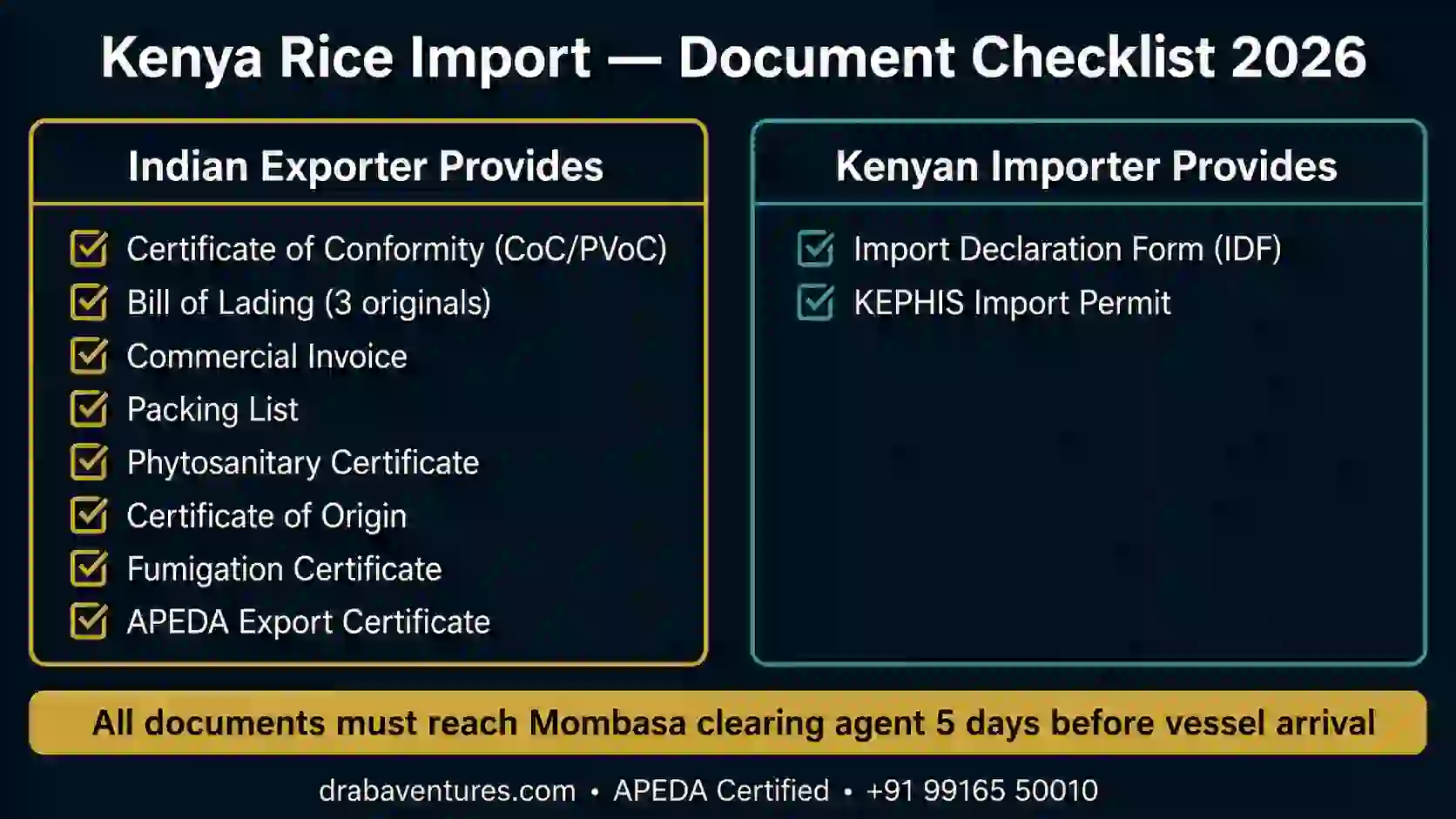
Document Responsibility - At a Glance
Document errors are the primary cause of demurrage at Mombasa Port. Not shipping line delays, not port congestion, not KNRA screening - document problems. A missing Certificate of Conformity, an expired phytosanitary certificate, or an unfiled IDF can each add 3-10 days to clearance time and $300-$2,000 in avoidable costs.
Understanding who is responsible for each document - the Indian exporter or the Kenyan importer - is the foundation of a smooth import transaction.
Each Document - Explained in Detail
1. Certificate of Conformity (CoC) - KEBS PVoC
Why it is the most critical document: Without a valid CoC, your cargo is subject to Destination Inspection (DI) at Mombasa - 5-10 additional days and a $300-$600 DI fee. No other document substitutes for the CoC.
What it must reference: Invoice number, HS code (10063010 for parboiled), container number, consignment quantity, and loading port. All must match the commercial invoice exactly.
2. Bill of Lading
Critical requirements for Kenya: Consignee name must exactly match the IDF and commercial invoice. Notify party details must be complete. Port of discharge must state "MOMBASA, KENYA." Container number and seal number must be correct.
Telex release vs original: For first-time transactions, always send 3 original B/Ls by DHL. Once a trading relationship is established (2-3 successful LC transactions), telex release can be discussed with the buyer. Do not use telex release for unknown buyers.
3. Commercial Invoice
Critical: The value declared on the commercial invoice forms the basis for IDF (2.25%), RDL (2%), and customs duty calculations. Under-declaration is a customs offence in Kenya and triggers investigation, cargo hold, and penalties.
4. Packing List
Exact match requirement: The packing list must match the commercial invoice on every item - quantity, weight, and container number. A 1-bag discrepancy between packing list and invoice can trigger a physical examination at Mombasa, adding 2-3 days to clearance.
5. Phytosanitary Certificate
Validity: 21 days from issuance. This is the tightest validity window of any document in the set. For Kakinada to Mombasa transit of 16-20 days, the certificate must be issued as close to the loading date as possible - ideally on the day of or day before container stuffing.
Required by: KEPHIS (Kenya Plant Health Inspectorate Service) at Mombasa Port. KEPHIS will physically examine the consignment against the phytosanitary certificate. An expired certificate means KEPHIS re-inspection - adds 3-5 days.
6. Certificate of Origin
Form A (GSP CO): Where applicable, use Form A (Generalised System of Preferences Certificate of Origin) rather than a non-preferential CO. GSP Form A may entitle the Kenyan importer to reduced duty under applicable trade preferences. Confirm with your clearing agent whether GSP benefits apply to rice at the current duty rate.
Non-preferential CO: A standard non-preferential CO is the minimum requirement. It is accepted by Kenya Revenue Authority for all rice imports.
7. Fumigation Certificate
Who issues it: A licensed Indian fumigation agency. The certificate must state: the fumigant used, concentration, exposure duration, date of treatment, and the name/registration of the fumigation company.
Timing: Fumigation must occur after packing and before container sealing. The phytosanitary certificate is typically issued after fumigation, referencing the fumigation treatment.
8. Import Declaration Form (IDF)
Indian exporter's role: Confirm with your Kenyan buyer that the IDF has been filed and the TradeNet reference number is available. Ask for the reference number before the vessel departs. If the IDF is not filed on vessel arrival, clearance cannot start and demurrage begins accruing.
The IDF reference number is used by the clearing agent to lodge the customs entry. Without it, the entire clearance process stalls at step one.
9. KEPHIS Import Permit
Why it matters: KEPHIS inspectors at Mombasa check the import permit against the phytosanitary certificate from India. If the permit does not exist or the specifications do not match (wrong variety, quantity exceeds permit), KEPHIS will hold the consignment pending resolution.
Indian exporter's role: Confirm with your Kenyan buyer that the KEPHIS import permit is obtained before loading. Provide the permit number to reference on shipping documents where applicable.
Document Dispatch Timeline
📅 The Right Timeline - India to Mombasa
Apply to SGS India for PVoC inspection. Submit application with draft invoice, packing list, HS code, specs. Book inspection date. Confirm Kenyan buyer is filing IDF via TradeNet.
SGS physical inspection conducted. Ensure full consignment is present and accessible. Fumigation completed. Moisture test result confirmed ≤13.5% before inspector arrives.
Apply for Phytosanitary Certificate from India NPPO. Apply for Certificate of Origin from Indian Chamber of Commerce. Obtain Fumigation Certificate. Container stuffing begins.
CoC received from SGS. All documents assembled: CoC, phytosanitary certificate, CO, fumigation certificate ready. B/L not yet available (issued after vessel departure).
Vessel departs. Container loaded and sealed. Request B/L from shipping line immediately on departure. Confirm IDF reference number from Kenyan buyer.
B/L received from shipping line. Assemble complete document set: 3 original B/Ls + all 7 other documents. Dispatch by DHL courier to Kenyan clearing agent immediately.
Documents received by Kenyan clearing agent. Agent pre-lodges customs entry via iCMS. All documents verified against each other. Vessel still 13-17 days from Mombasa - clearing agent has time to identify any discrepancies.
Vessel arrives Mombasa (Kakinada transit). Clearance commences immediately. Documents already with clearing agent, IDF filed, KEPHIS permit confirmed. Target clearance in 6-7 days within free time window.
Most Common Document Errors and How to Avoid Them
Wrong HS Code on Commercial Invoice
Using 10063090 (raw rice) instead of 10063010 (parboiled rice) or vice versa triggers customs reclassification. Always match HS code to the actual product processing state. Double-check before issuing invoice.
Expired Phytosanitary Certificate
The phytosanitary certificate is valid for 21 days. If you issue it too early (before the loading date is confirmed) and the shipment is delayed, the certificate can expire before vessel arrival at Mombasa. Issue it as close to loading as possible.
Packing List and Invoice Quantity Mismatch
If the packing list shows 960 bags (24 MT) but the invoice shows 25 MT (1,000 bags), KRA triggers a physical examination. Count bags precisely. Both documents must agree to the gram.
IDF Not Filed Before Vessel Arrival
The Kenyan importer must file the IDF via TradeNet before the vessel arrives. If not filed on arrival, clearance cannot commence. Demurrage starts accruing from day 1. Always confirm IDF reference number from your buyer before loading.
CoC References Wrong Invoice Number
If the CoC was applied for using a draft invoice and the final invoice number changed, the CoC will reference a non-existent invoice. KRA will flag this. Always finalize invoice number before applying for SGS inspection.
Documents Sent After Vessel Arrival
Sending documents by DHL on the day the vessel arrives at Mombasa means the clearing agent receives them 2-3 days after arrival - the KNRA screening and IDF verification have already started without the documents. Always dispatch within 48 hours of vessel departure from India.
Draba Ventures document standard: For every Kenya shipment, we dispatch the complete document set by DHL within 48 hours of container loading. We share the DHL tracking number with the Kenyan buyer immediately. We confirm the phytosanitary certificate issue date against the vessel ETA to ensure no validity gap. We are APEDA certified - all credentials are publicly verifiable. Contact our trade desk to discuss document requirements for your first shipment.
Frequently Asked Questions
What documents are required to import Indian rice into Kenya in 2026?
Who is responsible for the Certificate of Conformity (CoC)?
Who files the IDF for Kenya rice imports?
How long is a Phytosanitary Certificate valid for Kenya rice exports?
Can I use telex release instead of original Bill of Lading for Kenya?
Let Us Handle the Documents
Draba Ventures manages the complete document set for every Kenya shipment - PVoC coordination with SGS, phytosanitary timing, DHL dispatch, and buyer briefing. Zero document errors on our track record.
