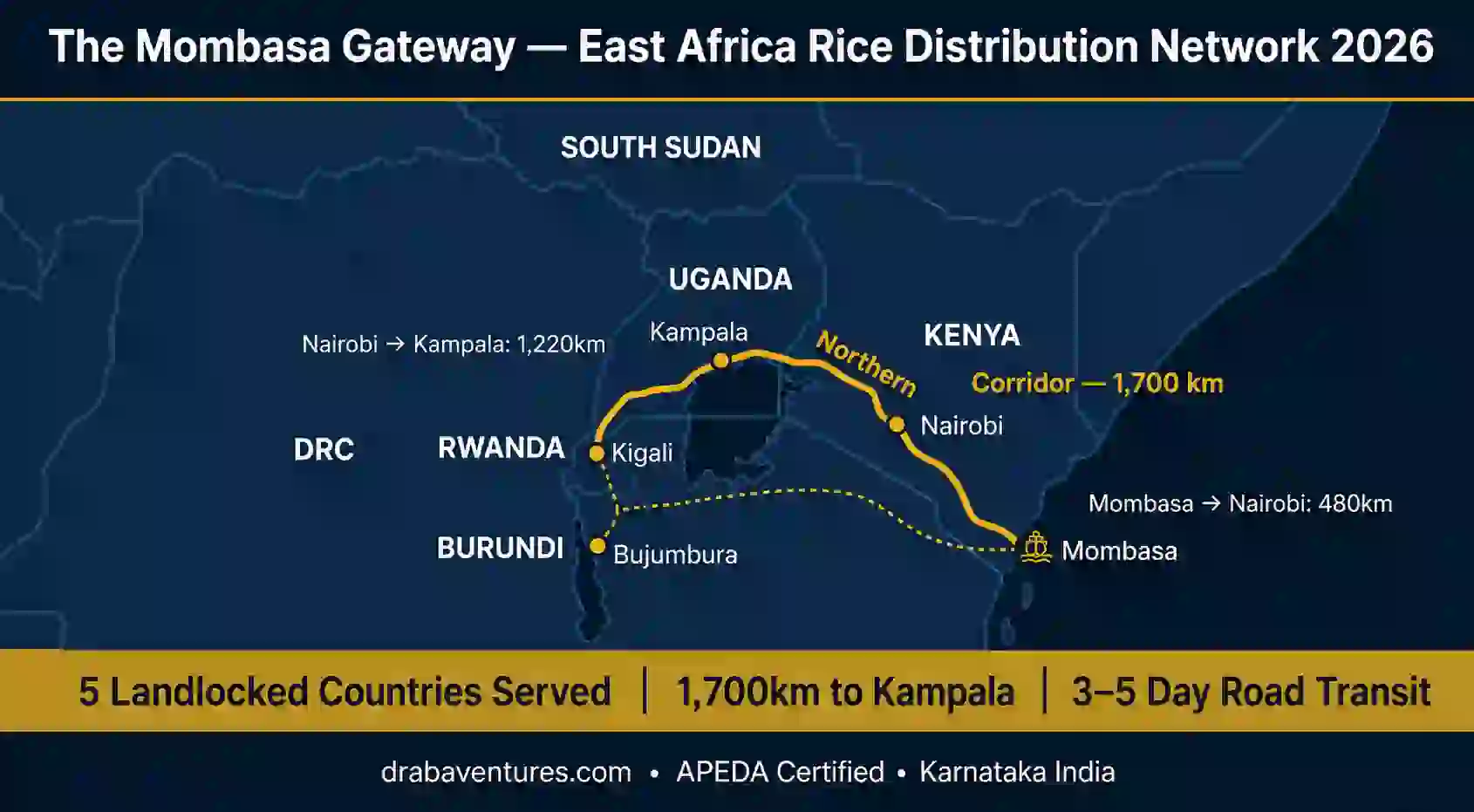
Mombasa Port is the gateway for 5 landlocked East African markets - Uganda, South Sudan, Rwanda, DRC, and Burundi. Large Kenyan distributors regularly import 3-5 FCLs of IR-64 Parboiled Rice from India at once and distribute across the Northern Corridor to Kampala (1,700 km, 3-5 days road). This re-export model earns significantly higher margins than domestic Kenya-only distribution. Road freight Mombasa → Kampala: $1,800-$2,400 per 20ft container.
Why Mombasa Is the Pivot Point for East Africa
The Port of Mombasa processes over 1.5 million TEUs annually, but its true significance for Indian rice exporters is not the volume it handles for Kenya alone - it is the volume it handles for the entire region. Five landlocked countries have no viable alternative to Mombasa as their primary sea-access gateway.
Uganda, South Sudan, Rwanda, DRC, and Burundi collectively import tens of millions of metric tonnes of goods annually. The vast majority of that cargo arrives by sea at Mombasa and moves inland by road or rail via the Northern Corridor. For rice specifically, the combination of India's FOB price advantage and Mombasa's regional distribution reach creates a structural opportunity that extends well beyond Kenya's domestic consumption.
Kenyan distributors who understand this operate a fundamentally different business model from those who import only for local sale. They source from India in larger volumes (3-5 FCLs per order), clear the cargo at Mombasa, and simultaneously dispatch to multiple destinations - part to Nairobi wholesale, part northbound to Kampala, part to Juba or Kigali. Their per-container margin is lower than a domestic-only importer, but their total return on each shipment is substantially higher.
The Five Landlocked Markets
The Northern Corridor - Mombasa to Kampala
The Northern Corridor is East Africa's primary trade artery. It runs approximately 1,700 km from Mombasa Port westward through Nairobi, then northwest to Kampala via the Malaba border crossing. It is the route that makes the Mombasa Gateway strategy viable for Indian rice.
Road Freight Economics
| Route | Distance | Road Transit | Freight Cost (20ft) | Key Border |
|---|---|---|---|---|
| Mombasa → Kampala | ~1,700 km | 3-5 days | $1,800-$2,400 | Malaba (KE/UG) |
| Mombasa → Kigali | ~1,900 km | 4-6 days | $2,200-$2,900 | Gatuna (UG/RW) |
| Mombasa → Juba | ~2,400 km | 5-8 days | $2,800-$3,800 | Nimule (UG/SS) |
| Mombasa → Bujumbura | ~2,000 km | 5-7 days | $2,400-$3,200 | Gatuna or Kagitumba |
Malaba border crossing: The Malaba border (Kenya/Uganda) is the most important crossing on the Northern Corridor. Under normal conditions, clearance takes 4-8 hours. With incomplete transit documentation, fuel shortages causing truck queues, or system outages at the Kenya Revenue Authority border station, Malaba can take 2-3 days. Always ensure transit bond documentation is complete before the truck departs Mombasa.
Standard Gauge Railway (SGR) - Mombasa to Nairobi
Kenya's Standard Gauge Railway (SGR) connects Mombasa to Nairobi (480 km) by rail in 4-5 hours at a freight cost of approximately $600-$800 per 20ft container. Using SGR to Nairobi, then road from Nairobi to Kampala (1,220 km), reduces overall transit time by 12-18 hours versus full road from Mombasa. Many larger distributors use this multimodal option for time-sensitive cargo.
Transit Bond Documentation
Rice that enters Mombasa on transit to Uganda, South Sudan, or Rwanda does not pay Kenya customs duty. Instead, the importer lodges a Transit Bond - a financial guarantee with Kenya Revenue Authority that the goods will exit Kenya within a specified time frame. If the goods are diverted or not documented as exiting, the bond is forfeited and duty becomes payable.
For Kenyan distributors who re-export to Uganda, there are two models:
- Duty-paid and re-exported (most common): The rice is cleared through Mombasa customs, duty paid in Kenya, then sold to Ugandan buyers who collect from Nairobi or Kampala. The Kenyan distributor absorbs the Kenyan duty cost and builds it into the Ugandan selling price.
- Transit bond (for large volumes going directly to Uganda): The cargo is placed under a transit bond at Mombasa and moves directly to Uganda without paying Kenyan duty. The Ugandan importer pays Uganda customs duty at the Malaba border. This model is more administratively complex and typically used by established distributors with customs relationships at both borders.
The Re-export Business Model - How It Works
📦 The Kenyan Re-export Distributor Model
Cost Breakdown - Mombasa to Kampala (Full Landed)
At Kampala wholesale pricing of $47-$58 per 50kg bag (KES equivalent: UGX 180,000-220,000), a 25 MT FCL of IR-64 Parboiled (500 bags at 50kg) generates gross revenue of approximately $23,500-$29,000 - well above landed cost even after customs duties are added.
For live FOB pricing on IR-64 Parboiled Rice, RNR Samba Masuri, and Sona Masoori, visit our Market Intelligence Hub.
Why Indian IR-64 Wins the East Africa Re-export Market
The re-export economics only work with a competitively priced, consistently high-quality source product. Indian IR-64 Parboiled Rice from APEDA-certified Karnataka exporters dominates this market for three reasons:
- FOB price advantage. Indian IR-64 is typically $8-15/MT cheaper than Pakistani IRRI-6 on equivalent broken percentage, and $60-80/MT cheaper than Thai 100% B. At 3-5 FCL scale, this price difference is $600-$3,750 per order - directly impacting re-export margin.
- Sortex consistency. East African traders at Kampala's Owino Market and Nakasero Market have clear quality preferences. Consistent 100% Sortex quality from Indian exporters builds repeat business. Pakistani IRRI-6 quality inconsistency (black grain contamination) costs Kenyan re-exporters customers in Uganda.
- Documentation reliability. Indian exporters with PVoC compliance track records clear Mombasa faster, which means the road freight to Kampala starts sooner - reducing total days out of cash for the distributor.
For high-volume re-export buyers: Draba Ventures accepts orders from 3+ FCL buyers planning the Mombasa Gateway model. We offer volume-tiered pricing, coordinated shipping schedules to align multiple FCLs on the same vessel, and centralised document dispatch. Contact our trade desk to discuss structure. We also supply for the Uganda market directly.
Frequently Asked Questions
Can rice imported into Kenya be re-exported to Uganda or South Sudan?
What is the Northern Corridor and why is it important?
How much does road freight from Mombasa to Kampala cost?
How many FCLs should I order from India for the re-export model to be viable?
Does Draba Ventures supply directly to Uganda without going through Kenya?
Operating the Mombasa Gateway Model?
Draba Ventures supplies 3-5 FCL orders for Kenyan re-export distributors. Volume pricing, coordinated vessel scheduling, PVoC-compliant documentation. IR-64 Parboiled, RNR Samba Masuri, and Sona Masoori available.
