White sorghum and yellow sorghum from India are not interchangeable - they serve different end markets, carry different price points and require different acceptance criteria in the purchase order. Getting the grade specification right before the Proforma Invoice is signed prevents the most common source of disputes: a shipment that meets the seller's internal standard but fails the buyer's processing requirement. This guide gives feed formulators, food buyers, brewers and starch processors the exact grading language to use when sourcing Indian sorghum.
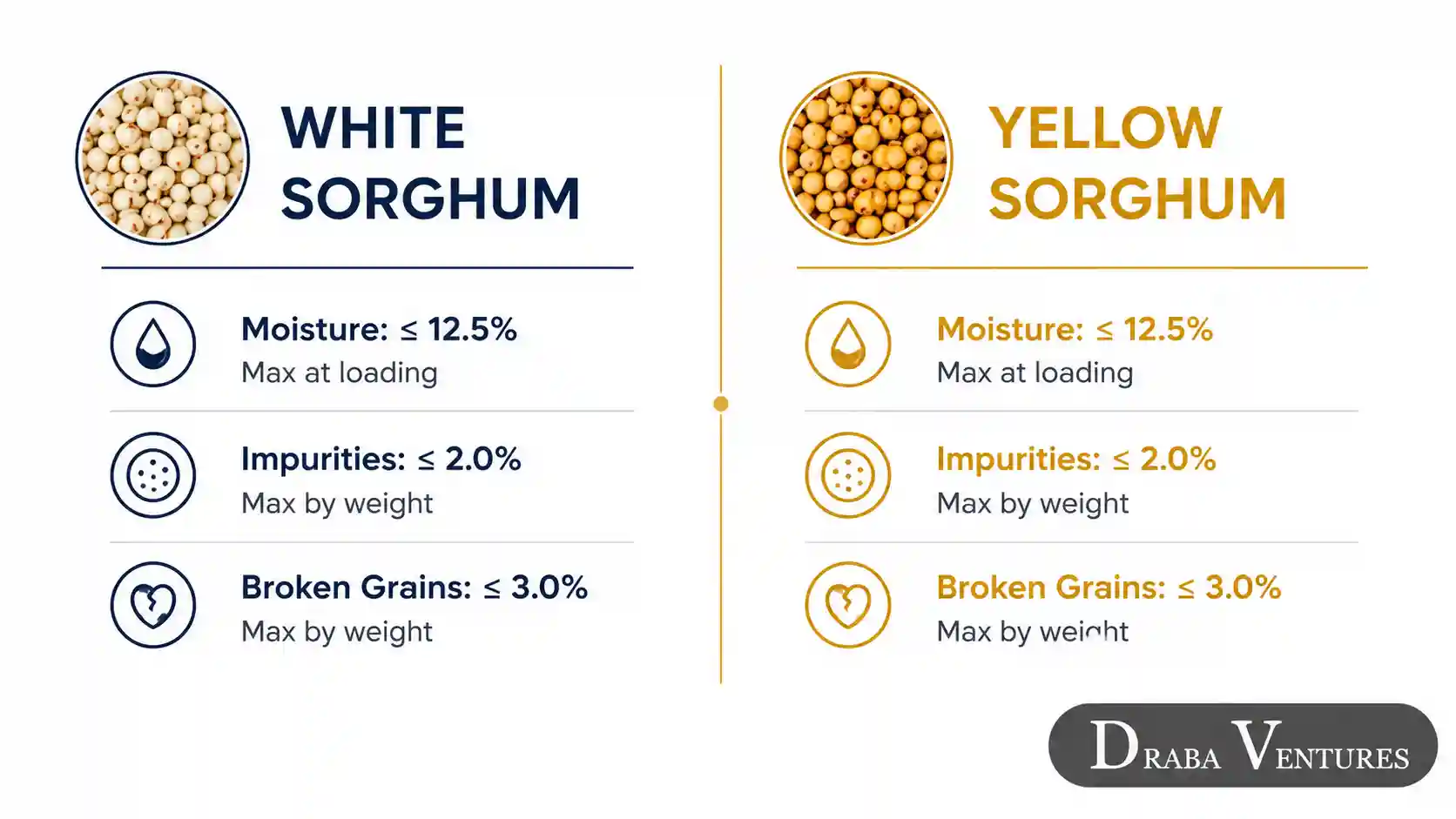
Key grading difference: White sorghum - colour-sorted, low tannin (≤0.3% as tannin equivalent), moisture ≤12.5%, broken ≤3%, foreign matter ≤1%. Yellow/red sorghum - moisture ≤13.5%, broken ≤5%, admixture ≤2%, no colour sorting required. Both grades are exported under HS code 10070090; the specification is contractual, not customs-defined.
Ready to Import Indian Sorghum?
Get an instant FOB and CIF cost estimate including shipping and insurance.
What Export Grading Means for Sorghum Buyers
Sorghum grading standards determine commercial classification and suitability for specific industrial applications. Quality standards ensure that physical and chemical properties align with the target processing requirements.
A standardized grading process ensures consistency across export lots, factoring in color, grain size, moisture level, and contamination limits. Contract specifications must define these tolerance thresholds clearly to avoid quality disputes.
White Sorghum Technical Profile
White sorghum, also known as food-grade jowar, requires strict color uniformity and minimal hull discoloration. Buyers evaluating this variety focus on brightness and starch quality for flour or milling industries.
White sorghum buyers should confirm color consistency, grain appearance and cleaning response before approving food or milling use. Photos help, but physical sample approval is stronger.
Yellow and Red Sorghum Technical Profile
Yellow and red sorghum varieties are primary raw materials for feed manufacturers and industrial starch production. These grains are graded based on energy value, density, and nutrient content rather than visual aesthetics.
Importers sourcing feed-grade yellow sorghum must establish specifications for protein content, starch yield, and tannin concentration, as these factors directly affect feed conversion ratios and production efficiency.
Color Grade, Density and End-Use Fit
The physical characteristics of sorghum, including grain density and pericarp color, serve as primary indicators of processing yield. Sorting processes use advanced optical sensors to separate sub-standard grains and foreign materials.
Bulk density is a useful signal, but it should not be assumed from soil type alone. Buyers should request a sample or lab value when density affects milling, bagging or plant yield.
Broken Grain and Foreign Matter Tolerance
Export contracts establish strict percentage limits for broken grains and foreign matter to protect manufacturing equipment. High levels of admixture can lead to dust development, mold growth, and logistical challenges during transit.
Sieve analysis is performed pre-loading to certify compliance with target specs (typically keeping broken kernels under 5% and foreign matter under 1.5%). These tolerances must be verified by a certified independent surveyor at the load port.
Buyer Inspection Checklist Before Contracting
To ensure quality alignment, buyers should request pre-shipment inspections covering both physical attributes and chemical safety parameters. This protocol protects the buyer before the cargo is loaded onto the vessel.
A strong contract defines grade, quantity, packing, price basis, shipment window, inspection point, payment term and document list. MOQ should be realistic for container economics.
Buyer Reference Table
| Buyer check | Target wording | Why it matters |
|---|---|---|
| Moisture | <=14% unless buyer specifies otherwise | Controls storage and cargo risk |
| Broken grains | 2-5% tolerance by contract | Affects processing and visual grade |
| Foreign matter | Low, measurable percentage | Protects food/feed processing lines |
| Inspection | Lot-specific before loading | Prevents disputes at destination |
Procurement Checklist Before You Ask for PI
- Confirm whether the cargo is white, yellow, red or feed-grade sorghum.
- State the end use: brewery, poultry feed, food processing, starch, distribution or industrial use.
- Ask for moisture, broken percentage, foreign matter, admixture and infestation status in writing.
- Confirm bag size, bag type, marking, container payload and shipment month.
- Request the expected document set before payment terms are finalized.
- Verify HS code, destination rules and importer obligations with your customs broker.
Grade language in an email is not a contract. Put moisture percentage, broken grain tolerance, foreign matter limit and colour specification as numbered clauses in the purchase order. If the seller cannot accept a specific moisture or broken-grain number in writing, that is the signal to keep looking.
Internal Authority Links
Frequently Asked Questions
What is the main buying decision in White vs Yellow Sorghum Grading Standards for International Buyers?
What should an importer include in a sorghum RFQ?
Which HS code should buyers use for sorghum imports?
Can Draba Ventures quote FOB and CIF sorghum shipments?
How does this page avoid keyword cannibalization?
Request a Sorghum Export Quote from Draba Ventures
Send product grade, quantity in MT, destination port, preferred Incoterm, payment preference and target shipment window. Our team will respond with a structured FOB or CIF quote.
Request a QuoteHS code note: this page uses 10070090 as the working sorghum trade entity. Final classification should be checked with the buyer's customs broker before import filing.
