Sortex cleaning and sieve analysis are the two quality control steps that separate export-grade Indian sorghum from domestic market grain. Without them, a buyer receives a mixed lot that fails processing yields, triggers border inspection and cannot be sold at a premium. This guide explains what Sortex cleaning achieves, what sieve analysis certifies, how to read both results in a test report, and what minimum standards to specify in the purchase order.
Sortex-cleaned sorghum: colour-sorted to remove discoloured, shrivelled and immature grains, achieving visual purity ≥97-98%. Sieve analysis certifies broken grain percentage, foreign matter and admixture. Both must be lot-specific - not a batch average - and issued before loading.
Ready to Import Indian Sorghum?
Get an instant FOB and CIF cost estimate including shipping and insurance.
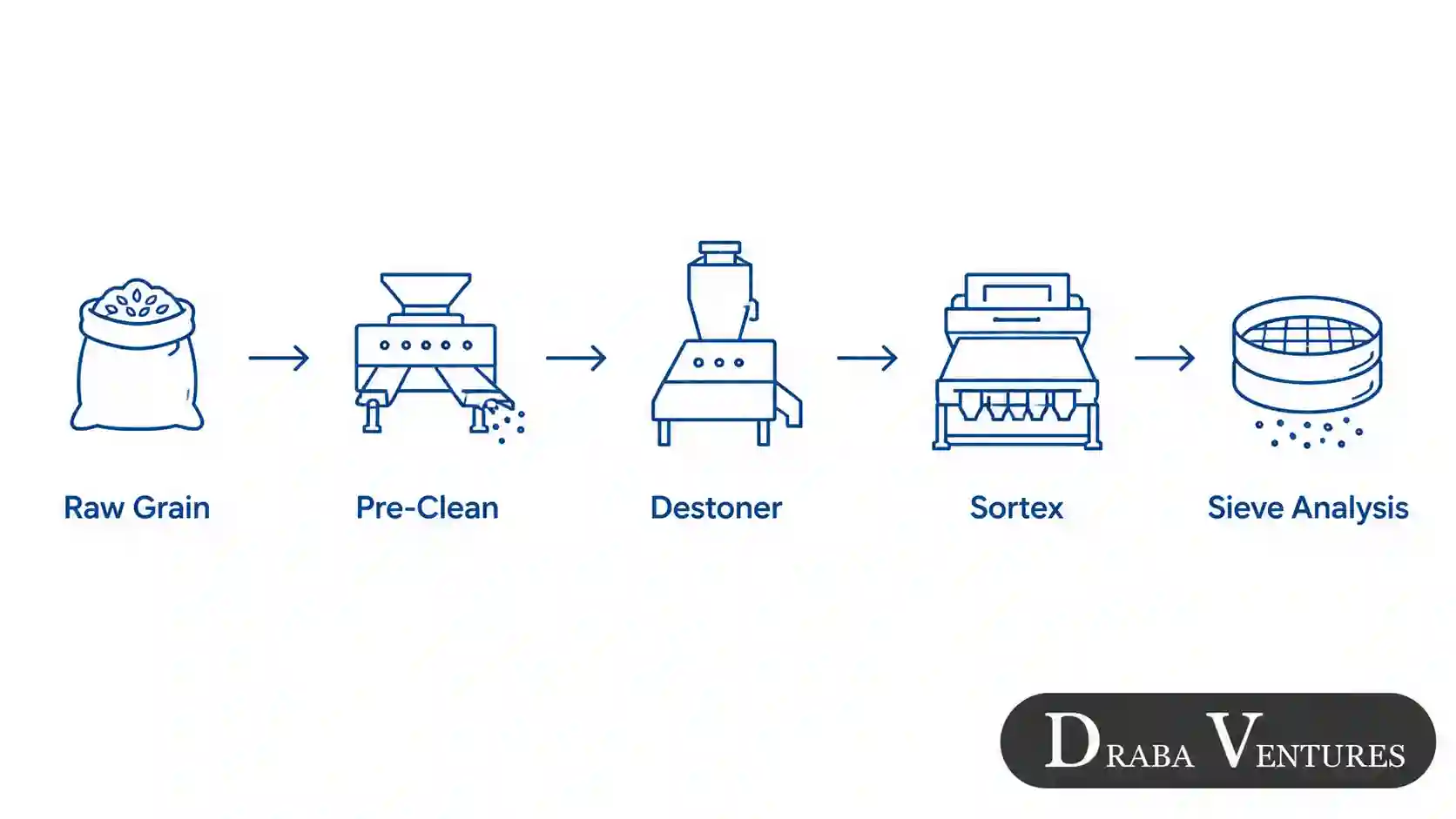
What Sortex-Cleaned Sorghum Means
Optical sorting, widely known as Sortex cleaning, is the gold standard for high-purity agricultural exports. In this process, raw sorghum grains are fed into high-speed optical sorting machines where advanced industrial cameras scan each grain mid-air. Grains that display discoloration, mold, insect damage, or surface defects are instantly detected and separated from the main stream by precise air jets, ensuring an output purity of up to 99.9%.
For international food processors and starch manufacturers, sortex-cleaned sorghum minimizes the risk of foreign matter contamination in the final product line. Standard machine-cleaned grains might look acceptable at a glance, but optical sorting is what removes hidden defects like black-spotted seeds or ergot-affected grains that manual inspection misses.
Cleaning Line Stages
Before sorghum reaches the optical sorter, it must pass through a multi-stage mechanical cleaning line. The first stage involves pre-cleaners and scalpers that screen out large foreign elements like sticks, straw, and stalks. Next, destoners utilize air flow and deck vibration to separate heavy stones, pebbles, and mud balls that match the grain size but differ in density.
The grain then moves to gravity separators, which sort the sorghum by weight, lifting out lightweight chaff, shriveled kernels, and empty hulls. Finally, magnetic separators extract any trace metal contaminants before the polished grain is routed to the Sortex machines for the final color and defect sorting step.
Sieve Size and Particle Separation
Sieve analysis is essential to calibrate grain size uniformity and meet strict buyer specifications. Sorghum grains typically range between 3.0mm and 4.5mm in diameter. Mechanical grading decks equipped with precise round-hole screens are calibrated to separate undersized, broken, or immature grains from the bulk lot.
A typical export sieve configuration might use a 3.5mm top screen to capture oversized particles and a 2.5mm bottom screen to filter out dust and small broken fragments. Importers should specify the minimum screen retention percentage (e.g., 95% retention on a 3.0mm screen) in their technical sheets to ensure process compatibility at their milling or brewing plants.
Broken Grain and Foreign Matter Tolerance
Export contracts dictate specific allowances for non-standard material. Standard commercial grades for Indian sorghum generally permit a maximum of 2% to 3% broken grains and less than 1% total foreign matter (admixture). Food-grade contracts are even stricter, often demanding foreign matter below 0.5%.
Importers should confirm how these tolerances are measured. Sieve analysis and hand-picking tests should be performed on representative samples taken from multiple points of the lot. Any deviation beyond these tolerances can lead to rapid cargo degradation during transit, as broken grains release dust and promote moisture retention.
Export Inspection Checklist
A reliable pre-shipment quality inspection is the buyer's ultimate safeguard. Importers should mandate independent inspection agencies like SGS or Intertek to perform onsite verification. The inspection checklist must include container cleanliness reviews to verify that no moisture or previous cargo residues exist.
Inspectors must also perform composite sampling during container loading, running physical tests for moisture content, screen-size distribution, and foreign matter. The inspector's final certificate should match the contracted limits, providing physical proof of Sortex sorting and cleanliness before the vessel departs.
Lab Report Fields Buyers Should Request
A comprehensive laboratory analysis report should accompany every sorghum cargo. Key fields that buyers must request include: Moisture Content (ideally under 14% to prevent mold), Physical Purity (percentage of sound grains), Admixture (organic and inorganic foreign matter), and count of Weevilled or damaged grains per 100g sample.
Furthermore, food-grade shipments require testing for chemical parameters such as aflatoxin levels (typically restricted to less than 10 ppb or 20 ppb depending on the importing nation's food safety authority) and heavy metal residues, ensuring full compliance with destination-port health regulations.
Buyer Reference Table
| Buyer check | Target wording | Why it matters |
|---|---|---|
| Moisture | <=14% unless buyer specifies otherwise | Controls storage and cargo risk |
| Broken grains | 2-5% tolerance by contract | Affects processing and visual grade |
| Foreign matter | Low, measurable percentage | Protects food/feed processing lines |
| Inspection | Lot-specific before loading | Prevents disputes at destination |
Procurement Checklist Before You Ask for PI
- Confirm whether the cargo is white, yellow, red or feed-grade sorghum.
- State the end use: brewery, poultry feed, food processing, starch, distribution or industrial use.
- Ask for moisture, broken percentage, foreign matter, admixture and infestation status in writing.
- Confirm bag size, bag type, marking, container payload and shipment month.
- Request the expected document set before payment terms are finalized.
- Verify HS code, destination rules and importer obligations with your customs broker.
Always confirm grade, packing, shipment month and document requirements in writing before requesting a Proforma Invoice. Draba Ventures responds to structured RFQs with a detailed FOB or CIF quote within 24 hours.
Internal Authority Links
Frequently Asked Questions
What is the main buying decision in Sortex Cleaning and Sieve Analysis for Sorghum Export?
What should an importer include in a sorghum RFQ?
Which HS code should buyers use for sorghum imports?
Can Draba Ventures quote FOB and CIF sorghum shipments?
How does this page avoid keyword cannibalization?
Request a Sorghum Export Quote from Draba Ventures
Send product grade, quantity in MT, destination port, preferred Incoterm, payment preference and target shipment window. Our team will respond with a structured FOB or CIF quote.
Request a QuoteHS code note: this page uses 10070090 as the working sorghum trade entity. Final classification should be checked with the buyer's customs broker before import filing.
