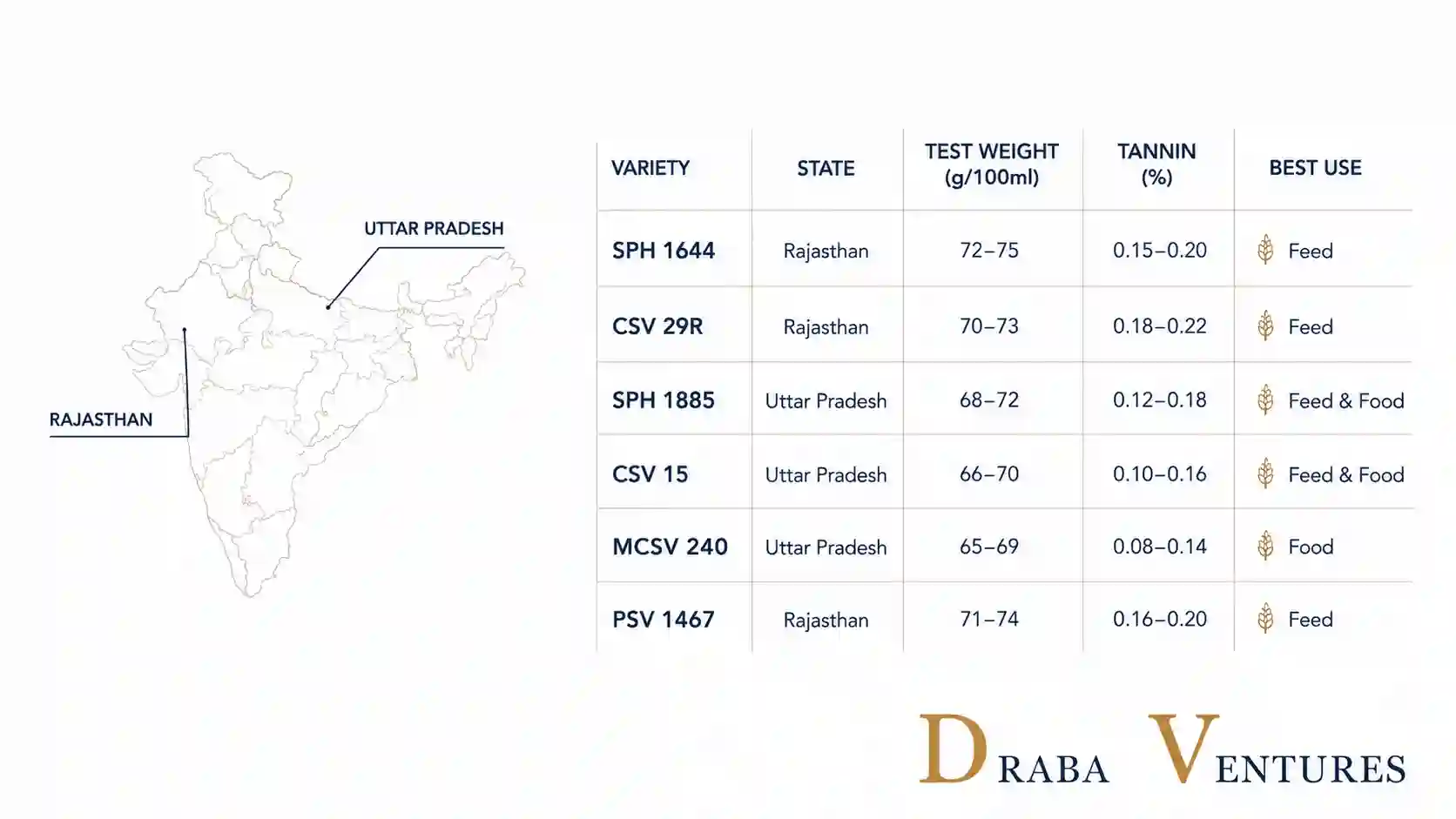
Rajasthan and Uttar Pradesh are emerging sorghum sourcing zones for Indian exporters, offering large aggregation volumes of white and mixed-grade grain during the Kharif season (October-December). This guide identifies the key varieties available from these northern states, the quality profile buyers should expect compared to Karnataka or Maharashtra origin, and which end-use markets they are best suited for.
Rajasthan and UP sorghum varieties: CSV-15, HC-308 and local Jowar varieties are common. Kharif crop; moisture levels can be higher (13-14.5%) at harvest due to monsoon proximity. Bulk density typically 680-720 g/L - lower than Karnataka Rabi. Best suited for feed and industrial applications; less consistent for premium food-grade or brewery specification.
Ready to Import Indian Sorghum?
Get an instant FOB and CIF cost estimate including shipping and insurance.
Why White Sorghum Origin Matters
White sorghum sourcing is highly dependent on geographic origin because soil quality, climate patterns, and agricultural practices shape the grain's chemical and physical characteristics. In India, North and South growing regions present distinct profiles. Sourcing teams looking for food-grade white sorghum must look closely at origin factors like soil fertility, moisture availability during maturity, and local harvest cycles. Understanding these regional variations prevents sourcing mismatched grains that fail destination country standards for size, color, or starch quality.
For buyers, selecting the right origin minimizes processing loss. Grains developed under optimal soil conditions yield higher milling outputs and exhibit lower breakage rates during shipping.
Rajasthan White Sorghum Sourcing Notes
Rajasthan represents a critical source for bold white sorghum (Jowar), particularly from regions like Jaipur, Ajmer, and Tonk. Due to the semi-arid climate and sandy loam soils, Rajasthan white sorghum exhibits low moisture content, typically under 12%, which reduces the risk of post-harvest mold and aflatoxin contamination. Sourcing from these belts requires working with local mandis where grain aggregation happens quickly post-harvest. Buyers should look for milky-white grains that have a firm endosperm, which are highly desired for processing.
Due to the dryness of the region, the grains naturally undergo optimal sun-drying, resulting in an appealing creamish-white luster that meets export aesthetics.
Uttar Pradesh White Sorghum Sourcing Notes
Uttar Pradesh, particularly the southern districts bordering Madhya Pradesh (such as Bundelkhand, Jhansi, and Hamirpur), is another major white sorghum cultivation zone. The alluvial and mixed soils of UP provide a nutrient-rich foundation, yielding grains with a high starch content. Sourcing teams must pay close attention to drying practices since post-harvest humidity levels can vary. Sourcing early in the post-harvest cycle ensures the grain preserves its natural bright color and does not develop weathering streaks.
Sourcing from UP is highly cost-effective for bulk contracts, provided the supplier operates dedicated mechanical drying facilities to stabilize moisture levels below 13%.
Appearance and Color Consistency
For international food processing buyers, grain appearance is a paramount quality criteria. Standard white sorghum contracts should specify a minimum of 98% color purity. White sorghum from Rajasthan and UP can sometimes get mixed with off-colored, yellow, or weathered grains during mandi aggregation. Exporters must utilize advanced color sorting (Sortex) technology to eliminate stained, moldy, or off-color kernels, ensuring the batch meets premium food-grade export requirements for consistency.
Color consistency is not just visual; it indicates uniform seed maturity, which ensures predictable cooking and milling behaviors during manufacturing.
Food and Milling Suitability
Milling performance is directly tied to the hardness of the sorghum endosperm. Rajasthan white sorghum varieties generally have a semi-hard to hard endosperm, yielding high flour recovery rates and excellent dough elasticity. UP varieties, with slightly softer endosperms, are highly suited for industrial starch conversion and flake manufacturing. Sourcing companies must match the grain's physical hardness and starch profile to the buyer's processing machinery to prevent high starch damage during milling.
We analyze the protein-to-starch ratio of each batch, certifying suitability for gluten-free flour blending before container loading.
Sample Approval Before Contracting
Given the decentralized nature of sorghum aggregation in North India, buyers should never finalize contracts without a physical sample approval. Mandis aggregate sorghum from multiple smallholders, creating variations in grain size and weight. Sourcing teams must request a representative pre-shipment sample (PSS) drawn from the actual aggregated lot. The PSS must be verified for bulk density, moisture, and grain size distribution to ensure the shipment matches the agreed purchase specifications.
Once the PSS is approved, it serves as the reference standard for the third-party pre-shipment inspection (such as SGS or Intertek) at the port of loading.
Buyer Reference Table
| Origin factor | Procurement relevance | Buyer action |
|---|---|---|
| Harvest window | Determines availability and freshness | Plan inquiry timing |
| Aggregation | Controls repeat supply | Confirm FCL capacity |
| Cleaning access | Improves export consistency | Request process details |
| Sample approval | Verifies real lot profile | Approve before PI |
Procurement Checklist Before You Ask for PI
- Confirm whether the cargo is white, yellow, red or feed-grade sorghum.
- State the end use: brewery, poultry feed, food processing, starch, distribution or industrial use.
- Ask for moisture, broken percentage, foreign matter, admixture and infestation status in writing.
- Confirm bag size, bag type, marking, container payload and shipment month.
- Request the expected document set before payment terms are finalized.
- Verify HS code, destination rules and importer obligations with your customs broker.
Always confirm grade, packing, shipment month and document requirements in writing before requesting a Proforma Invoice. Draba Ventures responds to structured RFQs with a detailed FOB or CIF quote within 24 hours.
Internal Authority Links
Frequently Asked Questions
What is the main buying decision in White Sorghum Varieties in Rajasthan and Uttar Pradesh for Export Sourcing?
What should an importer include in a sorghum RFQ?
Which HS code should buyers use for sorghum imports?
Can Draba Ventures quote FOB and CIF sorghum shipments?
How does this page avoid keyword cannibalization?
Request a Sorghum Export Quote from Draba Ventures
Send product grade, quantity in MT, destination port, preferred Incoterm, payment preference and target shipment window. Our team will respond with a structured FOB or CIF quote.
Request a QuoteHS code note: this page uses 10070090 as the working sorghum trade entity. Final classification should be checked with the buyer's customs broker before import filing.
