West Africa imports Indian sorghum through several major ports - Dakar (Senegal), Abidjan (Côte d'Ivoire), Tema (Ghana), Cotonou (Benin) and Lomé (Togo) - each with different customs clearance procedures, phytosanitary requirements and import duty structures. Failing to prepare the correct document set for the specific country of entry can result in 7-21 days of port detention and significant demurrage costs. This guide gives importers and logistics teams the country-specific compliance requirements for West African sorghum imports from India.
West Africa sorghum import compliance: ECOWAS Common External Tariff (CET) applies 5% import duty on sorghum (HS 10070090) across most member states. Phytosanitary certificate from India NPPO required by all. Fumigation certificate (methyl bromide or phosphine) required at all West African ports. Nigeria: NAFDAC pre-import notification for human food use. Côte d'Ivoire: FIRCA quality control inspection at port of arrival.
Ready to Import Indian Sorghum?
Get an instant FOB and CIF cost estimate including shipping and insurance.
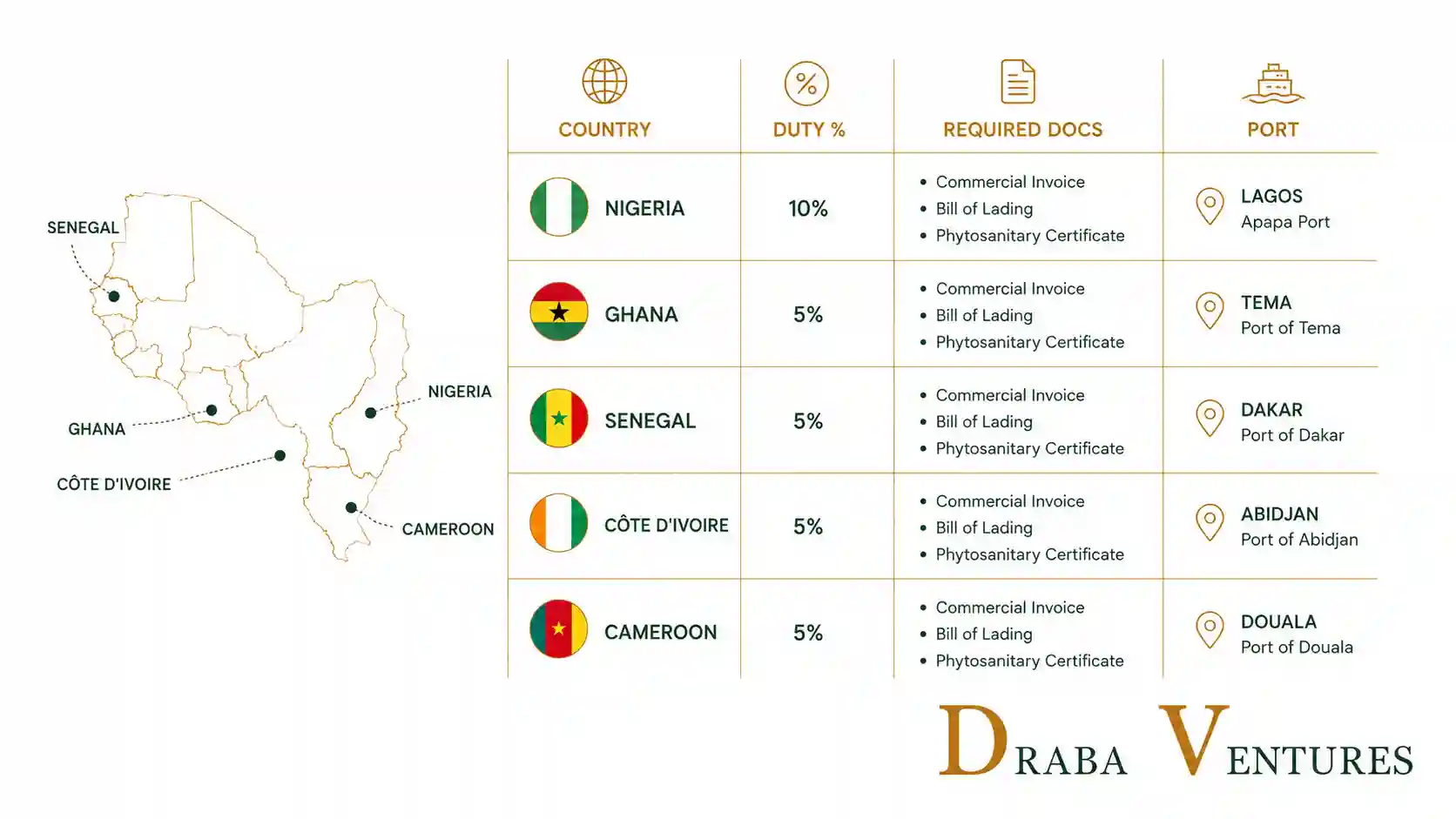
West Africa Import Documentation Stack
Importers bringing sorghum into West African ports (such as Dakar, Abidjan, Tema, Lomé, Cotonou, or Lagos) must comply with complex pre-shipment and customs clearance documentation. Sourcing agricultural commodities from India requires a highly organized document stack to prevent administrative delays at discharge. The primary export documents required from the Indian supplier include the Commercial Invoice, Packing List, and Bill of Lading. However, agricultural compliance dictates that the shipper also provide an official Phytosanitary Certificate issued by India’s National Plant Protection Organization (NPPO) and a Fumigation Certificate certifying phosphine or methyl bromide treatment to confirm the grain is pest-free.
In addition to standard trade papers, many West African countries mandate an Electronic Cargo Tracking Note (ECTN), also known as Bordereau de Suivi de Cargaison (BSC) or Bordereau d’Identification de Cargaison (BIC), which must be validated prior to vessel departure. Sourcing teams should ensure that all certificates are submitted in draft form for importer approval before cargo loading commences.
ECOWAS Corridor Considerations
The Economic Community of West African States (ECOWAS) maintains trade agreements designed to facilitate the free movement of goods across its fifteen member states. For sorghum importers, this is highly relevant when cargo lands at coastal ports like Cotonou (Benin) or Abidjan (Côte d'Ivoire) but is destined for landlocked markets like Mali, Burkina Faso, or Niger. Under the ECOWAS Trade Liberalization Scheme (ETLS), transit grain shipments are exempt from certain domestic import duties of the transit country, provided the cargo is accompanied by a compliant Inter-State Road Transit (ISRT) declaration.
Importers must ensure that transport operators utilize bonded trucks and that transit documentation is meticulously prepared. Discrepancies in border paperwork can lead to cargo seizure or forced tax payments at border checkpoints, completely neutralizing the logistical advantages of regional trade corridors.
Destination Port Document Matching
West African customs authorities utilize electronic Single Window systems (such as GUCE or ASYCUDA) to process agricultural shipments. These systems cross-reference shipping documents electronically to identify tax evasion or illegal imports. Consequently, typographical consistency across the document set is not merely preferred-it is mandatory for successful clearance. The description of the commodity, net and gross weights, container numbers, seal numbers, and buyer registration details must align exactly across all certificates.
If the Phytosanitary Certificate lists the cargo as "Indian White Jowar" while the Bill of Lading reads "Feed Sorghum," the customs system will flag the shipment. Correcting such errors post-arrival requires issuing amended certificates in India, which can take weeks and result in thousands of dollars in port demurrage fees.
Certificate Consistency Across the File
Customs officials pay close attention to dates and official seals on sanitary certificates. The Phytosanitary Certificate must be dated prior to the Bill of Lading shipped-on-board date, verifying that the grain was inspected before departure. Similarly, the Fumigation Certificate must detail the fumigant dosage, temperature, and exposure time, matching the date of container packing.
Importers should establish a verification checklist with the exporter. Reviewing drafts of all certificates, checking name spellings, verifying HS code alignment (specifically HS code 10070090), and cross-checking container seal numbers are simple steps that ensure zero delays when the cargo arrives at the destination port.
Customs Broker Coordination
Sorghum import clearance in West Africa cannot be executed without a registered, licensed customs broker. Given the frequent updates in national customs regulations and tariff structures, importers must engage their broker before the vessel leaves the loading port in India. Providing the broker with advanced copies of the Bill of Lading, invoice, and quarantine certificates allows them to file the pre-declaration and secure any necessary import permits from regional ministries of agriculture.
Furthermore, local brokers can advise on potential tax exemptions or reduced agricultural import VAT rates, helping importers optimize their landed costs and establish structured pricing structures for domestic resale.
Cross-Border Distribution Compliance
Once customs clearance is completed at the primary ocean port, onward overland distribution requires additional compliance steps. Trucking routes across the Sahelian corridors are subject to strict axle-load limits and national security checks. Drivers must carry certified copies of the customs release note, transit declarations, and veterinary/phytosanitary clearance stamps.
By coordinating with experienced logistics providers who understand cross-border compliance, sorghum importers can ensure their grain is delivered to inland warehouses or feed mills safely, maintaining quality and avoiding costly transit interruptions.
Buyer Reference Table
| Compliance item | Buyer confirmation | Evidence |
|---|---|---|
| Importer registration | Is buyer licensed for grain import? | Local registration or broker confirmation |
| Certificate set | Which documents are mandatory? | Destination checklist |
| Labeling | Is local language required? | Artwork or label approval |
| Port process | Who files and clears? | Broker instruction sheet |
Procurement Checklist Before You Ask for PI
- Confirm whether the cargo is white, yellow, red or feed-grade sorghum.
- State the end use: brewery, poultry feed, food processing, starch, distribution or industrial use.
- Ask for moisture, broken percentage, foreign matter, admixture and infestation status in writing.
- Confirm bag size, bag type, marking, container payload and shipment month.
- Request the expected document set before payment terms are finalized.
- Verify HS code, destination rules and importer obligations with your customs broker.
Always confirm grade, packing, shipment month and document requirements in writing before requesting a Proforma Invoice. Draba Ventures responds to structured RFQs with a detailed FOB or CIF quote within 24 hours.
Internal Authority Links
Frequently Asked Questions
What is the main buying decision in West Africa Sorghum Import Compliance Guide?
What should an importer include in a sorghum RFQ?
Which HS code should buyers use for sorghum imports?
Can Draba Ventures quote FOB and CIF sorghum shipments?
How does this page avoid keyword cannibalization?
Request a Sorghum Export Quote from Draba Ventures
Send product grade, quantity in MT, destination port, preferred Incoterm, payment preference and target shipment window. Our team will respond with a structured FOB or CIF quote.
Request a QuoteHS code note: this page uses 10070090 as the working sorghum trade entity. Final classification should be checked with the buyer's customs broker before import filing.
