Nigeria is India's largest single market for sorghum exports, driven by the country's substantial brewery industry and a growing livestock feed sector. Nigerian buyers - particularly brewery procurement teams and feed manufacturers - have specific grade requirements, unique regulatory clearance steps (NAFDAC for food-grade) and established payment preferences that differ significantly from Gulf or Asian buyers. This guide gives Indian exporters and Nigerian importers the full picture of what a compliant, efficient India-Nigeria sorghum shipment looks like.
India-Nigeria sorghum trade in 2026: white low-tannin jowar for brewery use (aflatoxin ≤10 μg/kg, NAFDAC compliant); yellow/mixed grade for poultry and livestock feed. Transit time from Indian ports to Apapa (Lagos): 18-22 days. Nigerian import duty: 5% CET + 7% VAT. NAFDAC pre-import notification required for human food-grade shipments. Payment: LC at sight recommended for first shipments.
Ready to Import Indian Sorghum?
Get an instant FOB and CIF cost estimate including shipping and insurance.
Nigeria Demand Structure for Sorghum
Nigeria is one of Africa's largest grain consumers, and while local production exists, rapid industrialization has created a substantial supply gap. Sorghum is highly valued due to its drought resilience and adaptability. Large industrial consumers (especially in food processing, livestock feed, and beverage production) look to import premium Indian sorghum to bridge domestic production shortages and maintain raw material buffers.
Additionally, local supply lines can be highly fragmented and subject to seasonal shortages. By establishing direct import corridors from reliable suppliers in India, Nigerian processors can secure bulk, year-round access to consistent grain grades, keeping their processing lines active even during local crop shortfalls.
Brewery Procurement Requirements
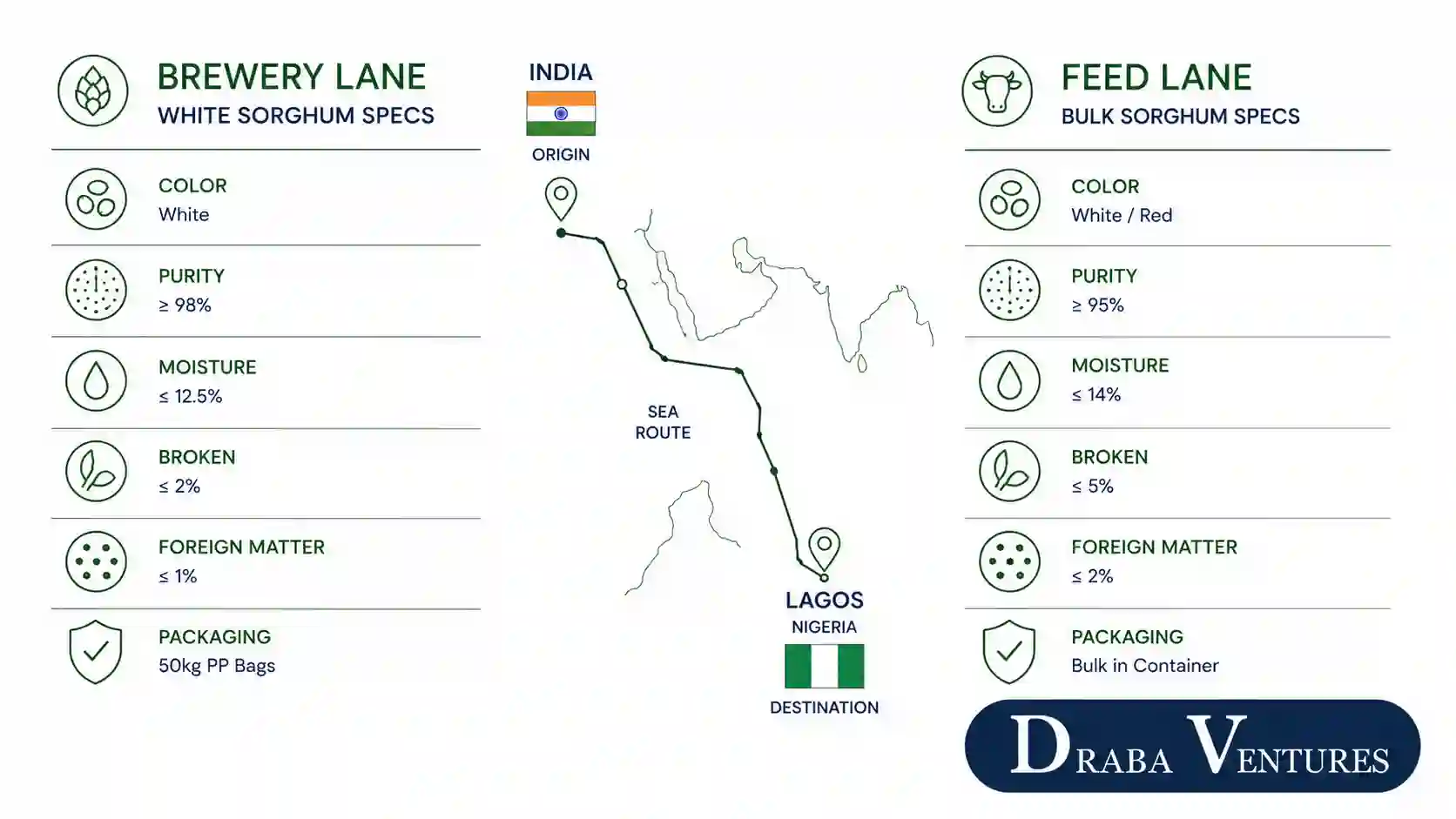
In Nigeria, the beverage sector has largely shifted toward local sourcing and grains like sorghum to substitute imported barley malt. For malting and brewing, buyers require white sorghum with high starch content, low tannin levels (under 0.5% to avoid astringent flavors and haze), high germination rates (above 90%), and moisture content below 12-13% to ensure stable storage and malt yield.
Breweries should run their own process approval because starch conversion, milling behavior and batch consistency matter more than a generic grain description. Establishing pre-shipment grain moisture checks and verifying starch solubility helps ensure compatibility with established brewing equipment.
Feed Mill Buying Preferences
Nigerian poultry and aquaculture sectors are growing rapidly. Feed manufacturers prefer sorghum as a key energy source to replace expensive yellow maize. Procurement managers seek white or yellow sorghum varieties with high crude protein content (around 9-11%), low tannin (to prevent digestive enzyme inhibition in poultry), and strict limits on aflatoxin (under 10-20 ppb) to safeguard flock health.
Feed mills should compare sorghum by formulation value, grinding behavior and repeat supply. A lower grain price is not useful if ration performance becomes inconsistent. Working with APEDA-registered exporters who conduct regular testing guarantees that feed-grade sorghum meets nutritional tolerances.
Lagos Port and Import Document Considerations
Importing grain into Nigeria through Apapa or Tin Can Island ports in Lagos requires strict regulatory compliance. Buyers must secure a Form M and clear NAFDAC (National Agency for Food and Drug Administration and Control) requirements. Exporters must provide a Clean Certificate of Inspection, Phytosanitary Certificate, Fumigation Certificate, and an APEDA-approved laboratory report to prevent customs holding.
Ensuring that the consignee details, container numbers, and seal records match precisely across all packing lists and bills of lading is crucial. Any spelling error or numerical discrepancy can result in long customs delays at the port, leading to high demurrage fees that impact the cargo's final landing cost.
Pre-Shipment Inspection Expectations
Pre-shipment inspections are standard practice for Nigerian imports to verify quality, quantity, and loading practices. Independent surveyors like SGS, Bureau Veritas, or Intertek sample the grain at origin (in India) to verify pesticide residue limits, moisture levels, grain purity, and load weights. This origin certification helps fast-track clearance upon arrival in Lagos.
Importers should establish clear quality parameters in their purchase agreements, authorizing surveyor verification before loading. Having the inspection report issued at the loading port gives Nigerian banks and customs officials the necessary proof of import compliance before the vessel arrives.
How Nigerian Buyers Should Structure RFQs
When importing from India, buyers should structure their Requests for Quotation (RFQs) with precise details. This includes specifying the exact sorghum type (white vs yellow/feed-grade), intended industrial application (malting vs animal feed), packaging format (typically 50kg PP bags or bulk container liners), destination port (Lagos Apapa/Tin Can), target delivery timeline, and preferred payment terms (e.g., Letter of Credit or CAD).
By providing structured specifications early, Indian exporters can quote precise FOB India or CIF Lagos terms, accounting for local cleaning processing, fumigation treatments, port paperwork, and container shipping rates during high-demand shipping windows.
Buyer Reference Table
| Compliance item | Buyer confirmation | Evidence |
|---|---|---|
| Importer registration | Is buyer licensed for grain import? | Local registration or broker confirmation |
| Certificate set | Which documents are mandatory? | Destination checklist |
| Labeling | Is local language required? | Artwork or label approval |
| Port process | Who files and clears? | Broker instruction sheet |
Procurement Checklist Before You Ask for PI
- Confirm whether the cargo is white, yellow, red or feed-grade sorghum.
- State the end use: brewery, poultry feed, food processing, starch, distribution or industrial use.
- Ask for moisture, broken percentage, foreign matter, admixture and infestation status in writing.
- Confirm bag size, bag type, marking, container payload and shipment month.
- Request the expected document set before payment terms are finalized.
- Verify HS code, destination rules and importer obligations with your customs broker.
Always confirm grade, packing, shipment month and document requirements in writing before requesting a Proforma Invoice. Draba Ventures responds to structured RFQs with a detailed FOB or CIF quote within 24 hours.
Internal Authority Links
Frequently Asked Questions
What is the main buying decision in Sorghum Export from India to Nigeria: Brewery and Feed Market Guide?
What should an importer include in a sorghum RFQ?
Which HS code should buyers use for sorghum imports?
Can Draba Ventures quote FOB and CIF sorghum shipments?
How does this page avoid keyword cannibalization?
Request a Sorghum Export Quote from Draba Ventures
Send product grade, quantity in MT, destination port, preferred Incoterm, payment preference and target shipment window. Our team will respond with a structured FOB or CIF quote.
Request a QuoteHS code note: this page uses 10070090 as the working sorghum trade entity. Final classification should be checked with the buyer's customs broker before import filing.
