The UAE imports Indian sorghum primarily for poultry feed, livestock feed and re-export to neighbouring GCC markets. UAE feed importers operate under MOAF (Ministry of Climate Change and Environment) regulations and require specific phytosanitary and fumigation documentation that differs from standard Indian export practice. This guide gives feed procurement teams in the UAE and their Indian suppliers the compliance requirements, port clearance process and grade specifications for efficient sorghum import through Jebel Ali and Khalifa Port.
India-UAE sorghum import: MOAF registration required for feed-grade sorghum. Phytosanitary certificate from India NPPO, fumigation certificate (phosphine preferred), aflatoxin test report (B1 ≤5 μg/kg for feed), certificate of origin mandatory. Transit time Mundra to Jebel Ali: 5-7 days. Import duty: 5% GCC CET. Payment: TT 30% advance + 70% against BL copy is standard for established UAE buyers.
Ready to Import Indian Sorghum?
Get an instant FOB and CIF cost estimate including shipping and insurance.
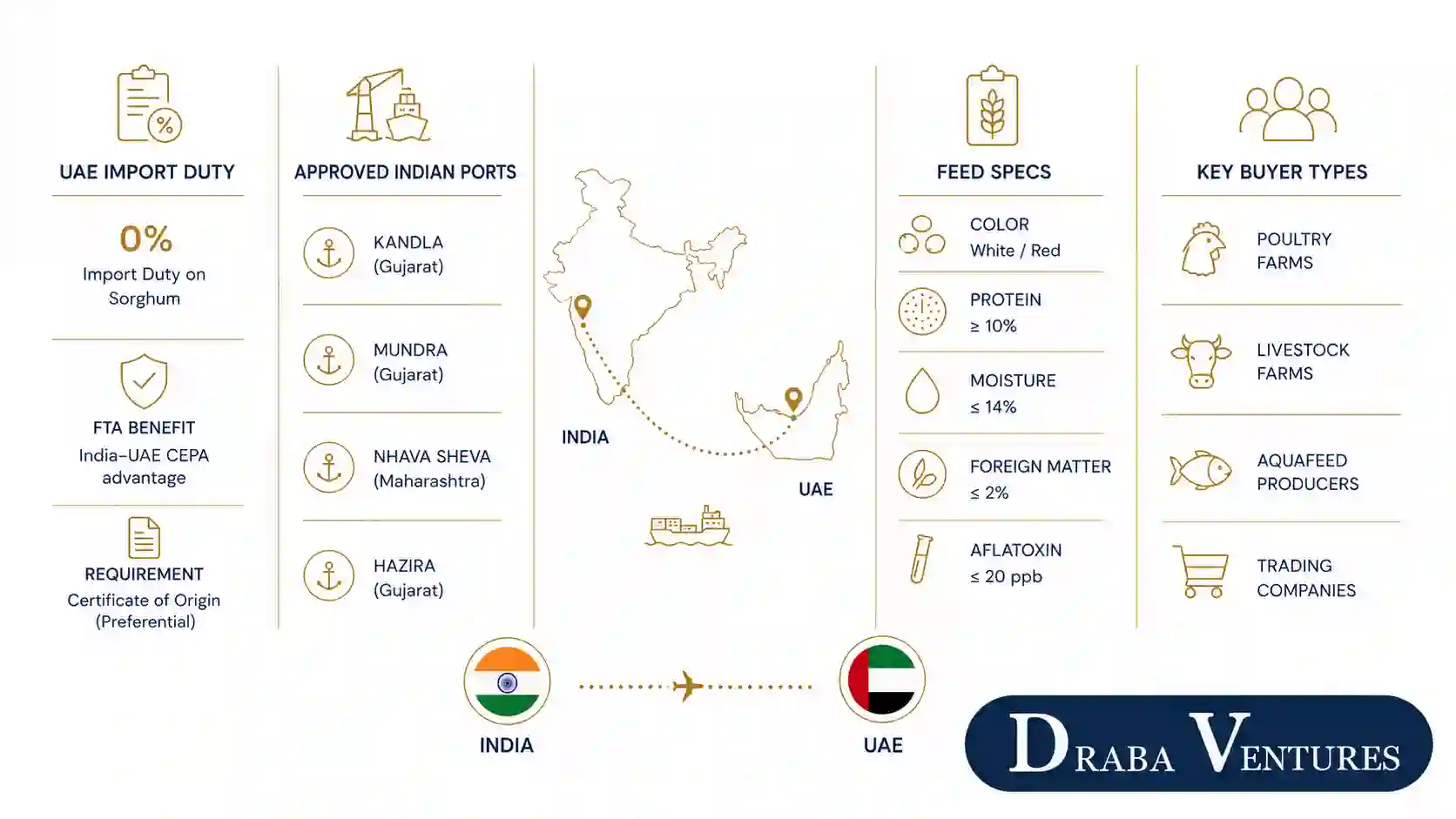
UAE Feed Demand Context
The United Arab Emirates is seeing a massive surge in demand for high-quality livestock, poultry, and camel feed. Driven by national food security strategies like the UAE National Food Security Strategy 2051, local feed mill operators in Al Ain, Dubai, and Abu Dhabi are constantly seeking cost-effective, high-nutrient grain alternatives. Indian sorghum (commonly known as Jowar) has emerged as an excellent bulk energy source, offering nutritional profiles comparable to corn and barley while requiring significantly less water to cultivate. As feed producers seek to insulate themselves from volatile global corn pricing, importing sorghum from India has transitioned from an occasional purchase to a core procurement strategy for UAE grain importers and livestock companies.
Importers must align their feed formulation goals with the exact variety of Indian sorghum being sourced. While yellow sorghum is highly prized in poultry rations for its carotenoid content which enhances yolk color, white sorghum is extensively utilized in general livestock feed, particularly for dairy cattle and camels, due to its excellent digestibility and neutral flavor profile. Understanding these specific UAE demand drivers allows importers to contract for the right variety and grade, avoiding costly formulation adjustments at destination feed mills.
Feed-Grade Specification Expectations
For animal feed applications, grain specifications dictate not only the price but also the performance of the feed ration. UAE feed manufacturers maintain strict quality parameters to ensure optimal animal health and mill efficiency. When importing sorghum from India, the industry-standard specifications typically include:
- Moisture Content: Maximum 12% to 13%. Controlling moisture is critical to preventing mold growth and mycotoxin development during transit and subsequent warehouse storage in hot GCC climates.
- Crude Protein: Minimum 9% to 11% on a dry matter basis, which provides a reliable amino acid profile for poultry and ruminant rations.
- Tannin Content: Ideally low-tannin white or yellow varieties (below 0.5% tannin). High-tannin sorghum can reduce feed intake and protein digestibility in poultry, making low-tannin verification a priority for feed nutritionists.
- Foreign Matter / Admixture: Maximum 1.5% to 2.0%. Minimizing straw, stones, and weed seeds protects feed mill grinding machinery and ensures consistent nutritional density.
- Aflatoxin Levels: Strictly maximum 20 ppb (parts per billion), conforming to GSO (GCC Standardization Organization) standards. Importers must require independent third-party analysis (e.g., SGS or Intertek) at the loading port to verify compliance.
Jebel Ali Import Planning
Jebel Ali Port in Dubai serves as the premier gateway for grain shipments into the UAE and the wider GCC region. Sourcing sorghum from India's west coast ports, such as Mundra, Kandla, or Pipavav, offers a major geographic advantage: transit times are extremely short, typically ranging from 4 to 7 days. This rapid transit minimizes the duration the grain spends in closed containers, significantly reducing the risks of container sweat, moisture migration, and heat build-up. However, efficient logistics require meticulous planning and close coordination with local clearing agents.
Importers must secure an import permit from the UAE Ministry of Climate Change and Environment (MOCCAE) before the vessel departs the Indian loading port. Upon arrival at Jebel Ali, the consignment undergoes inspection by quarantine officials. Having pre-arranged customs brokers who understand agricultural imports is vital to securing quick customs release, avoiding costly container demurrage and port storage charges, and maintaining the cold-chain or dry-chain integrity of the feed supply line.
Arabic Labeling and Document Notes
Clearance of agricultural cargo at UAE ports is strictly contingent on document compliance. Under UAE customs regulations, all imported feed cargo must be accompanied by a standardized set of documentation. Any discrepancy between the commercial invoice, phytosanitary certificate, and the bill of lading can lead to immediate quarantine holds or rejection of the cargo.
The mandatory document package includes:
- Phytosanitary Certificate: Issued by the National Plant Protection Organization (NPPO) of India, certifying that the sorghum is free from quarantine pests.
- Fumigation Certificate: Documenting treatment with methyl bromide or phosphine prior to loading, ensuring the grain is free from live insect infestation.
- Certificate of Origin: Attested by the Chamber of Commerce or an authorized agency in India.
- Arabic and English Product Labeling: For sorghum shipped in 50kg PP bags or jumbo bags, labels must clearly state the product name, country of origin, importer details, net weight, batch number, production date, and expiry date in both Arabic and English to comply with municipal inspection rules.
GCC Climate Implications for Storage
The Arabian Peninsula’s extreme weather-with summer temperatures regularly exceeding 45°C alongside high relative humidity-poses a severe challenge for grain storage. Sorghum is a biological commodity that remains active post-harvest; high temperatures accelerate respiration, leading to heating, moisture relocation, and rapid grain spoilage. Under these conditions, standard flat-storage warehouses without ventilation can turn into incubators for mold, leading to rapid aflatoxin spikes and rendering the feed toxic to livestock.
To mitigate these risks, UAE importers must utilize temperature-controlled silos or modern, well-ventilated dry warehouses. Sacks should be stacked on pallets away from direct contact with concrete floors and walls to prevent moisture absorption. Regular temperature monitoring, moisture checks, and professional pest control protocols are essential to preserving the nutritional value and safety of the imported sorghum during its storage life in the GCC.
RFQ Checklist for UAE Feed Buyers
To receive accurate, actionable quotes from Indian exporters like Draba Ventures, UAE procurement teams should compile structured Requests for Quotations (RFQs). Providing precise requirements reduces negotiation time and ensures that the final Proforma Invoice aligns with local customs requirements. When submitting an RFQ, ensure you specify:
- Sorghum Variety and Grade: Specify whether you require white sorghum (Jowar) or yellow sorghum, and outline your target moisture, protein, and tannin limits.
- Packaging Requirements: Define if the cargo should be packed in 50kg single/double PP bags, 1 MT jumbo bags, or loaded in bulk within the container.
- Shipping Terms (Incoterms): Clearly state if you require FOB India or CIF Jebel Ali / Khalifa Port pricing. If CIF, specify the target shipping line or free-time requirements.
- Inspection Preferences: Nominate your preferred third-party inspection agency (such as SGS, Intertek, or Bureau Veritas) to conduct pre-shipment quality and quantity analysis at the Indian port.
Buyer Reference Table
| Compliance item | Buyer confirmation | Evidence |
|---|---|---|
| Importer registration | Is buyer licensed for grain import? | Local registration or broker confirmation |
| Certificate set | Which documents are mandatory? | Destination checklist |
| Labeling | Is local language required? | Artwork or label approval |
| Port process | Who files and clears? | Broker instruction sheet |
Procurement Checklist Before You Ask for PI
- Confirm whether the cargo is white, yellow, red or feed-grade sorghum.
- State the end use: brewery, poultry feed, food processing, starch, distribution or industrial use.
- Ask for moisture, broken percentage, foreign matter, admixture and infestation status in writing.
- Confirm bag size, bag type, marking, container payload and shipment month.
- Request the expected document set before payment terms are finalized.
- Verify HS code, destination rules and importer obligations with your customs broker.
Always confirm grade, packing, shipment month and document requirements in writing before requesting a Proforma Invoice. Draba Ventures responds to structured RFQs with a detailed FOB or CIF quote within 24 hours.
Internal Authority Links
Frequently Asked Questions
What is the main buying decision in Sorghum Export from India to UAE: Animal Feed Import Guide?
What should an importer include in a sorghum RFQ?
Which HS code should buyers use for sorghum imports?
Can Draba Ventures quote FOB and CIF sorghum shipments?
How does this page avoid keyword cannibalization?
Request a Sorghum Export Quote from Draba Ventures
Send product grade, quantity in MT, destination port, preferred Incoterm, payment preference and target shipment window. Our team will respond with a structured FOB or CIF quote.
Request a QuoteHS code note: this page uses 10070090 as the working sorghum trade entity. Final classification should be checked with the buyer's customs broker before import filing.
