Saudi Arabia requires sorghum importers to register through the SFDA (Saudi Food and Drug Authority) and obtain SABER certification before cargo can clear customs. Exporters and importers who are unfamiliar with this system frequently face port holds, re-inspection costs and delayed customs release. This guide explains what SFDA registration requires, how the SABER platform works, what technical documentation Indian exporters must prepare, and the timeline to expect from registration to first container clearance.
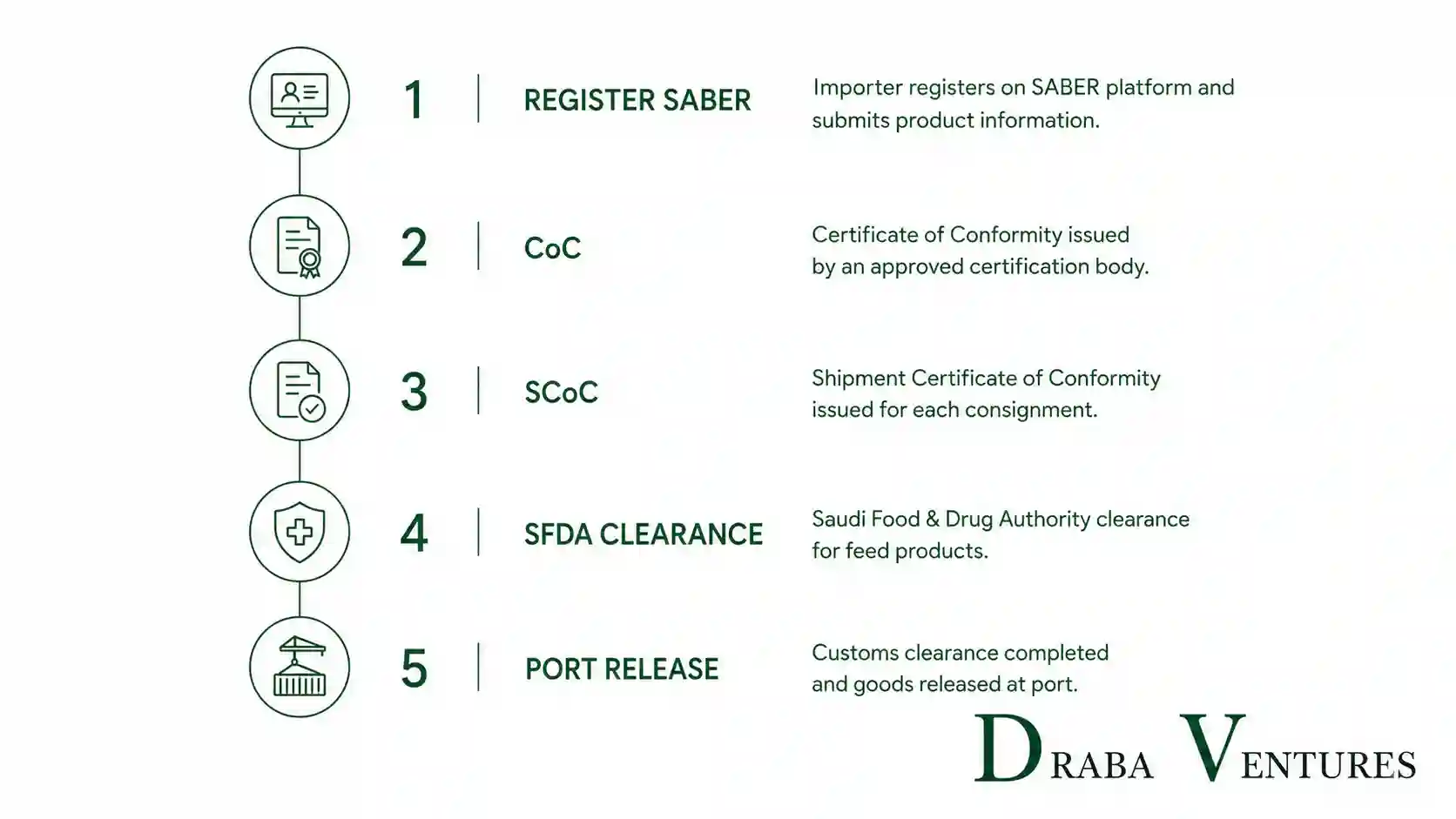
Saudi SFDA/SABER for sorghum imports: SABER registration is required before shipment. The importer registers the product on the SABER platform (sfda.gov.sa); the Indian exporter must provide product specification, health certificate, phytosanitary certificate and aflatoxin test report. First registration typically takes 5-10 business days. Once registered, subsequent shipments from the same exporter clear faster.
Ready to Import Indian Sorghum?
Get an instant FOB and CIF cost estimate including shipping and insurance.
Saudi Import Classification First
Importers sourcing sorghum from India to Saudi Arabia must first address the crucial step of product classification under KSA customs and regulatory frameworks. Sorghum (commonly referred to as Jowar in India) is classified under the primary HS Code 10070090. However, the regulatory path is heavily dictated by the intended end-use of the shipment: whether it is designated for human consumption (food-grade) or livestock feed (feed-grade). The customs clearance workflows, testing protocols, and agency reviews at major ports of entry-such as Jeddah Islamic Port or King Abdulaziz Port in Dammam-diverge significantly based on this distinction. Misdeclaring the product classification can result in immediate border retention or costly re-exportation orders.
Saudi buyers must align with their local customs brokers and secure preliminary approval of the commodity's HS code before the vessel departs India. Food-grade sorghum requires direct screening by the Saudi Food and Drug Authority (SFDA) food sector, whereas raw feed-grade shipments may navigate under feed registration protocols that have distinct moisture, cleanliness, and packaging rules.
SFDA Expectations for Grain Importers
The Saudi Food and Drug Authority (SFDA) enforces strict compliance guidelines for all imported food products to safeguard public health. For sorghum grain imports, SFDA sets rigorous limits on pesticide residues, heavy metals, and mycotoxins. Aflatoxins are a primary focus; the GSO standards enforced by SFDA limit total Aflatoxin contamination to a maximum of 10 ppb (parts per billion), with Aflatoxin B1 restricted to a maximum of 5 ppb for grains intended for direct human consumption. These thresholds require pre-shipment analysis at the loading port in India by accredited third-party inspection firms (e.g., SGS or Intertek).
In addition to chemical standards, SFDA inspectors at Saudi ports will verify the physical purity of the grain. The shipment must be free from live insects, mold, dirt, weed seeds, and animal waste. Importers are required to upload all test reports and clearance documentation to the SFDA electronic portal (Ghad) well in advance of the vessel’s arrival to ensure a smooth administrative review.
SABER Relevance Where Applicable
The SABER platform is the centralized Saudi electronic system designed to register products and issue Certificate of Conformity (CoC) documents. While raw agricultural bulk shipments (like bulk sorghum) are typically regulated directly by the SFDA and may not require standard SASO/SABER conformity certificates, any processed sorghum products (such as sorghum flour, grits, or branded retail packs) must be registered on SABER. Sourcing teams must confirm the registration requirements with their KSA customs broker based on the specific HS classification and packaging format.
If SABER registration is deemed necessary, the importer must initiate the product registration on the portal, selecting an SFDA/SASO-approved certification body to issue the Product Certificate of Conformity (PCoC) and Shipment Certificate of Conformity (SCoC). Draba Ventures coordinates closely with Saudi importers to provide the technical documentation, manufacturing facility details, and test reports required to complete the SABER process without delays.
Arabic Labeling and Product Identity
Labeling compliance is one of the most common reasons for custom clearance delays at KSA ports. SFDA rules stipulate that all product packaging must carry bilingual labels in both Arabic and English. For sorghum shipped in 25kg or 50kg PP bags or jumbo bags, the information must be printed directly on the packaging material or securely stitched into the bag seams. The label must explicitly state: the product name (e.g., "Indian White Sorghum" or "حبوب الذرة البيضاء الهندية"), the country of origin, the exporter name and address, the importer details, the net weight, the production and expiry dates, and the specific batch/lot number.
Temporary stickers, hand-written details, or unstitched labels are strictly prohibited by Saudi port inspectors. Importers must review and approve the labeling artwork during the contract phase. Draba Ventures implements direct bag printing of bilingual labels during the cleaning and packing stage at our processing mills to guarantee absolute compliance with SFDA labeling standards.
Certificate Matching Before Shipment
To avoid administrative holds, KSA customs demands absolute typographical consistency across all shipping certificates. The commercial invoice, packing list, bill of lading, Certificate of Origin, Phytosanitary Certificate, and Fumigation Certificate must align perfectly down to the single character. Discrepancies-such as listing the commodity as "Jowar" on the Phytosanitary Certificate but "Sorghum" on the Bill of Lading-will flag the shipment in the Saudi customs single-window system, delaying clearance.
Furthermore, Saudi customs requires the Certificate of Origin to be attested electronically or through the chamber of commerce. The Phytosanitary Certificate must be dated prior to the shipped-on-board date of the Bill of Lading, verifying that the cargo was inspected before departure. Before the container doors are closed, Draba Ventures shares draft versions of all certificates with the importer's customs broker to guarantee an error-free compliance file.
Questions Saudi Buyers Should Ask Exporters
Procuring sorghum from India requires vetting exporters to ensure they possess the compliance infrastructure needed for Middle Eastern trade. Saudi buyers should include several key questions in their initial evaluation checklist. First: "Is your company registered with APEDA, and do you have a history of successful exports to Saudi ports?" Second: "Can you provide lab certificates verifying Aflatoxin levels below GSO limits from an SFDA-accepted testing laboratory?" Third: "Are you equipped to execute bilingually printed packaging directly at your processing mills?"
Additionally, buyers should ask if the exporter can arrange specialized pre-shipment inspections and coordinate the certificate attestation workflow. A supplier like Draba Ventures, with dedicated compliance teams and direct oversight of the cleaning, bagging, and certification steps, minimizes the risk of port delays, ensuring your shipment arrives on schedule and clears Saudi customs without penalties.
Buyer Reference Table
| Compliance item | Buyer confirmation | Evidence |
|---|---|---|
| Importer registration | Is buyer licensed for grain import? | Local registration or broker confirmation |
| Certificate set | Which documents are mandatory? | Destination checklist |
| Labeling | Is local language required? | Artwork or label approval |
| Port process | Who files and clears? | Broker instruction sheet |
Procurement Checklist Before You Ask for PI
- Confirm whether the cargo is white, yellow, red or feed-grade sorghum.
- State the end use: brewery, poultry feed, food processing, starch, distribution or industrial use.
- Ask for moisture, broken percentage, foreign matter, admixture and infestation status in writing.
- Confirm bag size, bag type, marking, container payload and shipment month.
- Request the expected document set before payment terms are finalized.
- Verify HS code, destination rules and importer obligations with your customs broker.
Always confirm grade, packing, shipment month and document requirements in writing before requesting a Proforma Invoice. Draba Ventures responds to structured RFQs with a detailed FOB or CIF quote within 24 hours.
Internal Authority Links
Frequently Asked Questions
What is the main buying decision in Saudi SFDA and SABER Rules for Sorghum Imports?
What should an importer include in a sorghum RFQ?
Which HS code should buyers use for sorghum imports?
Can Draba Ventures quote FOB and CIF sorghum shipments?
How does this page avoid keyword cannibalization?
Request a Sorghum Export Quote from Draba Ventures
Send product grade, quantity in MT, destination port, preferred Incoterm, payment preference and target shipment window. Our team will respond with a structured FOB or CIF quote.
Request a QuoteHS code note: this page uses 10070090 as the working sorghum trade entity. Final classification should be checked with the buyer's customs broker before import filing.
