Minimum order quantities (MOQ) and annual volume contracts for Indian sorghum work very differently depending on whether you're a first-time importer, a repeat buyer or a large-volume industrial processor. Getting MOQ wrong costs both parties - too low and the economics don't work for the exporter; too high and the buyer takes excess inventory risk. This guide gives importers the real FCL economics, how to structure volume contracts, and what pricing concessions are realistic at different quantity tiers.
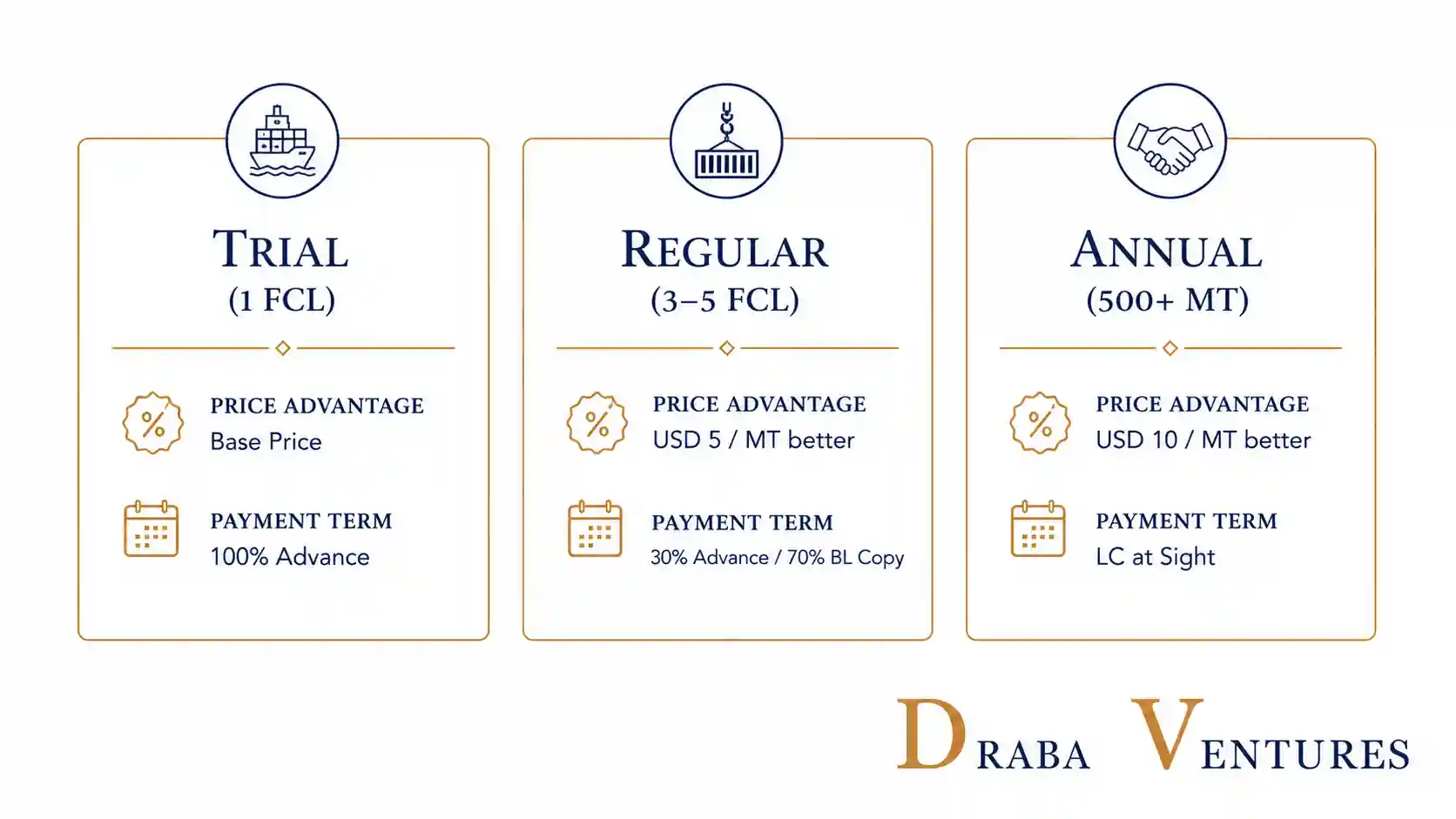
Indian sorghum MOQ in practice: 1 FCL (24-25 MT) is the minimum for a serious quote. 2-5 FCL shipments per quarter qualify for stable pricing agreements. Annual contracts of 500 MT+ (≈20 FCL/year) allow buyers to lock in seasonal prices and secure priority allocation during peak harvest. First-time buyers: start with 1 FCL sample order before committing to annual volumes.
Ready to Import Indian Sorghum?
Get an instant FOB and CIF cost estimate including shipping and insurance.
Minimum Order Quantity in Sorghum Export
Establishing a viable Minimum Order Quantity (MOQ) is essential for aligning cargo volumes with ocean logistics and export terminal handling fees. In containerized Indian sorghum exports, the standard MOQ is 1 Full Container Load (FCL), representing approximately 20 to 24 metric tons depending on the packaging format (such as 50kg PP bags or bulk container liners).
Ordering volumes below this limit raises the per-ton domestic transportation and document compliance costs (e.g., Phytosanitary and Origin certificates) to uncompetitive levels, making smaller parcel shipments economically impractical.
Trial FCL vs Repeat FCL Orders
Sourcing managers frequently structure procurement into a two-phased program. Initially, a trial order of 1 to 2 FCLs is executed to verify the exporter's product quality, transit times, cleaning parameters, and document compliance under physical import conditions. This serves as a test run to clear destination customs smoothly.
Once the trial shipment confirms the quality, buyers transition to repeat FCL contracts, which unlock logistical efficiencies. Repeating orders allows the supplier to pre-book container space and negotiate competitive freight rates with ocean carriers.
Monthly Contract Structure
For industrial consumers like feed manufacturers or breweries, securing a continuous supply requires a structured monthly supply contract. Under this framework, the importer commits to a total annual volume (e.g., 240 MT), which is divided into scheduled monthly shipments (e.g., 20 MT per month).
This contractual structure hedges the buyer against seasonal mandi price fluctuations in key growing regions like Maharashtra and Karnataka, while providing the exporter with a predictable schedule for crop sourcing, cleaning, and sorting.
Specification Lock-In
A critical step in bulk grain contracting is locking in the exact physical and chemical specifications of the sorghum. The contract must explicitly outline limits for moisture content (typically <12% to 14%), aflatoxin levels, total admixture (foreign matter <1%), percentage of broken grains, and grain size distribution.
To avoid quality disputes at destination, the contract should name a third-party inspection agency (such as SGS or Geo-Chem) to analyze cargo samples at the Indian loading port. The surveyor's report acts as the final quality arbiter before container sealing.
Proforma Invoice Fields
The Proforma Invoice (PI) acts as the commercial foundation of the trade contract. Importers must review the PI to ensure it documents the exact product grade (white, yellow, or feed sorghum), HS Code 10070090, precise quantity in metric tons, unit pricing, Incoterm, packing details, payment terms, and shipment window.
Furthermore, the PI should detail the bank routing information and carry a clear validity period to protect both parties from unexpected shifts in currency exchange rates or domestic mandi prices.
How Buyers Reduce Contract Ambiguity
Importers can minimize commercial risks by ensuring their bulk purchase contracts leave no room for interpretation. Clearly define risk transfer points (e.g., crossing the ship's rail under FOB Mundra/Nhava Sheva), outline specific shipping tolerances (usually +/- 5% of weight to account for bulk scale variations), and establish clear force majeure terms.
By connecting payment releases directly to the presentation of clean, original shipping documents, buyers ensure the exporter completes all domestic regulatory and logistical steps before final funds are transferred.
Buyer Reference Table
| Commercial term | Buyer should define | Why it matters |
|---|---|---|
| MOQ | Minimum MT or FCL count | Avoids impractical RFQs |
| Incoterm | FOB or CIF destination | Defines responsibility |
| Validity | Quote expiry date | Controls market movement |
| Payment | TT, LC, SBLC or mixed terms | Controls release risk |
Procurement Checklist Before You Ask for PI
- Confirm whether the cargo is white, yellow, red or feed-grade sorghum.
- State the end use: brewery, poultry feed, food processing, starch, distribution or industrial use.
- Ask for moisture, broken percentage, foreign matter, admixture and infestation status in writing.
- Confirm bag size, bag type, marking, container payload and shipment month.
- Request the expected document set before payment terms are finalized.
- Verify HS code, destination rules and importer obligations with your customs broker.
Always confirm grade, packing, shipment month and document requirements in writing before requesting a Proforma Invoice. Draba Ventures responds to structured RFQs with a detailed FOB or CIF quote within 24 hours.
Internal Authority Links
Frequently Asked Questions
What is the main buying decision in MOQ and Bulk Contracts for Sorghum Imports?
What should an importer include in a sorghum RFQ?
Which HS code should buyers use for sorghum imports?
Can Draba Ventures quote FOB and CIF sorghum shipments?
How does this page avoid keyword cannibalization?
Request a Sorghum Export Quote from Draba Ventures
Send product grade, quantity in MT, destination port, preferred Incoterm, payment preference and target shipment window. Our team will respond with a structured FOB or CIF quote.
Request a QuoteHS code note: this page uses 10070090 as the working sorghum trade entity. Final classification should be checked with the buyer's customs broker before import filing.
