KEBS PVoC requires every rice shipment to Kenya to be inspected at origin in India before shipment. The inspection agency issues a Certificate of Conformity (CoC). Without it, your cargo cannot clear Mombasa customs. In February 2026, KEBS reset its inspection contracts - the new 2026-2029 cycle is now active. SGS is the primary accredited PVoC provider for Indian exporters under the new cycle. Apply to SGS India at least 10 working days before your planned loading date.
What is KEBS PVoC?
PVoC stands for Pre-export Verification of Conformity. It is a mandatory programme operated by the Kenya Bureau of Standards (KEBS). Under PVoC, regulated products destined for Kenya - including all rice - must be inspected at their country of origin by a KEBS-accredited inspection agency before shipment.
The PVoC programme serves two purposes. First, it protects Kenyan consumers by ensuring imported products meet Kenya's quality and safety standards. Second, it shifts the compliance burden upstream - to the exporting country - reducing the need for comprehensive port-of-entry inspections at Mombasa.
The key document produced by PVoC inspection is the Certificate of Conformity (CoC). This is not a generic quality certificate - it is a specific KEBS-mandated document issued only by accredited agencies under the PVoC programme. A third-party SGS quality report or an APEDA certificate does not substitute for a CoC.
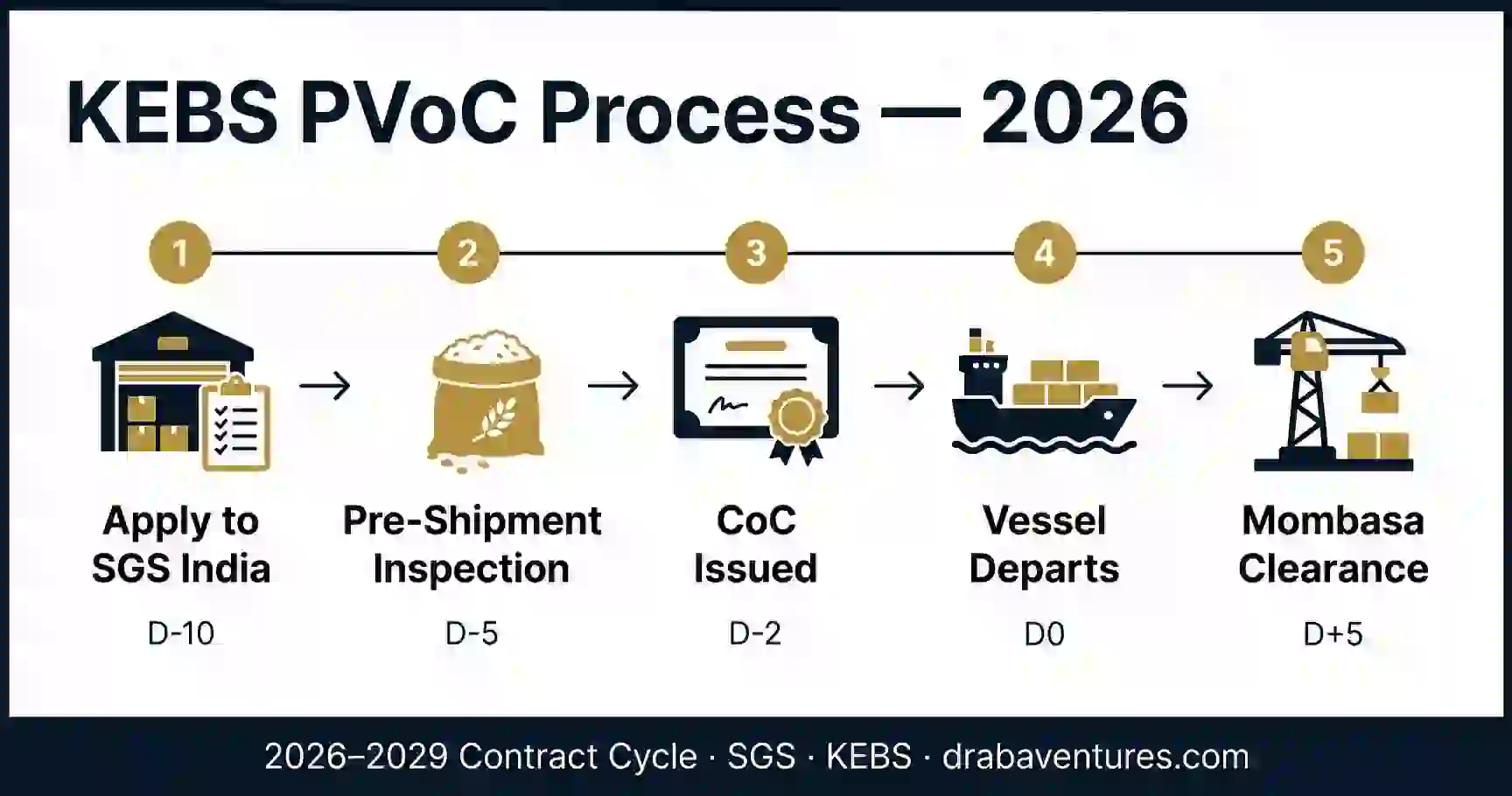
Consignments without a valid CoC are subject to Destination Inspection (DI) at Mombasa. DI is conducted by KEBS on arrival. It is slower (adds 5-10 days), more expensive (DI fee applies on top of standard port charges), and the cargo cannot be released until DI is completed. A $150-$300 PVoC inspection in India saves significantly more than its cost in avoided DI fees and demurrage.
The February 2026 Contract Reset - What Changed
KEBS PVoC inspection contracts operate on fixed multi-year cycles. The previous contract cycle expired in early 2026. KEBS issued a public notice and ran a fresh tendering process. The new 2026-2029 contract cycle was established in February 2026.
What changed for Indian rice exporters:
- Contract references updated. Inspection applications submitted to SGS under the old contract reference numbers may be rejected or delayed. Ensure all applications reference the 2026-2029 cycle. SGS India has issued updated application forms - use these from February 2026 onwards.
- SGS remains primary provider. SGS India retains accreditation under the new cycle and is the most widely used PVoC provider for Indian exporters. Bureau Veritas and Intertek also hold accreditation but have fewer inspection facilities at key Indian loading ports (Kakinada, Mundra, Chennai).
- New KEBS KS standard version. The PVoC inspection for rice now references the updated KEBS KS 2295:2022 standard (Kenya Standard for Rice). Ensure your product specifications are aligned with this version - particularly moisture (≤14%), foreign matter (≤0.1%), and milling degree requirements.
- No disruption for existing exporters with valid CoCs. CoCs issued under the previous cycle remain valid for consignments shipped before the contract reset date. New applications must use 2026-2029 cycle procedures.
If you shipped to Kenya before February 2026 and your previous SGS CoCs were accepted without issues, your process is essentially unchanged. Contact your SGS India account manager to confirm you are using the updated 2026-2029 application forms. No re-registration required.
The PVoC Process - Step by Step
Submit Application to SGS India D-10 before loading
Complete the SGS PVoC application form (2026-2029 version). Submit with: draft commercial invoice, draft packing list, HS code (10063010 for parboiled), product specification sheet, and loading port details. SGS requires a minimum of 5 working days notice - 10 days is recommended to allow for scheduling flexibility.
SGS Schedules Physical Inspection D-7 to D-5
SGS confirms an inspection date and sends an inspector to your warehouse, rice mill, or loading facility. The full consignment must be present and accessible. Partial or staged loading is not permitted - the inspector must see the complete consignment as it will be shipped.
Physical Inspection Conducted D-5 to D-3
The SGS inspector conducts the following checks against KEBS KS 2295:2022: moisture content test (calibrated meter), broken grain sampling and sieving, foreign matter visual and weight check, Sortex quality inspection (black/red grain count), packaging integrity (stitching, weight, labelling), and HS code verification against invoice. Inspection duration: 2-4 hours for a standard 20ft FCL.
CoC Issued (if passed) D-2 to D-1
If all parameters are within KEBS KS 2295 limits, SGS issues the Certificate of Conformity within 24-48 hours of the inspection. The CoC references your specific invoice number, loading port, container number (if available), and exact consignment quantity. It cannot be transferred to another shipment.
Include CoC in Shipping Documents At vessel loading
The original CoC must be sent by DHL as part of your complete document set to the Kenyan clearing agent. Dispatch documents within 48 hours of container loading. Send the CoC together with: original Bill of Lading, commercial invoice, packing list, phytosanitary certificate, certificate of origin, and fumigation certificate.
KRA Verifies CoC at Mombasa On vessel arrival
Kenya Revenue Authority cross-checks the CoC reference number against the cargo manifest. Valid CoC = fast-track green channel clearance. Invalid or missing CoC = Destination Inspection queue - adds 5-10 days and a DI fee to the importer's cost.
What the SGS Inspector Checks for Rice
| Inspection Parameter | KEBS KS 2295 Limit | Test Method | Failure Consequence |
|---|---|---|---|
| Moisture Content | ≤14.0% for parboiled | Calibrated moisture meter, 3 samples | CoC not issued - re-dry and re-inspect |
| Broken Grains | Per PO specification (5%, 15%, 25%) | Sample sieving, 100g per lot | Downgraded or CoC refused if exceeds spec |
| Foreign Matter | ≤0.1% by weight | Visual + weight check | CoC refused - re-sort required |
| Black/Red Grains | Effectively zero (100% Sortex) | Visual count per 100g sample | CoC refused - re-Sortex required |
| Packaging Integrity | No torn bags, correct weight labelling | Visual inspection of all bags | Partial CoC - affected bags excluded |
| HS Code on Invoice | 10063010 for parboiled | Document verification | Application rejected - amend invoice |
| Country of Origin Label | "Product of India" on each bag | Visual inspection | CoC refused - re-label required |
What Happens If Your Consignment Fails PVoC
A failed PVoC inspection is recoverable in most cases. Standard operating procedure:
- Moisture failure: The rice must be re-dried using a flat-bed dryer or sun-drying facility until moisture drops to ≤13.5% (to provide a buffer against further absorption). A re-inspection must then be scheduled. Lead time: 3-5 working days. Your vessel booking will likely need to be rescheduled - rebooking fees apply.
- Broken grain or Sortex failure: The consignment must be re-milled, re-sorted, or blended with better-quality stock. Re-inspection required. This is the most common failure for new suppliers with inconsistent milling quality.
- Packaging failure: Torn bags can be replaced on-site if SGS agrees to a partial re-inspection of the affected bags. Typically completed same-day.
- HS code error: Administrative only - correct the commercial invoice and resubmit. No physical re-inspection required.
Critical timeline risk: A failed inspection that requires re-processing typically delays the shipment by 7-14 days. If you are shipping on a fixed vessel booking, a failed inspection means missing your booking, rebooking costs of $100-$300, and potential demurrage at your warehouse. The single best protection is quality consistency - ensure your moisture certificate from the mill is ≤13% before scheduling the SGS inspection.
PVoC Inspection Costs
Compare this to the cost of Destination Inspection (DI) if no CoC is present: DI fee of $300-$600 per FCL, plus 5-10 additional days of demurrage at $50-$150/day. A single missed CoC on a delayed clearance can cost $800-$2,100. The PVoC inspection is always the cheaper option.
Pre-Inspection Checklist for Indian Exporters
✓ PVoC Readiness Checklist - Before SGS Inspector Arrives
How Draba Ventures Handles PVoC for Kenyan Buyers
Draba Ventures coordinates the complete PVoC process on behalf of our Kenyan buyers. Standard operating procedure for every Kenya shipment:
- SGS inspection application submitted minimum 10 working days before planned vessel loading
- Internal quality check (moisture, Sortex, broken) conducted before SGS appointment to eliminate failure risk
- CoC obtained and dispatched by DHL within 48 hours of container loading
- Kenyan buyer provided with CoC reference number and DHL tracking before vessel departure
- We are APEDA certified and IEC licensed - all credentials are publicly verifiable on apeda.gov.in and dgft.gov.in
For live FOB pricing on IR-64 Parboiled Rice, RNR Samba Masuri, and Sona Masoori for Kenya, visit our Market Intelligence Hub.
Frequently Asked Questions
What is the KEBS PVoC program for rice imports into Kenya?
What changed with the KEBS PVoC contract in February 2026?
How much does the SGS PVoC inspection cost for a 20ft FCL of rice?
What happens if my rice consignment fails the PVoC inspection?
Does a phytosanitary certificate or APEDA certificate substitute for the CoC?
Can I use Bureau Veritas instead of SGS for PVoC in India?
Need PVoC-Compliant Rice for Kenya?
Draba Ventures coordinates SGS PVoC inspection, CoC issuance, and complete document dispatch for every Kenya shipment. APEDA certified. Full documentation by DHL before vessel departure. First orders via LC at sight.
