The Ultimate Challenge: Healthy Mauritian Biriyani Without Compromise
Mauritian Biriyani is not just a meal; it is a cultural masterpiece, a centerpiece of celebrations, and a testament to the island's rich heritage of layered spices, marinated meats, and perfectly cooked, aromatic rice. However, for the nearly 20% of the Mauritian population actively managing diabetes or insulin resistance, this beloved dish often represents a severe dietary hazard.
The core issue lies in the carbohydrate load. Traditional Biriyani utilizes massive quantities of high-GI white rice or basmati, which triggers violent blood sugar spikes. Over the years, dietitians have suggested "healthier" alternatives, urging families to cook Biriyani using brown rice or dense parboiled varieties. Unfortunately, from a culinary standpoint, these attempts have categorically failed. They ruin the dish's delicate texture and fail entirely to absorb the complex aromatic profile of cinnamon, cardamom, saffron, and slow-cooked meat juices.
The Science of Spice Absorption: Why Parboiled and Brown Rice Fail
To understand why brown rice fails in Biriyani, we have to look at the anatomy of the grain. Brown rice retains its tough, fibrous bran layer. While this bran is rich in nutrients, it acts as an impenetrable barrier during the cooking process. It physically prevents the rich, spiced moisture of the Biriyani marinade from penetrating the endosperm. As a result, the rice tastes bland, and the texture remains unpleasantly chewy and dense.
Parboiled rice, while slightly better, has been partially gelatinized in its husk before milling. This hardens the grain, altering its cellular structure and making it highly resistant to flavor absorption. For a dish that relies entirely on the rice soaking up layers of fat and spice, parboiled rice yields a heavy, clumpy result.
Enter RNR 15048 (Low-GI Rice). This specific grain solves the culinary dilemma completely. As a naturally grown, clean-milled short-slender white rice, RNR 15048 has had its bran layer delicately removed through traditional, clean milling processes without any artificial fortification. This exposes the highly receptive endosperm, offering the exact mouthfeel, fluffiness, and spice-absorption capabilities of premium raw basmati - but remarkably, it maintains a clinically proven Low-GI of 51.5.
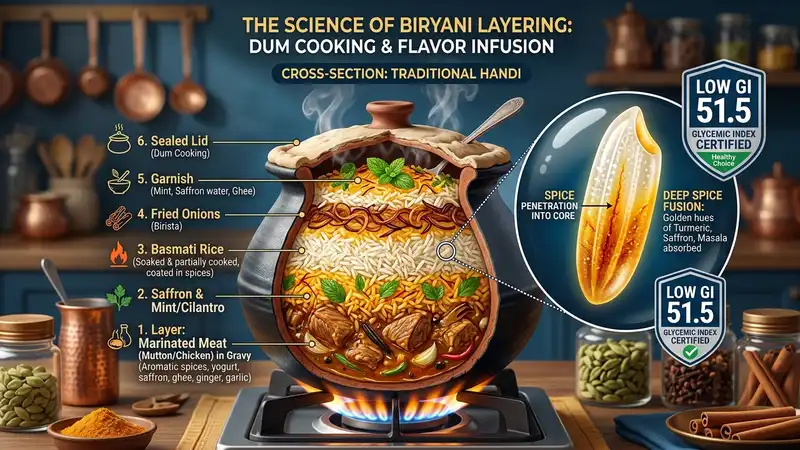
Spice Absorption & Texture Comparison for Biriyani
When cooking a complex layered dish like Biriyani, the physical properties of the grain dictate the success of the meal. Here is how RNR 15048 dominates the alternatives:
| Grain Variety | Spice Absorption Capacity | Cooked Texture & Separation | Glycemic Impact (GI) |
|---|---|---|---|
| Premium Basmati | Excellent (Deep penetration) | Fluffy, Distinctly Separate | High (GI ~70) - Dangerous for Diabetics |
| Traditional Brown Rice | Poor (Bran barrier blocks flavor) | Chewy, Dense, Heavy | Medium (GI 68) - Mildly Better |
| Standard Parboiled | Moderate (Hardened endosperm) | Clumpy, Stiff | Medium-High (GI ~65) |
| RNR 15048 (Low-GI) | Excellent (Deep penetration) | Soft, Fluffy, Perfectly Separate | Low (GI 51.5) - Clinically Safe |
Perfecting the "Dum" Cooking Method with Low-GI Rice
When utilizing RNR 15048 for Biriyani, the traditional "Dum" (slow-cooking under pressure) method works flawlessly. Because the grain is structurally sound, it does not disintegrate or turn into mush during the extended steaming process. The grains elongate slightly, releasing just enough starch to bind the flavors while remaining distinctly separate on the plate.
For Mauritian families, this means the Sunday Biriyani tradition does not have to end with a diabetes diagnosis. By simply switching the base carbohydrate to Draba Ventures' exported Low-GI Rice, the cultural heritage is preserved, the sensory enjoyment is identical, and the metabolic impact is safely neutralized.
Culinary Tip: When prepping RNR 15048 for Biriyani, wash the rice exactly 3 times to remove surface starch, and soak it for 20 minutes prior to par-boiling. This ensures maximum elongation and perfect flavor absorption during the final Dum stage.
For Consumers: Don't compromise on your favorite cultural dishes. Ask your local Super U, Winners, or pharmacy to stock Draba Ventures' Low-GI Rice today.
For B2B Buyers: Are you a Mauritian retailer or distributor capitalizing on the health-food movement? Access our live 120-month price-tracking intelligence dashboard and secure your next shipment. Contact Draba Ventures
Frequently Asked Questions
Why does brown rice ruin traditional Mauritian Biriyani?
Brown rice has a tough, fibrous bran layer that acts as a waterproof barrier, preventing the grain from fully absorbing the deep aromatic spices (like cardamom, cinnamon, and meat juices) essential to an authentic, flavorful Biriyani.
How does RNR 15048 maintain the texture of traditional Biriyani?
As a naturally grown, clean-milled short-slender white rice, RNR 15048 cooks fluffy, separates beautifully without clumping, and absorbs spices perfectly, all while maintaining a clinically low GI of 51.5.
Do I need to change my Biriyani recipe to use Low-GI rice?
No. RNR 15048 acts as a perfect 1:1 substitute for basmati or standard white rice. You can use your exact family recipe, water ratios, and cooking times.
