The Escalating Diabetes Epidemic in Mauritius: Rethinking the Rice Staple
Mauritius is currently facing a profound public health crisis. With a diabetes prevalence hovering near 20%, the island nation has one of the highest rates of Type 2 Diabetes and insulin resistance globally. Public health officials and endocrinologists point to a combination of genetic predispositions, sedentary lifestyles, and most notably, the heavy reliance on high-carbohydrate dietary staples.
For generations, imported high-GI white rice has formed the unshakeable foundation of the Mauritian diet. From daily home-cooked meals to elaborate festive feasts, rice is omnipresent. Unfortunately, this heavy reliance on standard long-grain white rice contributes heavily to insulin resistance and rapid post-prandial blood sugar spikes. However, entirely eliminating rice from the Mauritian diet is culturally impractical and historically unsuccessful. Diets built on total deprivation often lead to poor patient adherence. The pivotal question arises: can diabetics in Mauritius eat rice every day without compromising their metabolic health?
The Deep Science of Glycemic Index (GI) and Blood Sugar Spikes
To understand the solution, we must first understand the mechanism of the Glycemic Index (GI). The Glycemic Index is a standardized medical measurement ranking carbohydrates on a scale of 0 to 100 based on how rapidly they break down into glucose during digestion.
- High GI (70 and above): Causes an immediate, sharp spike in blood glucose levels, prompting the pancreas to release massive amounts of insulin. Standard white rice operates at a GI of ~73 to 80.
- Medium GI (56 to 69): Causes a moderate increase. Brown rice typically falls here, around 68.
- Low GI (55 and under): Digested and absorbed slowly, resulting in a gradual, sustained release of glucose. This prevents insulin dumping and keeps energy levels stable.
When a diabetic consumes high-GI standard white rice, the rapid insulin dump stresses the pancreas and exacerbates cellular insulin resistance over time. Conversely, RNR 15048 (Telangana Sona) - a premium short-slender grain cultivated in specific agro-climatic zones in India - clocks in at a clinically proven GI of 51.5. It is a completely natural, non-GMO grain that is traditionally farmed without any artificial processing or chemical fortification. This natural low GI ensures a slow, sustained release of glucose, mitigating dangerous spikes and mimicking the metabolic response of complex vegetables rather than simple starches.
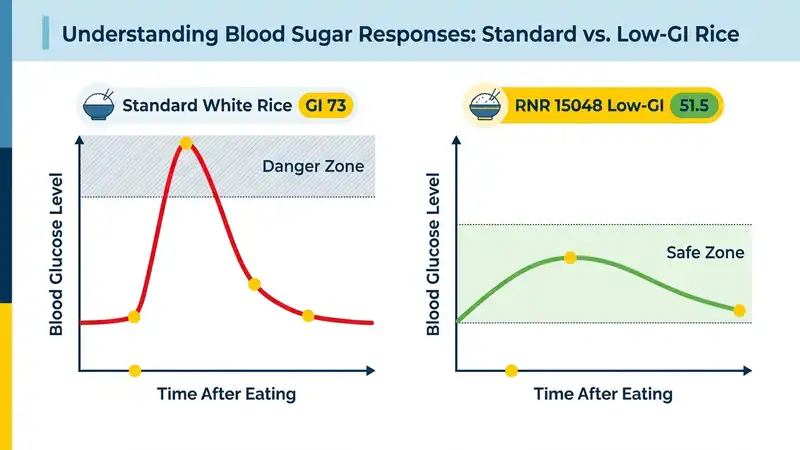
Data Comparison: RNR 15048 vs. Traditional Staples
For a detailed macro-nutritional understanding, let's observe how RNR 15048 compares mathematically against other highly consumed grains in the Mauritian retail market.
| Grain Type | Glycemic Index (GI) | Carbohydrate Breakdown Speed | Diabetic Suitability & Clinical Recommendation |
|---|---|---|---|
| Standard White Rice | 73 - 80 (High) | Rapid Spike (Under 30 mins) | Strictly Not Recommended for pre-diabetics or diabetics. |
| Traditional Brown Rice | 68 (Medium) | Moderate (45-60 mins) | Acceptable, but often rejected by consumers due to chewy texture and dense flavor. |
| RNR 15048 (Low-GI White Rice) | 51.5 (Low) | Slow / Sustained (2+ hours) | Highly Recommended. Perfect 1:1 culinary substitute for daily consumption. |
The Clinical Implications for Mauritian Healthcare
The introduction of RNR 15048 into the Mauritian retail ecosystem is not merely a dietary trend; it is a public health intervention. By swapping standard rice for Low-GI rice, patients do not have to alter their cooking habits, recipes, or portion sizes drastically. The compliance rate for this dietary shift is exceptionally high because the sensory experience - taste, aroma, and fluffiness - remains identical to premium standard rice.
Endocrinologists and dietitians across the island are increasingly recognizing that to fight the diabetes epidemic, the focus must shift from 'elimination' to 'substitution'. Draba Ventures has spent years perfecting the milling and export logistics of this specific grain to ensure it reaches Mauritian shores with its nutritional profile intact.
Clinical Note: The 51.5 GI rating of RNR 15048 was established through rigorous clinical trials and human in-vivo testing, proving its efficacy in long-term HbA1c management when consumed as part of a balanced diet.
For Consumers: Protect your family's metabolic health today. Ask your local Super U, Winners, or pharmacy to stock Draba Ventures' Low-GI Rice.
For B2B Buyers: Are you a Mauritian retailer or distributor looking to capture the surging health-food market? Access our live 120-month price-tracking intelligence dashboard and secure your next wholesale shipment today. Contact Draba Ventures
Frequently Asked Questions
What is the Glycemic Index of standard white rice in Mauritius?
Standard long-grain white rice typically has a high Glycemic Index (GI) ranging from 70 to 80, which causes rapid spikes in blood sugar levels and stresses the body's insulin response.
Is RNR 15048 clinically proven for diabetics?
Yes, RNR 15048 (Telangana Sona) has a naturally cultivated, non-GMO low GI of 51.5, classifying it as a low-GI food that produces a gradual, healthy blood sugar response, making it exceptionally safe for daily consumption.
Does Low-GI rice taste different from regular white rice?
No. One of the greatest advantages of RNR 15048 is that it looks, cooks, and tastes exactly like premium short-slender white rice, ensuring zero compromise on culinary enjoyment.
