The Volumetric Freight Penalty on Eco-Friendly Tableware
Wholesale buyers face margin destruction when shipping lightweight eco-packaging because ocean freight is calculated by volumetric weight rather than actual dead weight. International maritime carriers price 40ft High Cube containers on a cubic meter (CBM) basis or through volumetric dimensional rules. Because sugarcane bagasse clamshells and Areca palm leaf plates consist of hollow structural geometries, uncalibrated shipments cube out a container long before approaching the vessel's 26-metric-ton payload limit.
When containers ship with internal headspace or loose-nesting tolerances, importers pay thousands of dollars in ocean transit fees for transported air. For high-volume commercial distributors supplying hospitality groups and supermarket chains, a 10% to 15% loss in container volume translates directly into an unsustainable per-unit freight penalty. Enforcing precision nesting mechanics and carton fluting standards at the factory floor is an indispensable operational discipline.
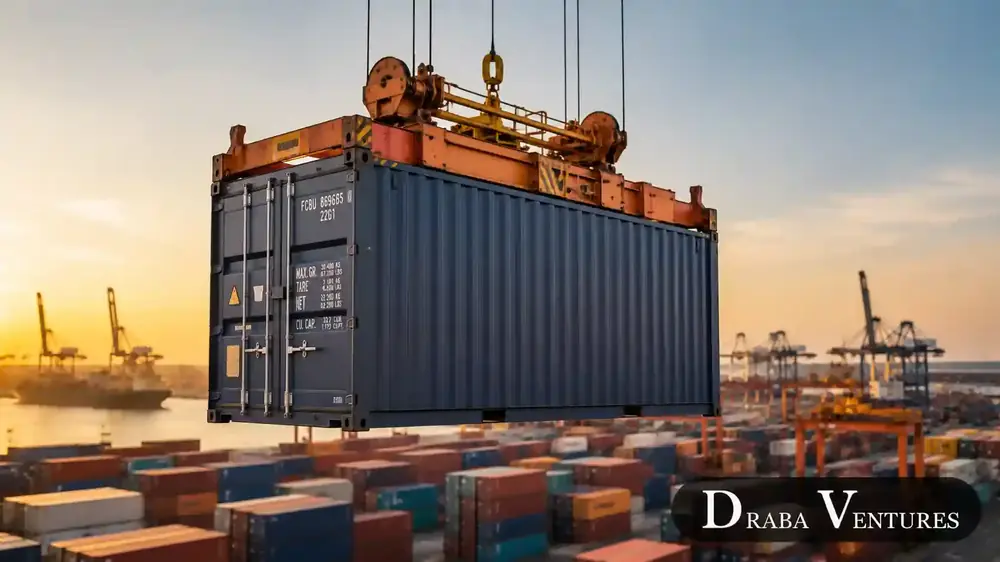
Logistics Engineering Audit: Draba Ventures designs bespoke corrugated carton dimensions calibrated specifically to the 76.4 CBM internal envelope of 40ft High Cube containers. High-density mechanical compression stacks eliminate air gaps, accommodating up to 15% additional units per container load.
Factory-Level Nesting & Mechanical Compression Protocols
Standard molded fiber containers naturally resist tight stacking due to mold draft angles and perimeter anti-nesting lugs. If secondary packaging is poorly engineered, each stack expands in height, reducing carton capacity. Draba Ventures implements strict structural protocols during the final thermoforming and packaging process:
- Controlled Draft Angle Geometry: Molds are calibrated with uniform 3.5 to 4.0-degree draft angles, allowing clamshells and plates to nest deep within one another without interlocking or jamming.
- Pneumatic Stack Compression: Finished bagasse stacks pass through hydraulic compression presses prior to moisture-barrier sleeve heat-sealing, compressing loose stack height by 12% without fracturing fiber walls.
- Zero-Headspace Master Cartons: Corrugated boxes are scored to exact millimeter tolerances, preventing box bulging while ensuring complete structural support from the internal tableware stacks.
- Heavy-Duty 5-Ply Kraft Construction: High Edge Crush Test (ECT-44) outer fluting prevents carton wall sagging under humid maritime transit conditions.
Direct Density & Freight Savings Matrix
Review the empirical loading density gains and per-unit freight cost reductions achieved through Draba high-density container loading:
| Packaging Format | Standard Loose Packing (Units/40ft HC) | Draba High-Density Packing | Net Freight Cost Reduction |
|---|---|---|---|
| 9x6-inch Bagasse Clamshells | 220,000 units | 255,000 units | 13.7% savings per unit |
| 10-inch Round Areca Leaf Plates | 310,000 units | 350,000 units | 11.4% savings per unit |
| FSC Birchwood Cutlery Sets | 3,500,000 units | 4,100,000 units | 14.6% savings per unit |
| 12-oz Sugarcane Bowls | 280,000 units | 325,000 units | 13.8% savings per unit |
Volumetric Packaging Performance Benchmarks
Maintaining high structural strength while achieving dense nested stacking requires precise manufacturing tolerances:
| Engineering Parameter | Uncalibrated Commodity Packaging | Draba Precision Export Standard |
|---|---|---|
| Stack Height Compression Index | 0% (Loose manual pack) | 12% - 15% Pneumatically Pre-Compressed |
| Internal Carton Headspace | > 25 mm empty void | < 3 mm (Direct load-bearing contact) |
| Corrugated Fluting Grade | Standard 3-ply Single Wall (ECT-29) | 5-Ply Double Wall Heavy Kraft (ECT-44) |
| Container Cube Utilization | 78% - 82% usable volume | 91% - 94% full CBM optimization |
The Landed Margin Impact for Commercial Distributors
On a transatlantic or transpacific route costing $4,000 in ocean freight, an increase of 35,000 units of 9x6 clamshells inside a single 40ft HC reduces the shipping cost per container unit from $0.0181 to $0.0156. Across an annual procurement volume of 20 containers, this single engineering refinement protects over $18,000 in direct logistics capital, giving wholesale distributors an unbeatable pricing edge in competitive bidding.
Frequently Asked Questions
Why is ocean freight expensive for biodegradable packaging?
How can importers reduce freight costs on bagasse containers?
How many Areca plates fit in a 40ft High Cube container?
Ready to Secure Certified PFAS-Free Biodegradable Packaging?
Click the WhatsApp icon in the bottom corner to request our lab test reports and live CIF pricing. Our procurement team is online.
Request High-Density Load Plan Chat on WhatsApp