Tannin content is the most misunderstood specification in white sorghum procurement for poultry feed. High-tannin sorghum depresses feed intake, reduces nutrient digestibility and lowers weight gain - directly hitting feed conversion ratios and farm profitability. This guide gives poultry feed formulators and procurement managers the exact tannin thresholds to specify, how to verify them before shipment, and why Indian white sorghum from Karnataka and Maharashtra consistently outperforms mixed-origin grain for low-tannin formulation.
Low-tannin white sorghum for poultry feed: specify tannin content ≤0.3% (as tannic acid equivalent) in the purchase order. Indian Rabi white jowar from Karnataka typically tests at 0.1-0.25%. Require an accredited lab report - not a certificate of analysis from the seller's own facility - before confirming payment.
Ready to Import Indian Sorghum?
Get an instant FOB and CIF cost estimate including shipping and insurance.
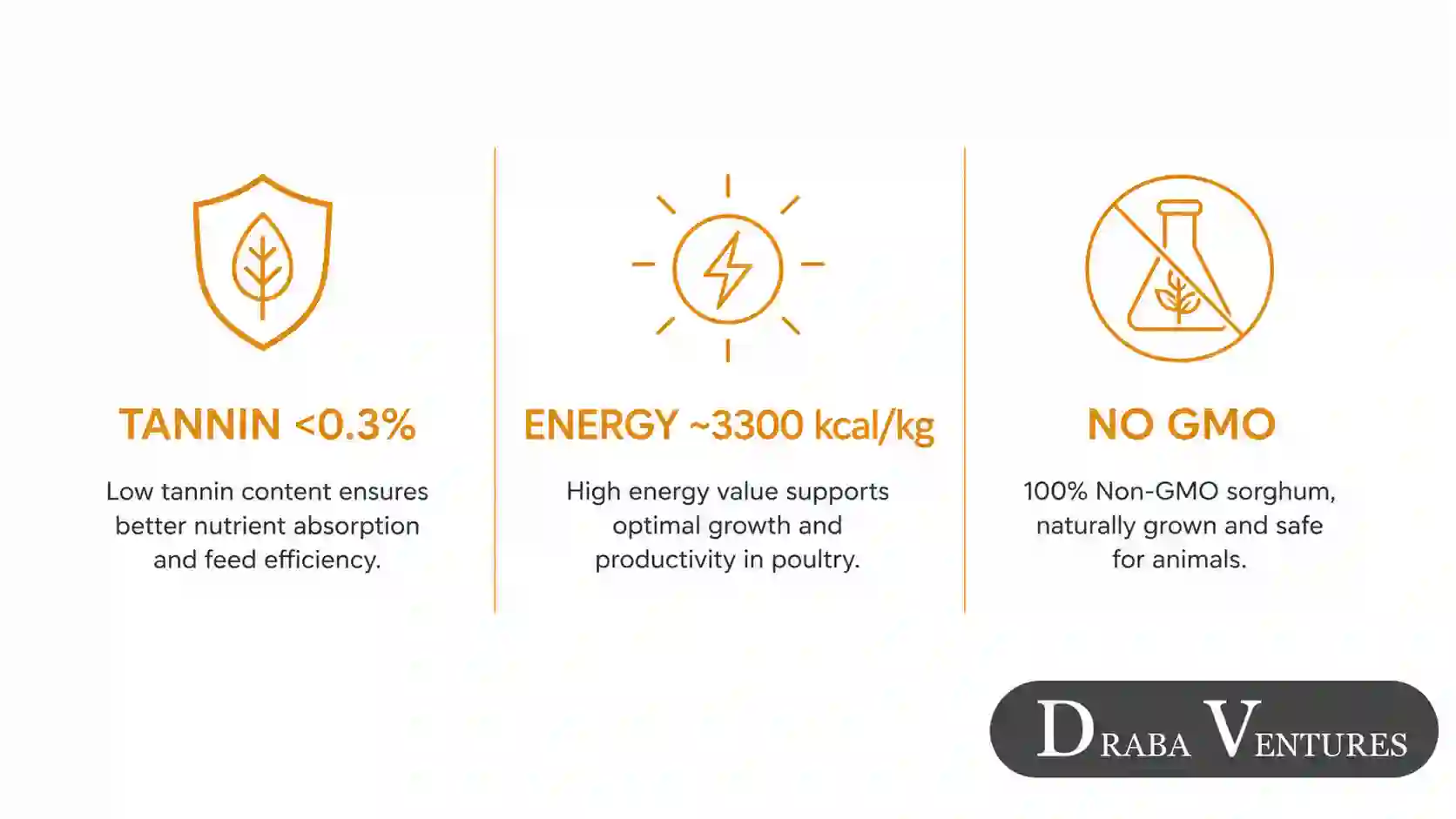
Why Tannin Level Matters in Poultry Diets
Tannins are polyphenolic compounds found in sorghum that can bind to proteins and reduce their availability in poultry feeds. High-tannin levels reduce feed conversion rates, which is why sourcing certified low-tannin white sorghum is a priority for commercial feed mills.
Poultry diets require highly digestible energy and amino acids. Sourcing sorghum with tannin content below 0.5% ensures that feed efficiency remains high and growth performance is optimized.
White Sorghum Digestibility Profile
White sorghum varieties from India generally exhibit a lower tannin profile compared to red or brown varieties. This chemical structure makes white sorghum significantly more digestible, allowing feed formulators to use it as a reliable carbohydrate source.
White sorghum buyers should confirm color consistency, grain appearance and cleaning response before approving food or milling use. Photos help, but physical sample approval is stronger.
Energy and Protein Contribution
Sorghum provides metabolisable energy comparable to corn, making it an excellent base ingredient. Its crude protein content, typically ranging from 8% to 10%, contributes valuable amino acids to the feed formulation.
Formulators analyze the exact amino acid digestibility of each batch to balance dietary requirements. Sourcing low-tannin grains ensures that protein availability is not compromised by chemical binding.
Maize Substitution Logic
Low-tannin white sorghum can replace maize up to 100% in poultry rations without negatively impacting broiler weight gain or layer egg production. This substitution is key to optimizing feed cost-efficiency.
Feed mills should compare sorghum by formulation value, grinding behavior and repeat supply. A lower grain price is not useful if ration performance becomes inconsistent.
Feed Mill Procurement Specifications
Procurement teams establish rigid parameters for feed-grade sorghum purchases. Specifications define acceptable limits for moisture, foreign matter, and broken grains to guarantee smooth milling and processing.
Feed mills should compare sorghum by formulation value, grinding behavior and repeat supply. A lower grain price is not useful if ration performance becomes inconsistent.
Questions to Ask Before Buying Feed-Grade Sorghum
Importers must clarify the grain processing history and storage conditions prior to shipping. Sourcing from experienced agricultural suppliers ensures that moisture and biological safety parameters are actively managed.
Key questions should cover harvest year, origin belt, pesticide residue limits, and the presence of third-party quality certifications at the origin port.
Buyer Reference Table
| Buyer check | Target wording | Why it matters |
|---|---|---|
| Moisture | <=14% unless buyer specifies otherwise | Controls storage and cargo risk |
| Broken grains | 2-5% tolerance by contract | Affects processing and visual grade |
| Foreign matter | Low, measurable percentage | Protects food/feed processing lines |
| Inspection | Lot-specific before loading | Prevents disputes at destination |
Procurement Checklist Before You Ask for PI
- Confirm whether the cargo is white, yellow, red or feed-grade sorghum.
- State the end use: brewery, poultry feed, food processing, starch, distribution or industrial use.
- Ask for moisture, broken percentage, foreign matter, admixture and infestation status in writing.
- Confirm bag size, bag type, marking, container payload and shipment month.
- Request the expected document set before payment terms are finalized.
- Verify HS code, destination rules and importer obligations with your customs broker.
Always confirm grade, packing, shipment month and document requirements in writing before requesting a Proforma Invoice. Draba Ventures responds to structured RFQs with a detailed FOB or CIF quote within 24 hours.
Internal Authority Links
Frequently Asked Questions
What is the main buying decision in Low-Tannin White Sorghum for Poultry Feed Formulation?
What should an importer include in a sorghum RFQ?
Which HS code should buyers use for sorghum imports?
Can Draba Ventures quote FOB and CIF sorghum shipments?
How does this page avoid keyword cannibalization?
Request a Sorghum Export Quote from Draba Ventures
Send product grade, quantity in MT, destination port, preferred Incoterm, payment preference and target shipment window. Our team will respond with a structured FOB or CIF quote.
Request a QuoteHS code note: this page uses 10070090 as the working sorghum trade entity. Final classification should be checked with the buyer's customs broker before import filing.
