Indian IR-64 Parboiled Rice reaches Kampala via Mombasa Port (sea transit 16-20 days from Kakinada) + Northern Corridor road (1,700 km, 3-5 days). Total India to Kampala: 24-32 days. UNBS compliance (moisture ≤14%, Sortex, labelling) is required. KEBS PVoC CoC from SGS India is the primary pre-shipment document. Road freight Mombasa → Kampala: $1,800-$2,400 per 20ft FCL. Full landed cost Kampala: approximately $14,000-$16,500 per 20ft FCL (excl. Uganda customs duty).
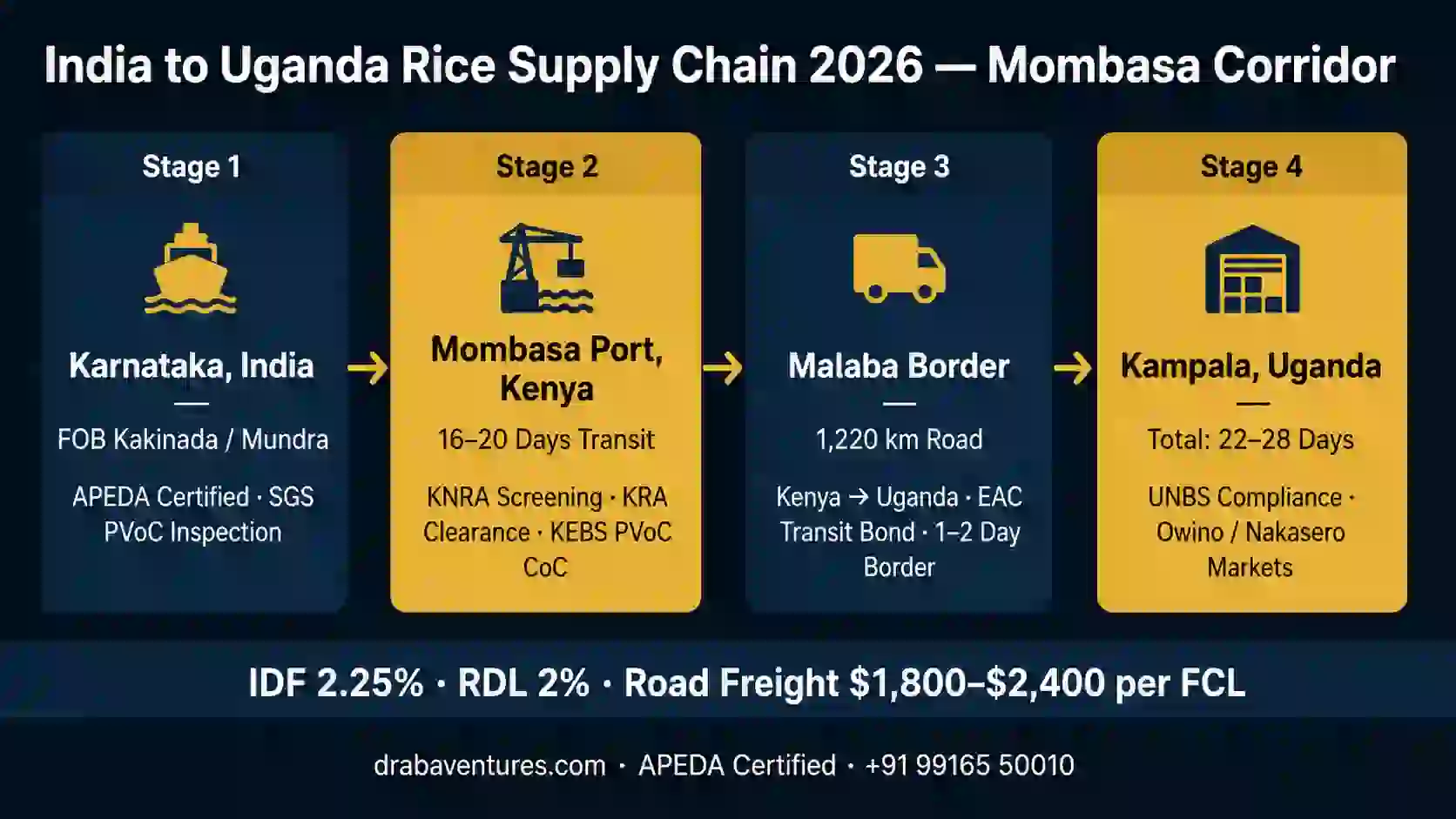
The Complete Route: India to Kampala
SGS PVoC inspection
Container stuffed
MSC / CMA CGM
Weekly services
Direct East Africa
service
KRA clearance
5-7 days
→ Malaba border
→ Kampala
Nakasero Market
or direct to buyer
Uganda is a landlocked country. Every grain of Indian rice imported into Uganda passes through Mombasa Port. There is no alternative sea route. This makes the Mombasa clearance process - KEBS PVoC, KNRA radiation screening, KRA customs, KEPHIS inspection - equally relevant to Ugandan importers as to Kenyan ones.
The key difference for Ugandan importers: after Mombasa clearance, an additional 3-5 days of road transit and the Malaba border crossing are required before the cargo reaches Kampala. This adds approximately $1,800-$2,400 in road freight costs and 1-2 days at the Malaba border crossing to the landed cost calculation.
Uganda Rice Market - Why Indian Rice Dominates
Uganda's domestic rice production - primarily from the eastern Bugiri and Doho rice schemes - covers approximately 30-40% of national consumption. The remaining 60-70% is imported, with India and Tanzania as the two primary sources. India's share has been growing consistently since 2020 due to a combination of price advantage and quality improvement among Indian exporters targeting the East Africa market.
The dominant format in Uganda's wholesale rice trade is 50kg PP woven bags of IR-64 Parboiled Rice. Kampala's Owino Market (St Balikuddembe) and Nakasero Market are the two primary wholesale distribution points. From these markets, smaller traders supply retailers and households across central and western Uganda, and re-export traders move rice to South Sudan (Juba) and eastern DRC (Goma).
Uganda Rice Market Segments
🏪 Kampala Wholesale
Owino Market and Nakasero Market are the primary wholesale hubs. 50kg PP woven bags. Buyers typically take 10-50 bags per purchase. Indian IR-64 Parboiled competes directly with Pakistani IRRI-6 and Tanzanian local rice.
🏬 Urban Retail
Nakumatt, Carrefour (Uganda), Shoprite, and local supermarkets in Kampala stock 1kg, 2kg, and 5kg packs. Premium segment: RNR Samba Masuri and Sona Masoori in branded packaging for South Asian diaspora in Kampala.
🚛 Upcountry Distribution
Wholesalers in Mbarara, Gulu, Mbale, and Fort Portal receive weekly truck deliveries from Kampala wholesalers. 50kg bags remain the dominant format. Parboiled preferred for longer shelf life in areas without reliable cold storage.
🏗️ Institutional / NGO
WFP, UNHCR, and Uganda government food aid programmes are significant rice buyers, particularly for South Sudanese refugee settlement areas in northern Uganda (Adjumani, Kiryandongo). Long-term contracts with 3-6 month delivery cycles.
UNBS Compliance - Uganda National Bureau of Standards
The Uganda National Bureau of Standards (UNBS) regulates the quality of imported food products including rice. UNBS requirements for imported rice align closely with KEBS standards - moisture ≤14%, Sortex cleaning, foreign matter limits, and labelling requirements.
In practice, how UNBS compliance works for Indian rice:
- Rice arriving via Mombasa with a valid KEBS Certificate of Conformity (CoC from SGS under the 2026-2029 cycle) is generally accepted by UNBS authorities at the Malaba border crossing. The CoC demonstrates pre-shipment compliance with regional quality standards.
- UNBS may conduct random sampling at Malaba or at the Kampala destination - typically checking moisture content and Sortex quality visually. Rice from APEDA-certified Indian exporters consistently passes these checks.
- Labelling requirement: bags must indicate "Product of India," variety, weight, and importer name (Ugandan importer details). Ensure your PP woven bags are correctly labelled before container sealing in India.
KEBS CoC covers UNBS requirements. If your consignment has a valid KEBS Certificate of Conformity from SGS India, you are effectively UNBS-compliant for the quality parameters. The KEBS PVoC inspection checks the same parameters UNBS requires - moisture, Sortex, foreign matter, packaging. No separate UNBS pre-shipment inspection is required for rice.
The Malaba Border Crossing
The Malaba border crossing is the primary Kenya-Uganda land border on the Northern Corridor. It processes the highest volume of commercial truck traffic in East Africa - hundreds of trucks per day. For your rice container, the following process applies:
- Kenya exit: KRA verifies the transit bond (if goods are in transit) or confirms duty-paid status. Truck scanned at Kenya border scanner. Takes 2-4 hours under normal conditions.
- Uganda entry: Uganda Revenue Authority (URA) officer checks the truck manifest, Certificate of Origin, commercial invoice, and Uganda customs declaration. Uganda customs duty assessed on rice. Takes 3-6 hours under normal conditions.
- UNBS check: Random checks for quality. Moisture meter check on a sample of bags. If moisture is above 14%, the consignment can be held. This is rare for well-prepared Indian rice.
- Total Malaba crossing time (normal conditions): 6-12 hours. Under peak congestion or system outages: 2-3 days. Always ensure all documentation is complete before the truck departs Mombasa.
Malaba congestion warning: Malaba border is frequently congested with trucks waiting 24-48 hours during peak periods (end/start of month, holiday periods, system maintenance). Budget for potential border delays in your total transit time calculation. Your Kampala buyer should not plan inventory just-in-time against the vessel ETA - build 3-5 days buffer into delivery commitments.
Document Checklist - India to Uganda via Mombasa
✓ Uganda Rice Import Document Checklist 2026
Full Landed Cost: India to Kampala
At Kampala wholesale pricing of approximately $47-$58 per 50kg bag (500 bags per 25 MT FCL), gross revenue is $23,500-$29,000 - well above landed cost at market pricing levels. Customs duty from both Kenya and Uganda is the primary variable affecting final margin - confirm both rates before placing your order.
For live FOB pricing, visit our Market Intelligence Hub. For the full Kenya clearance guide (which applies to all Uganda-bound cargo passing through Mombasa), see: Import Indian Rice to Kenya 2026 - Complete Buyer Guide.
Rice Varieties for the Uganda Market
| Variety | Format | Packaging | Uganda Market Fit | FOB Kakinada |
|---|---|---|---|---|
| IR-64 Parboiled | 25% broken | 50kg PP woven | ✅ Primary wholesale - Owino, Nakasero | $310-330/MT |
| IR-64 Parboiled | 15% broken | 50kg PP woven | ✅ Standard wholesale | $340-360/MT |
| IR-64 Parboiled | 5% broken | 25kg PP woven | ✅ Premium wholesale + retail | $355-375/MT |
| RNR Samba Masuri | Raw 2% | 5kg / 10kg BOPP | ✅ Kampala supermarket + diaspora retail | $380-420/MT |
| Sona Masoori | Raw 2% | 5kg / 10kg BOPP | ✅ Kampala premium retail | $370-410/MT |
25% broken IR-64 Parboiled in 50kg bags is the dominant format for Uganda's mass market. The higher broken percentage makes it the most affordable grade at the consumer level while maintaining the golden colour and non-sticky texture that Ugandan households expect. Institutional buyers (WFP, NGOs) typically specify 15% broken with strict Sortex and moisture requirements.
Frequently Asked Questions
How does rice get imported from India to Uganda?
Does Indian rice need UNBS compliance for Uganda?
What is the road freight cost from Mombasa to Kampala?
What is the total transit time from India to Kampala?
What rice variety is most popular in Uganda's wholesale market?
Sourcing Indian Rice for Uganda?
Draba Ventures supplies IR-64 Parboiled, RNR Samba Masuri, and Sona Masoori for the Uganda market. APEDA certified. KEBS PVoC/SGS coordinated. Full document set dispatched before vessel departure. CIF Mombasa available.
