Importing Indian IR 64 parboiled rice into Francophone West Africa requires rigorous alignment with three regulatory pillars: pre-departure Electronic Cargo Tracking Note (ECTN / BESC) waiver validation, third-party pre-shipment quality and weight certification (SGS / Bureau Veritas), and UCP 600-compliant Irrevocable Letter of Credit (LC at Sight) execution. Draba Ventures centralizes these workflows through digital compliance systems, ensuring zero customs demurrage, zero documentary discrepancies, and complete capital protection for commercial distributors.
Navigating ECTN / BESC Cargo Waivers
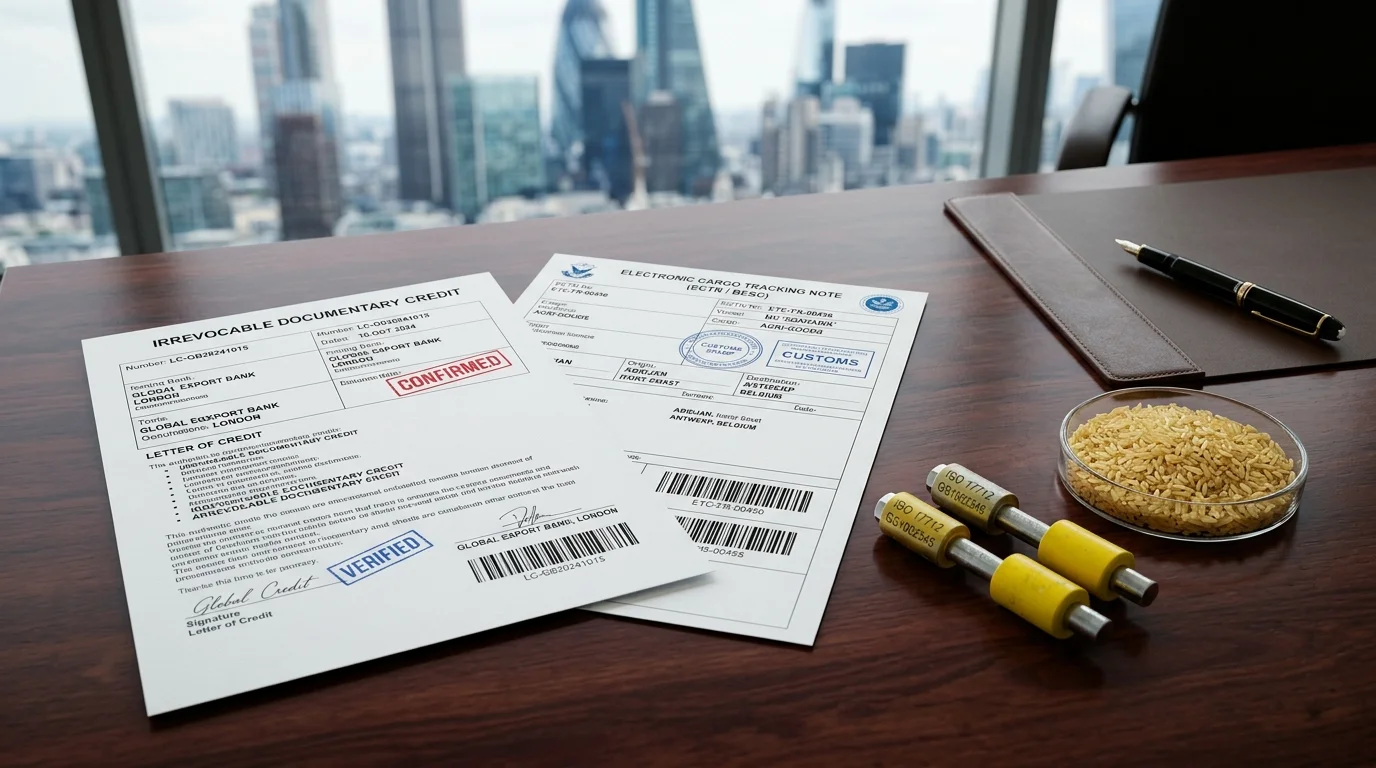
Throughout the maritime trading corridors of Francophone West Africa, national shippers councils enforce strict pre-arrival cargo tracking mandates. Known variously as an Electronic Cargo Tracking Note (ECTN), Bordereau Électronique de Suivi des Cargaisons (BESC), or Cargo Tracking Note (CTN), this statutory electronic certificate provides destination port authorities with verified financial and operational intelligence before container vessels make landfall.
Failure to present a validated ECTN certificate prior to vessel discharge carries devastating financial penalties. Customs administrations across the Port Autonome de Dakar (PAD, Senegal), Port Autonome d'Abidjan (PAA, Côte d'Ivoire), Port Autonome de Cotonou (PAC, Benin), and Port Autonome de Lomé (PAL, Togo) levy regulatory fines amounting to up to 100% of the ocean freight tariff, in addition to statutory administrative surcharges and container storage demurrage. In severe instances, cargo without a validated BESC number faces immediate port impoundment.
Draba Ventures manages the complete ECTN/BESC registration protocol as an institutional export service:
- Pre-Loading Document Harmonization: We reconcile the Bill of Lading (B/L), Commercial Invoice, Freight Invoice, and Indian Customs Export Declaration (Shipping Bill) to ensure exact numerical and descriptive parity across all fields.
- Official Shippers Council Portal Filing: Our trade compliance desk interfaces directly with authorized national filing portals (including COSEC for Senegal, OIC for Côte d'Ivoire, CNCB for Benin, and CNUT for Togo) to secure official document validation.
- Mandatory B/L Endorsement: We guarantee the verified ECTN/BESC tracking number is formally endorsed on the face of the original maritime Bill of Lading prior to vessel departure, allowing local customs clearing agents in Dakar or Abidjan to process immediate advance clearance.
SGS and Bureau Veritas Pre-Shipment Inspections
West African customs and municipal trade ministries enforce strict controls against substandard grain imports, moisture degradation, and net-weight fraud. To protect their capital, institutional importers require independent, third-party verification performed directly at the point of origin in India before containers are gated into maritime terminals.
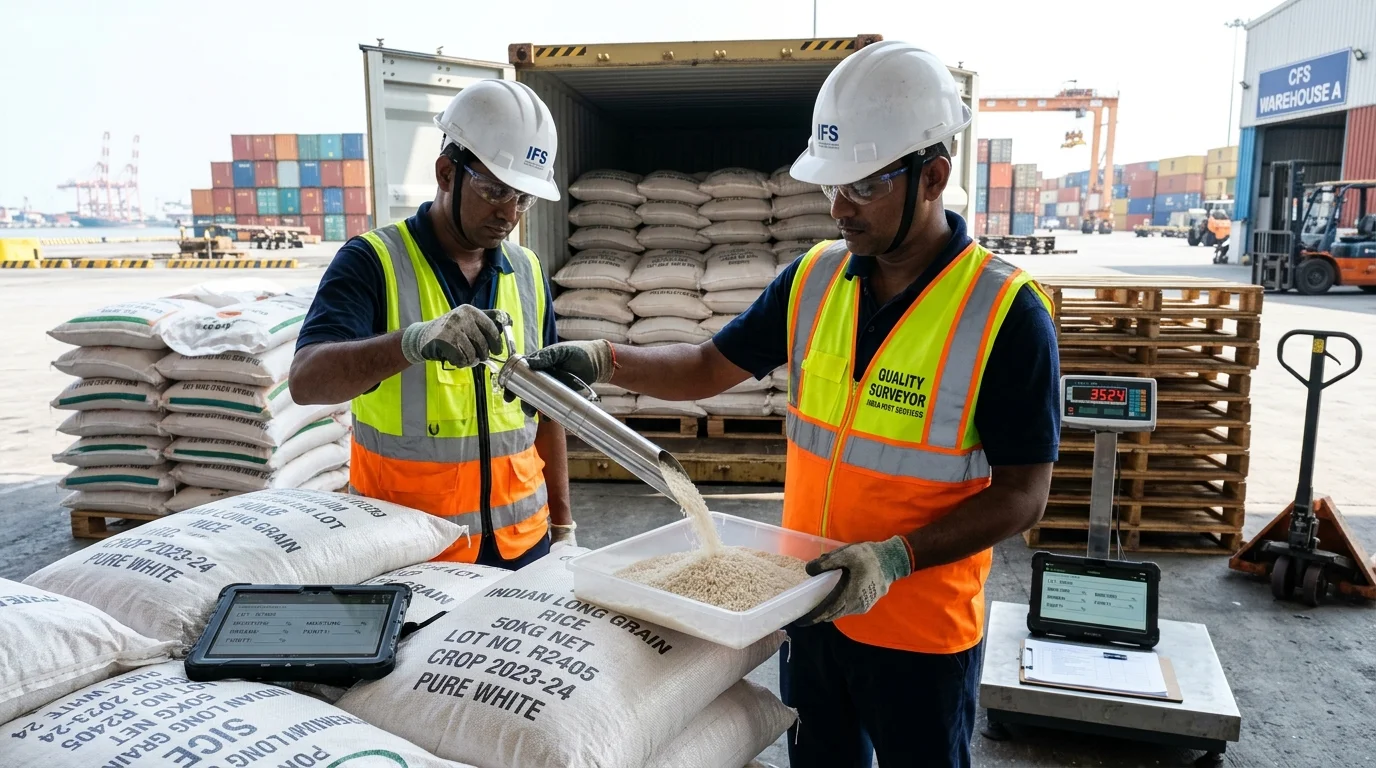
Draba Ventures routinely partners with premier international inspection agencies (including SGS, Bureau Veritas, Cotecna, and Intertek) to conduct rigorous pre-shipment inspections (PSI) across our port-proximate Container Freight Stations (CFS):
- Mechanical Weight Calibration: Surveyors extract sample bags across production runs to verify individual bag gross weight and certified tare weight. Automated digital scale hoppers ensure a zero-tolerance margin for under-fill, maintaining an average gross fill of 50.08 kg per bag to ensure a guaranteed 50.00 kg net weight upon discharge.
- Grain Technical Analysis: Certified surveyors perform laboratory grading to verify compliance with contractual parameters: percentage broken (5% vs 25%), moisture content strictly below 14.0%, foreign matter under 0.5%, chalky grains, damaged/discolored kernels, and red-streaked grains.
- Bag Stitching and Integrity: Inspecting high-density woven polypropylene (PP) or laminated BOPP sacks for seam durability, double-chain synthetic polyester stitching, and clear bilingual regulatory markings.
- High-Security Bolt Seal Application: Upon completion of container stuffing, third-party inspectors supervise the placement of heavy-duty ISO 17712 high-security container bolt seals, recording unique alphanumeric seal numbers on the official Certificate of Weight and Quality.
Letters of Credit (LC at Sight) and Trade Finance
Managing payment risk is paramount when executing large-scale bulk agricultural transactions. An importer cannot afford to prepay 100% of a multi-thousand-ton contract to an unverified broker, while an exporter cannot risk shipping high-value grain without guaranteed financial settlement.
To provide ironclad security for both parties, Draba Ventures conducts international commercial contracts under Irrevocable Letters of Credit payable at Sight (LC at Sight), governed strictly by the Uniform Customs and Practice for Documentary Credits (ICC UCP 600):
| Compliance Parameter | Traditional Inland Mill Exporter | Draba Ventures Institutional Model | Importer Legal & Financial Security |
|---|---|---|---|
| ECTN / BESC Waiver Filing | Neglected or delegated to buyer post-arrival | Validated pre-departure by Draba compliance desk | Zero destination customs fines; immediate gate release |
| Pre-Shipment QC Inspection | Internal mill certificate only (bias risk) | Mandated independent SGS / Bureau Veritas audit | Certified grain specs (5% or 25%) and exact net weight |
| Trade Finance Structure | Demands risky upfront telegraphic cash transfers | Structured Irrevocable LC at Sight / CAD via Tier-1 banks | Capital released only upon presentation of flawless documents |
| Document Turnaround Speed | 14 to 21 days (frequent missing-vessel delays) | 48 to 72 hours via automated Xpensio systems | Documents arrive at buyer bank weeks before ship berths |
| Discrepancy Risk under UCP 600 | High; typographical errors cause banking holds | Zero; automated dual-check documentary protocol | Flawless bank negotiation; eliminates amendment fees |
| Demurrage Exposure at Destination | Severe risk due to late arrival of original B/L | Negligible; fast courier dispatch via DHL / FedEx | Eliminates costly container terminal detention fees |
Under this trade finance structure, the buyer commercial bank guarantees payment to Draba Ventures through our prime banking partners. Payment is negotiated only when Draba Ventures presents a completely non-discrepant, institutional shipping dossier confirming that the rice has been loaded, inspected, insured, and tracked.
The Agile Documentation Advantage
Traditional rice export operations managed by single-facility inland mills are notorious for administrative bottlenecks. Because rural mills lack dedicated international trade compliance teams, generating commercial invoices, obtaining chamber of commerce origin certificates, and securing government phytosanitary certificates often takes two to three weeks. By the time paperwork is completed, the vessel has already arrived in West Africa, subjecting the buyer to exorbitant demurrage fees while waiting for original documents.
Draba Ventures eliminates this operational failure through an agile merchant export model powered by centralized digital infrastructure. By integrating our proprietary Xpensio accounting and compliance software with government export portals (APEDA, DGFT, and ICEGATE), our compliance desk generates certified, error-free documentation packages within 48 to 72 hours of vessel sailing.
The Draba Ventures Zero-Discrepancy Document Suite
Every commercial consignment exported to West Africa is accompanied by a comprehensive, fully reconciled 7-document institutional suite:
- Full Set Clean On-Board Ocean Bills of Lading (3/3 Original): Issued by top-tier global shipping lines, clearly noting freight prepaid, container numbers, seal numbers, and statutory ECTN/BESC tracking numbers.
- Signed Commercial Invoices (Original + Copies): Itemizing net metric tonnage, unit price per MT CIF, harvest crop season, and exact contract reference numbers.
- Detailed Packing Lists: Documenting individual container numbers, bag counts (50kg or 25kg), gross cargo weights, and verified container tare weights.
- Certificate of Origin: Issued and stamped by accredited Chambers of Commerce and approved export inspection councils in India.
- Official Phytosanitary Certificate: Issued by the National Plant Protection Organization (NPPO / DPPQS), Ministry of Agriculture, Government of India, certifying grain cleanliness and treatment.
- Independent Certificate of Weight and Quality: Issued by SGS, Bureau Veritas, or Cotecna, verifying technical grain parameters and net weight calibration.
- Marine Cargo Insurance Certificate: Underwritten under Institute Cargo Clauses (A) covering 110% of total CIF invoice value against all maritime risks.
Frequently Asked Questions
Structure Your Trade Finance & Compliance Framework Today
Consult with our international trade desk to review Letter of Credit requirements, coordinate ECTN/BESC waiver filings, or request formal proforma invoices for Indian IR 64 parboiled rice exports.
Consult Trade Compliance Desk