Indian IR 64 Parboiled Rice accounts for the majority of non-basmati rice imports across Senegal, Côte d'Ivoire, and Burkina Faso due to its hydrothermal durability, high swell ratio, and firm texture in traditional West African stews such as Jollof and Thieboudienne. Draba Ventures strictly sources from modern APEDA-registered Indian mills equipped with Buhler optical Sortex grading, ensuring moisture levels strictly milled below 14% to completely prevent ocean transit Aflatoxin contamination.
The Dominance of IR 64 Parboiled in West Africa
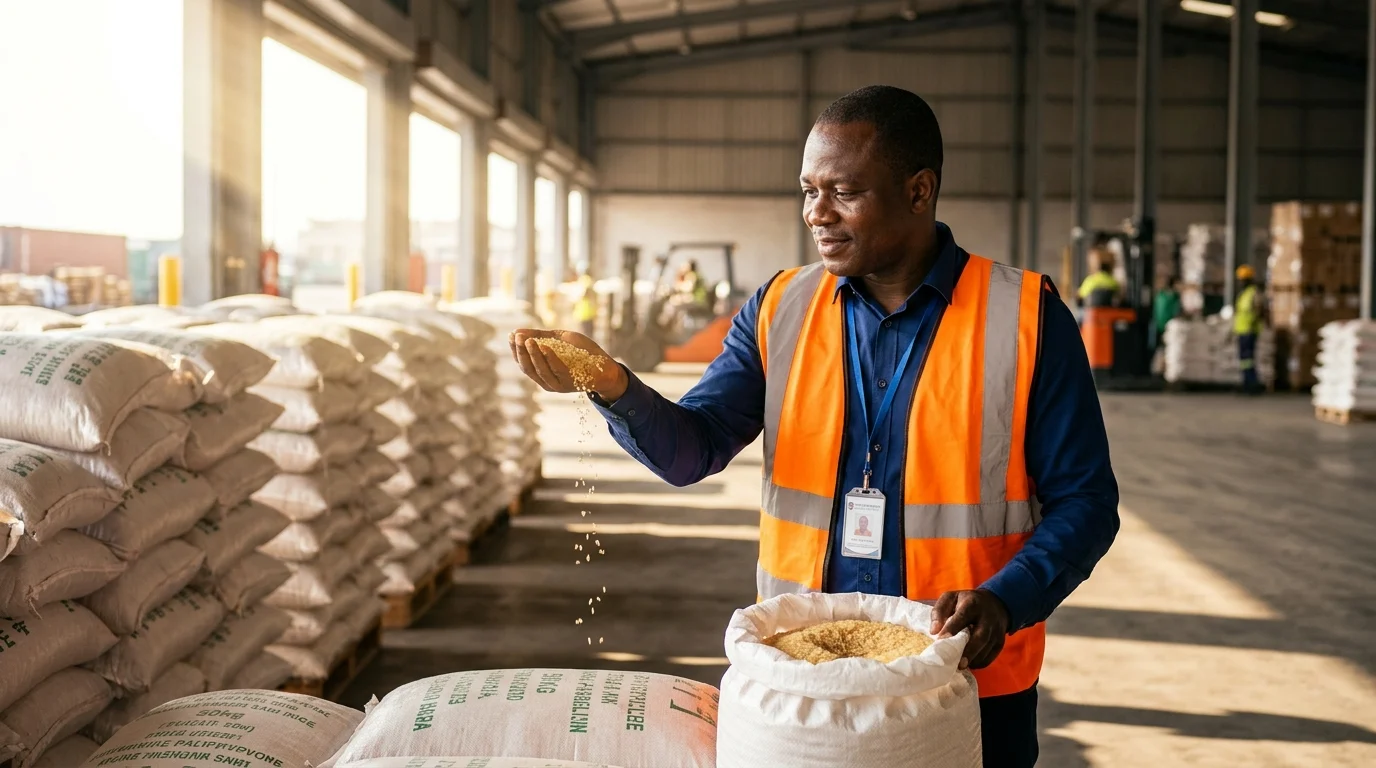
Across key maritime commercial trade lanes from Kakinada and Kandla to West African ports including Dakar, Abidjan, Cotonou, Lomé, and San Pédro, Indian IR 64 Parboiled rice is the backbone of staple food security. Commercial importers, large wholesale distributors, and institutional tender boards in Senegal, Côte d'Ivoire, and landlocked nations like Burkina Faso rely on this long-grain indica variety above all other origins.
The culinary hegemony of IR 64 rests on the precision of the parboiling process. In this three-stage hydrothermal treatment, raw harvested paddy undergoes soaking in temperature-controlled water, pressurized steaming, and controlled air-drying prior to mechanical dehusking and polishing. This gelatinizes the starchy grain core, driving natural vitamins and minerals from the bran layer directly into the endosperm.
Crucially for West African gastronomy, parboiling hardens the starch polymer chains. When cooked in rich, slow-simmered, oil-and-tomato-heavy broths such as Senegalese Thieboudienne or West African Jollof rice, the grains maintain complete physical integrity. Unlike raw white rice which rapidly disintegrates into mush under prolonged moisture and heat, IR 64 parboiled grains remain distinct, firm, and expand uniformly without breaking.
Unit Economics: 5% Broken vs. 25% Broken
For commodity procurement executives, selecting the broken fraction is the critical determinant of unit margins, inventory turnover, and market channel placement. West African non-basmati rice imports are segmented into distinct functional tiers:
| Commercial Parameter | IR 64 Parboiled 5% Broken | IR 64 Parboiled 25% Broken | 100% Broken (Brewers / Mass) |
|---|---|---|---|
| Target Market | Premium urban retail (Dakar, Abidjan, Bamako) | Mass-market wholesale, regional distributors | Budget institutional tenders, value retail, industrial |
| Average Grain Length | 6.0 mm - 6.2 mm | 5.8 mm - 6.0 mm | Varies (pure broken fragments) |
| Sortex Optical Purity | 99.5% clean (zero black / peck grains) | 98.5% - 99.0% clean | 98.0% clean |
| Moisture Content | Under 14.0% guaranteed at load port | Under 14.0% guaranteed at load port | Under 14.0% guaranteed at load port |
| Packaging Standard | 25kg or 50kg BOPP laminated / woven PP | 50kg standard woven polypropylene bags | 50kg woven PP bulk bags |
| CIF Pricing Advantage | Baseline premium grade | $18 to $28 per MT discount vs. 5% | $45 to $65 per MT discount vs. 5% |
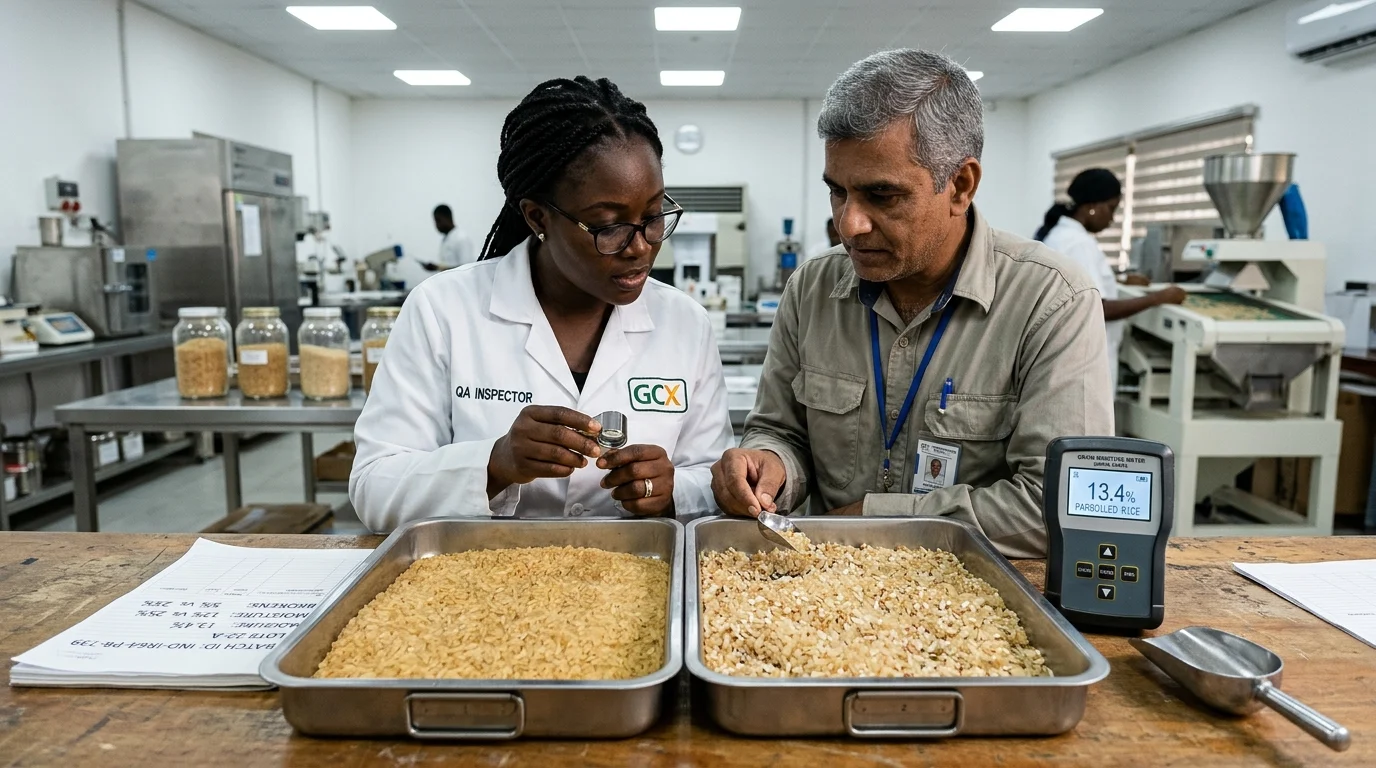
In municipal hubs like Dakar and Abidjan, supermarkets and formal grocery wholesalers command high margins on IR 64 5% Broken packaged in custom-branded 25kg BOPP bags. Conversely, interior semi-urban and rural distribution across Burkina Faso and Mali moves immense volumes of 25% Broken, where aggressive CIF pricing per metric ton is the primary purchasing driver.
APEDA Certification and FSSAI Milling Standards
Navigating cross-border trade between India and West Africa requires rigorous institutional compliance. Uncertified brokers often source from antiquated huller mills that introduce unacceptable stone counts, yellowed kernels, and variable moisture that ruin shipments at sea.
Institutional Reliability: Draba Ventures exclusively procures rice from modern processing plants certified by the Agricultural and Processed Food Products Export Development Authority (APEDA) and compliant with the Food Safety and Standards Authority of India (FSSAI). Every consignment undergoes multi-stage destoning, magnetic ferrous separation, and Buhler optical Sortex grading to eliminate discolored seeds, chalky grains, and foreign matter.
Key documentation provided with every export container includes:
- Phytosanitary Certificate: Issued by the Directorate of Plant Protection, Quarantine and Storage, verifying freedom from regulated quarantine pests.
- Fumigation Certificate: Administered under accredited aluminum phosphide protocols to ensure zero live insect infestation upon arrival.
- SGS / Bureau Veritas Certificate of Quality & Quantity: Independent pre-shipment sampling and testing confirming exact broken percentage, average grain length, and optical grading specifications.
- Certificate of Origin: Authenticated chamber of commerce documentation verifying 100% Indian origin.
Moisture Control and Aflatoxin Prevention
The maritime corridor from Indian ports through the Indian Ocean and around the Cape of Good Hope to the Gulf of Guinea exposes cargo to severe thermal and humidity shifts. Equatorial condensation in unventilated shipping containers, known as container sweat, is the leading cause of Aflatoxin B1 formulation and grain discoloration.
Draba Ventures mitigates maritime risks through institutional pre-export moisture management:
- Strict Under-14% Moisture Threshold: While international trade standards permit up to 14.5% moisture, Draba Ventures mandates an internal ceiling of 13.5% to 13.8% prior to stuffing. This dry baseline eliminates the free moisture required for Aspergillus flavus mould germination.
- Container Dressing and Desiccants: All standard 20ft maritime containers are dressed with food-grade kraft paper lining along the floor and sidewalls, accompanied by high-absorption calcium chloride desiccant bags suspended in container corrugations.
- Pre-Loading Vessel Inspection: For breakbulk consignments, ship holds undergo rigorous atmospheric and water-tightness surveys, ensuring bilge wells are clean, dry, and sealed against sea spray.
Frequently Asked Questions
Procure Direct from APEDA-Registered Indian Mills
Partner with Draba Ventures for institutional IR 64 Parboiled Rice supply to Dakar, Abidjan, Cotonou, Lomé, and San Pédro. Get firm CIF quotations with guaranteed <14% moisture and SGS inspection.
Request CIF Quotation