The Strict Aviation Weight Budget and Galley Space Constraints
In commercial aviation catering, packaging engineering is an exact science governed by strict weight budgets and dimensional tolerances. With global airlines phasing out single-use plastics under European Union Directive 2019/904 and international civil aviation sustainability frameworks, procurement directors face a delicate operational balance. Replacing lightweight polystyrene and CPET trays with heavy, bulky eco-alternatives risks triggering punishing aircraft weight penalties.
Standard commercial flight galleys operate on the ATLAS equipment standard. Galley carts, meal carriers, and passenger tray tables are engineered to fractions of a millimeter. Every meal component must integrate into standardized 1/1 full-size trays (380x273mm), 1/2 half-size trays (194x273mm), or 2/3 trays (256x273mm) without overhang or wasted tray surface.
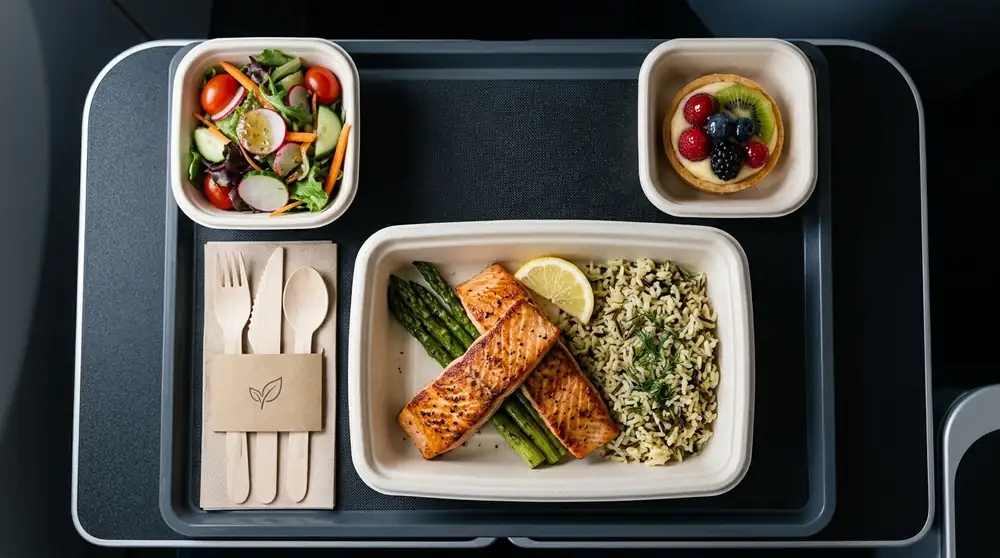
Aviation Fuel Mathematics: An incremental weight increase of just 15 grams per passenger meal across a long-haul carrier operating 200 daily flights adds over 180 metric tons of deadweight annually. At current jet fuel rates, this avoidable weight penalty translates to tens of thousands of dollars in added fuel burn per aircraft type.
Molded Bagasse Engineering for In-Flight Ovens and Carts
Aircraft meal services present unique thermodynamic challenges. Chilled meal inserts loaded into galley chillers at 4°C must withstand rapid heating inside aircraft convection steam ovens up to 120°C without warping, buckling, or emitting chemical aromas into the pressurized passenger cabin.
Draba Ventures supplies precision-molded sugarcane bagasse casserole dishes and tray inserts engineered specifically for in-flight operational parameters:
- Precision Flange Rigidity: Clean, flat perimeter rims ensure hermetic sealing with heat-sealable lidding films and foil covers, preventing sauce leaks during aircraft turbulence.
- Thin-Wall Thermoforming: High-tonnage hydraulic compression yields ultra-thin yet rigid structural walls, matching the weight envelope of thin CPET plastic trays.
- Organoleptic Purity: Heat-treated and baked under vacuum drying to ensure absolute odor neutrality during oven reheating cycles.
ATLAS Galley Tray Compatibility Matrix
Review the exact dimensional parameters for standard commercial airline meal tray configurations:
| ATLAS Tray Standard | Dimensions (mm) | Draba Eco-Insert Compatibility | Weight Profile |
|---|---|---|---|
| 1/1 Full Size Tray | 380 x 273 mm | Standard Entrée + 3 Sides | Calibrated to match legacy ABS plastics |
| 1/2 Half Size Tray | 194 x 273 mm | Compact Meal + Cutlery Pack | Ultra-lightweight thin-wall bagasse molding |
| 2/3 Size Tray | 256 x 273 mm | Premium Cabin Configurations | Custom multi-cavity mold availability |
Fleet Weight Analysis: Birchwood vs. Alternative Cutlery
In addition to meal containers, in-flight cutlery represents a substantial cumulative payload weight. Birchwood provides the ideal strength-to-weight ratio for commercial fleets:
| Cutlery Substrate | Average Fork Weight | Full Cutlery Pack (4-in-1) | Fleet Weight (10M Meals/Year) | Aviation Feasibility |
|---|---|---|---|---|
| FSC Certified Birchwood | 2.8 grams | 9.2 grams | 92 Metric Tons | Optimal (Zero splinter risk, light) |
| Molded Bamboo Cutlery | 4.2 grams | 14.1 grams | 141 Metric Tons | Unfavorable (+49 Tons deadweight fuel cost) |
| C-PLA Bioplastic Cutlery | 4.8 grams | 15.8 grams | 158 Metric Tons | Poor (Heaviest bio-option, high melt risk) |
| Legacy Polystyrene (PS) | 2.7 grams | 8.9 grams | 89 Metric Tons | Legally banned in Western airspaces |
Frequently Asked Questions
Are sugarcane bagasse containers compatible with ATLAS airline trays?
Does biodegradable packaging increase aircraft weight?
What is the best eco-friendly cutlery for in-flight catering?
Ready to Secure Certified PFAS-Free Biodegradable Packaging?
Click the WhatsApp icon in the bottom corner to request our lab test reports and live CIF pricing. Our procurement team is online.
Inquire for Airline Supply Chat on WhatsApp