Switching from raw seeded tamarind to machine-defibered seedless tamarind slabs from South India increases net usable pulp yield from 40% to over 85%, eliminating intensive factory labor, destoning waste, and equipment clogging. Grown in Karnataka and Tamil Nadu, South Indian tamarind delivers a world-leading natural tartaric acid concentration of 12% to 18%. When hydraulically compressed below 18% moisture, it creates oxygen-free slabs that completely prevent white fungal growth during 30 to 45-day ocean transit.
The Yield Advantage of Seedless (Defibered) Tamarind: Industrial Processing Economics
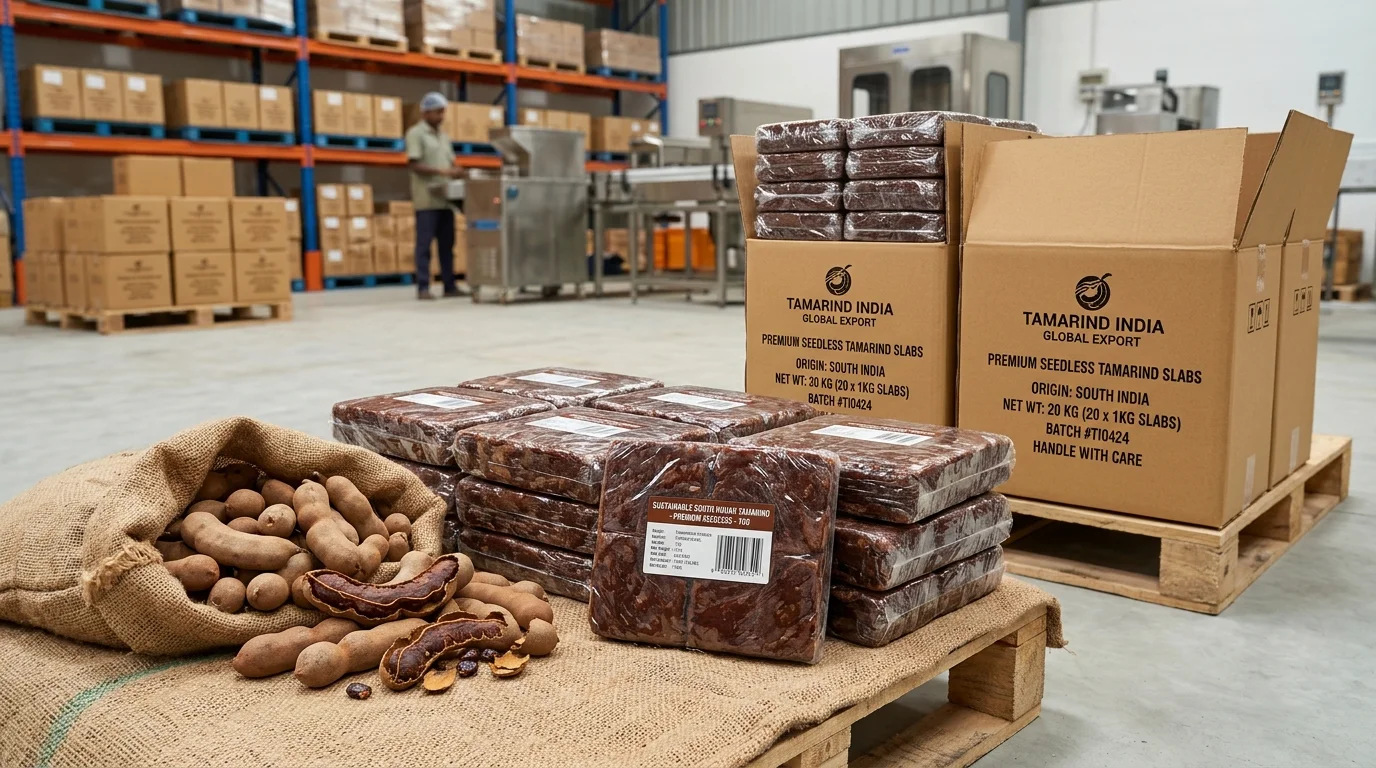
In global agricultural procurement, purchasing raw commodities based solely on gross metric ton pricing frequently masks severe operational inefficiencies. Tamarind (Tamarindus indica) in its raw, natural tree-ripened pod consists of three primary physical fractions: brittle outer shells (10% to 12%), hard stone seeds (30% to 40%), and coarse structural vascular fibers (10% to 15%). Consequently, when industrial food manufacturers purchase raw "Seeded" tamarind, up to 60% of the purchased gross container weight represents inert biological waste that must be extracted and discarded at the processing plant.
For international buyers producing Worcestershire sauce, barbecue glazes, tamarind concentrate paste, sour candy, or savory chutneys, processing seeded tamarind incurs massive operational penalties:
- Destoning Machinery Capital & Maintenance: Rock-hard tamarind seeds (containing high levels of tannin and polysaccharide gum) rapidly wear down industrial stainless steel pulping screens, impeller blades, and macerators.
- Wasted Ocean Freight Costs: Importers paying container freight rates on seeded tamarind are essentially paying maritime logistics charges on hundreds of metric tons of useless seed mass.
- Effluent and Disposal Overhead: Disposing of sticky, fibrous seed residue in destination countries involves municipal disposal fees and environmental compliance burdens.
Draba Ventures' defibered seedless processing model shifts the labor-intensive extraction pipeline directly to the harvesting clusters of South India. By mechanically destoning, manually defibering, and hydraulically compressing pure pulp at origin, industrial buyers secure an active pulp yield of 85% to 92% per metric ton, slashing factory processing time and delivering immediate cost savings on landed active ingredients.
Seeded vs. Seedless Grade Specifications: Technical Physical Parameters
Commercial tamarind trade relies on distinct physical gradations established by export inspection standards and buyer tolerance thresholds. Establishing unambiguous contract specifications avoids destination disputes regarding seed residue, moisture variance, and extraneous vegetal matter.
| Quality Parameter | Commercial Seeded Grade | Semi-Seedless Grade | Premium Defibered Seedless (Draba Export) |
|---|---|---|---|
| Seed Content (by Weight) | 30.0% to 40.0% (natural) | 8.0% to 15.0% maximum | Strict Maximum 5.0% tolerance |
| Structural Fiber Strings | 10.0% to 15.0% (intact) | Partial removal (5% to 8%) | Completely defibered (< 1.5%) |
| Moisture Content | 18.0% to 22.0% | 16.0% to 19.0% | 15.0% to 18.0% maximum |
| Natural Tartaric Acid | 10.0% to 14.0% | 12.0% to 15.0% | 12.0% to 18.0% (titratable) |
| Color Appearance | Variable brown to black | Dark reddish-brown | Uniform rich reddish-brown to dark mahogany |
| Packaging Configuration | 20kg loose in woven sacks | 10kg / 20kg bulk slabs | 1kg, 5kg, 10kg vacuum/hydraulic slabs in cartons |
| Extractable Pulp Yield | ~38% to 45% net | ~70% to 75% net | 85% to 92% direct usable pulp |
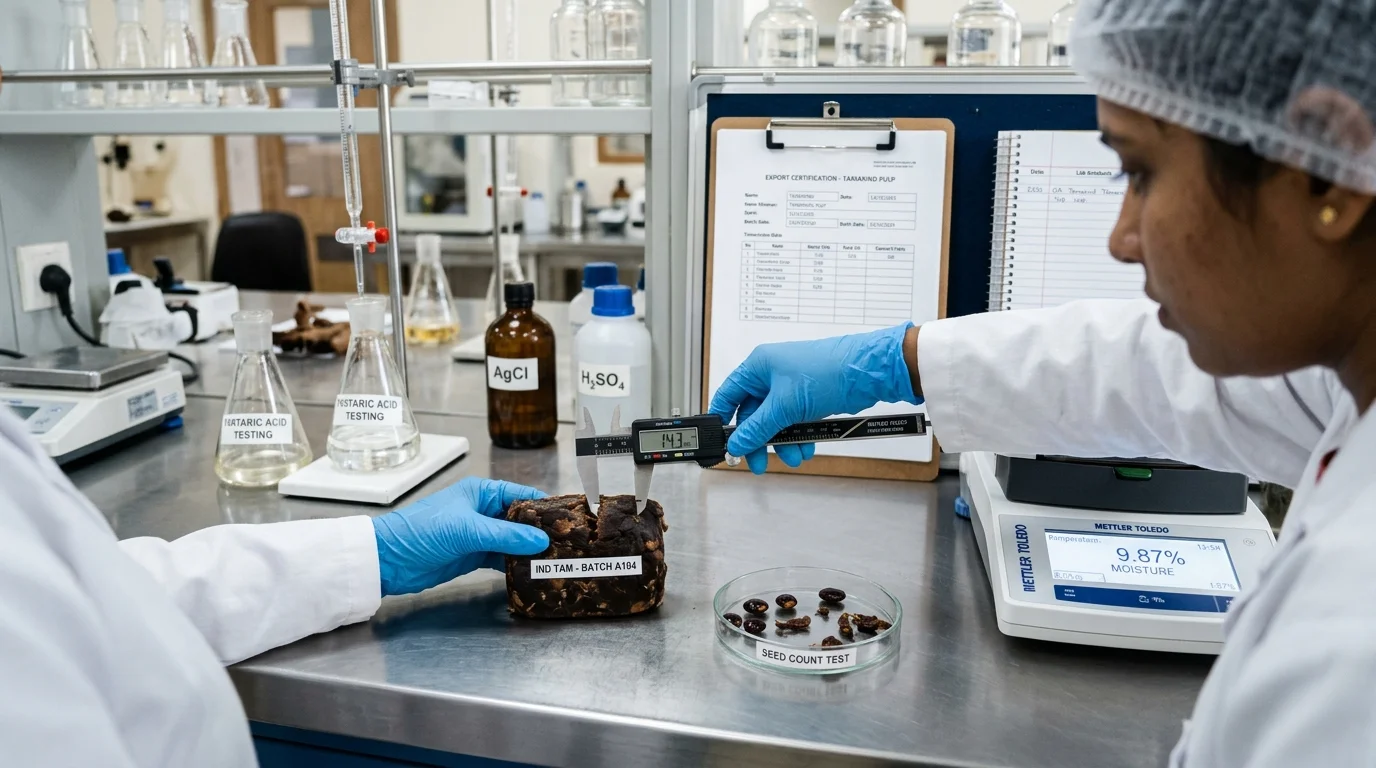
Under our strict export protocols, every lot of Premium Defibered Seedless Tamarind undergoes dual-stage inspection: automated rotary deseeding followed by illuminated visual inspection conveyors where trained sorters manually pluck residual seeds, broken shell fragments, and woody veins before hydraulic pressing.
The South Indian Tartaric Acid Advantage: Karnataka and Tamil Nadu Agro-Climatic Superiority
Tamarind is grown across several tropical zones globally, but industrial flavor chemists and procurement directors consistently prioritize South Indian origins over competing supply chains in Thailand, Myanmar, or Sub-Saharan Africa. The rationale lies in the unique biochemical balance of the South Indian crop.
Cultivated across the dry, red laterite soils and rain-shadow belts of Karnataka (Kolar, Tumakuru, Chintamani) and Tamil Nadu (Dharmapuri, Krishnagiri), South Indian tamarind trees thrive under intense sun exposure and prolonged dry harvest spells. This agro-climatic stress drives exceptionally high synthesis of natural tartaric acid (C4H6O6), reaching concentrations of 12% to 18%:
- Comparison with Thai Tamarind: The Thai tamarind market is heavily centered on "sweet tamarind" cultivars (such as Makham Wan) bred specifically for fresh fruit snacking. Thai tamarind possesses elevated inverted sugar levels (35% to 45%) and low acidity (sub-6%), making it ineffective for industrial sauce or paste applications that require clean, intense tartness.
- Comparison with African Wild Tamarind: African varieties frequently grow in untended wild stands, resulting in erratic pulp-to-fiber ratios, dark charring from uncontrolled tree-drying, and unpredictable batch-to-batch acid variation.
- The South Indian Profile: Delivers high acid potency coupled with 20% to 30% natural pectin and fruit sugars. This unique chemical profile provides natural gelation characteristics, rich mahogany coloration, and a sharp, rounded sourness that cannot be replicated by synthetic acidulants or sweetened pulp variants.
Industrial Recipe Formulation Efficiency
Because South Indian seedless tamarind carries significantly higher natural tartaric acid per kilogram, beverage, sauce, and seasoning manufacturers require 15% to 25% less raw material by volume to achieve target pH levels (typically pH 2.8 to 3.2) in their finished formulas. This tartaric acid density directly reduces recipe ingredient costs per production batch.
Moisture Control and Fungal Prevention: Hydraulic Compression and Master Packaging
The single greatest operational hazard in transatlantic and transoceanic tamarind logistics is the emergence of white fungus (surface mold colonies of Aspergillus, Penicillium, or Rhizopus) and secondary sugar fermentation during extended maritime voyages. Tamarind contains high natural fructose and glucose. If packed with high residual moisture and exposed to warm humid marine holds, microbial spores naturally present on tree bark can rapidly proliferate into visible white filamentous fungal patches.
Draba Ventures eliminates fungal degradation through a four-stage preservation and packaging protocol:
1. Controlled Solar Conditioning (< 18% Moisture)
Raw pulp is dried on clean poly-tarp raised platforms in monitored, low-humidity rural zones until moisture stabilizes between 15% and 18%. Keeping moisture strictly below 18% deprives mold spores of the free water activity required to initiate vegetative growth.
2. Hydraulic Slab De-Aeration
Fungi are obligate aerobes that cannot survive without molecular oxygen. Draba Ventures feeds calibrated pulp into industrial hydraulic compression presses that compact the loose fruit into ultra-dense 1kg, 5kg, or 10kg slab blocks, forcing out trapped atmospheric oxygen and eliminating micro-cavities where mold could germinate.
3. Barrier Film Wrapping
Each compressed tamarind slab is immediately wrapped in food-grade clear polyethylene film and hermetically heat-sealed. This barrier prevents ambient moisture re-absorption and isolates the dense slab from external maritime humidity.
4. Heavy Corrugated Master Cartons
Wrapped slabs are packed into heavy-duty 5-ply export master cartons (typically 20kg or 25kg net) lined with high-barrier plastic liners and pharmaceutical-grade silica gel desiccants. Cartons are strapped, stretch-wrapped, and loaded into dry, clean 20ft ocean containers carrying 20 to 22 metric tons per FCL.
This rigorous moisture stabilization and hydraulic compression protocol guarantees that every container arriving at Jebel Ali, Rotterdam, Houston, or Callao matches the pristine quality, aroma, and color certified on the Phytosanitary Inspection Certificate at loading.
Frequently Asked Questions
Source High-Yield Seedless Tamarind Slabs for Your Processing Facility
Consult with Draba Ventures' agricultural export team to review technical specifications, request laboratory samples for tartaric acid titration, and obtain competitive FOB or CIF quotations for containerized tamarind shipments.
Request Tamarind Specifications & Quote