Importing raw agricultural commodities into the United States requires navigating one of the strictest regulatory environments in international trade. For American specialty roasters, commercial coffee distributors, and green procurement teams, procuring unroasted coffee beans from India demands total alignment with the United States Food and Drug Administration (FDA) and the Food Safety Modernization Act (FSMA). Without active facility registrations, verified domestic legal representation, and audit-ready supply chains, consignments face catastrophic customs holds, costly FDA Notices of Action, and devastating demurrage fees. Draba Ventures provides an institutional, fully certified export bridge connecting South Indian highland plantations directly to American ports with zero regulatory friction.
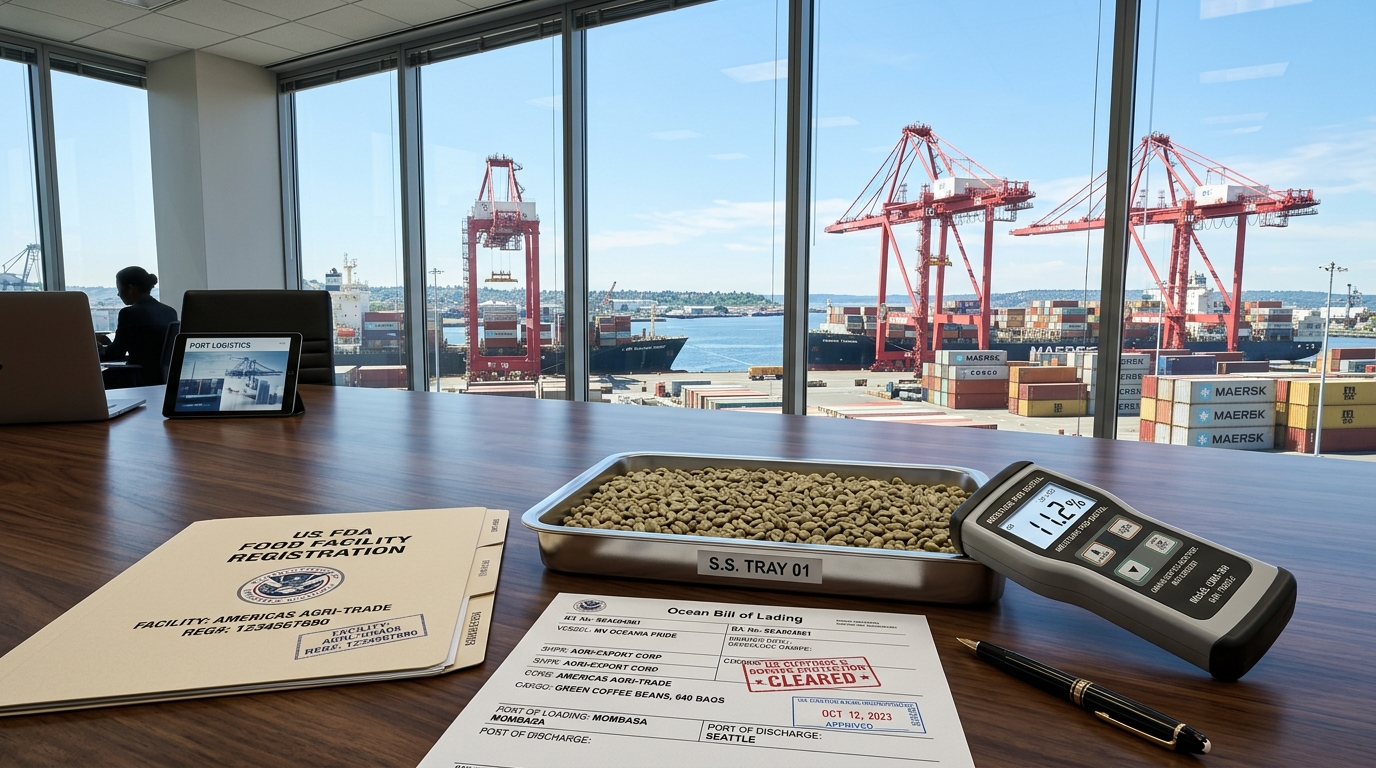
US FDA Food Facility Registration (FSMA Compliance)
Under Section 415 of the Federal Food, Drug, and Cosmetic Act (FD&C Act), enacted through the Food Safety Modernization Act (FSMA), every foreign facility that manufactures, processes, packs, or holds food destined for commercial consumption in the United States must maintain an active registration with the US FDA. Green coffee, as an unroasted agricultural commodity, falls strictly within these statutory mandates. Foreign curing works and dry mills cannot ship commercial cargo to US borders without a verified 11-digit FDA Food Facility Registration Number and an active Unique Facility Identifier (UFI) recognized through the Dun & Bradstreet Data Universal Numbering System (DUNS).
Draba Ventures maintains continuous, fully verified US FDA Food Facility Registrations across its processing and consolidation facilities in Karnataka. Our regulatory compliance desk strictly adheres to the mandatory biennial registration renewal window during even-numbered years (October 1 through December 31). This institutional maintenance prevents unexpected registration cancellations that commonly ground unvetted exporter shipments upon arrival at American container terminals:
- Mandatory Prior Notice (PN) Integration: Under Title III of the Public Health Security and Bioterrorism Preparedness and Response Act of 2002, the FDA must receive electronic Prior Notice before any food cargo reaches US borders. Working through the Automated Commercial Environment (ACE) and the FDA Prior Notice System Interface (PNSI), Draba Ventures coordinates with your US customs broker to transmit exact manifest metrics: including our FDA registration number, country of origin, port of arrival, and harmonized tariff schedule (HTS 0901.11).
- Prior Notice Confirmation (PNC): Prior Notice must be submitted and confirmed no less than 8 hours before vessel arrival for ocean freight. Draba Ventures generates verified PNC receipts well in advance of vessel berthing, eliminating customs red-flags and terminal gate holds.
- FSVP Audit-Readiness: Under the Foreign Supplier Verification Program (FSVP) codified in 21 CFR Part 1 Subpart L, US importers are legally responsible for verifying that their foreign suppliers maintain adequate hazard analysis and preventive controls. Draba Ventures provides American buyers with complete hazard analysis dossiers, standard operating procedures (SOPs), and historical pathogen and chemical audit reports for immediate FSVP qualification.
The Role of the Designated U.S. Agent
A critical cornerstone of US import compliance is the designated U.S. Agent. Under 21 CFR 1.227, every foreign facility registered with the FDA must appoint a legal representative who lives or maintains an active place of business physically within the United States. The U.S. Agent cannot be a passive post-office box; they are the legal entity authorized by the foreign exporter to communicate directly and bindingly with the FDA.
Many independent exporters make the critical error of listing unvetted contacts or relying on third-party broker favors, resulting in unanswered FDA communications and immediate administrative detention. Draba Ventures maintains an active, contracted domestic legal U.S. Agent infrastructure based permanently on American soil. This structure protects wholesale buyers across multiple operational dimensions:
- 24/7/365 Emergency Regulatory Availability: When FDA inspectors or CBP officers flag a container manifest for document clarification, the U.S. Agent must respond in real time. Our domestic agent infrastructure operates within US business hours and across all continental time zones, bridging the 9.5 to 12.5 hour time differential between Karnataka and US ports.
- Inspection Scheduling & Audit Coordination: The FDA conducts periodic on-site inspections of foreign curing facilities. Our U.S. Agent serves as the designated operational channel for scheduling routine mill audits, coordinating pre-inspection documentation, and verifying facility status without disruptive delays.
- Eliminating Demurrage and Detention Exposure: Demurrage fees at major US container ports (such as Port of New York/New Jersey, Long Beach, Los Angeles, and Seattle) frequently exceed $300 to $500 per container per day when administrative holds occur. Having an alert, responsive U.S. Agent ensures documentation issues are resolved before containers incur punitive terminal storage penalties.
Quality Assurance and Optical Defect Extraction
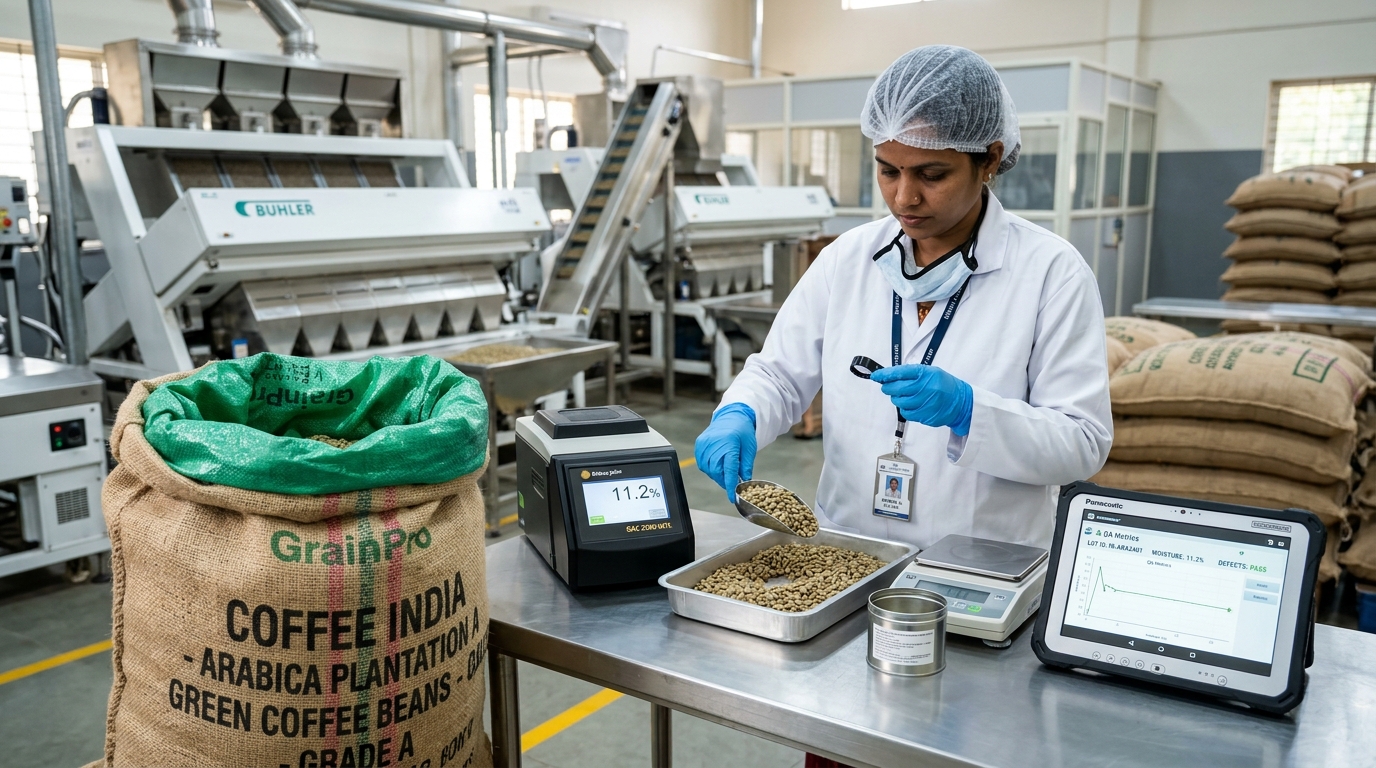
Regulatory paperwork means nothing if the physical commodity fails US import inspection. The US FDA enforces rigorous 'Defect Action Levels' (DALs) under 21 CFR 110.110. These guidelines establish maximum allowable thresholds for natural or unavoidable physical defects, specifically targeting insect damage, mold, and extraneous foreign matter. Shipments exceeding DAL tolerances are subject to immediate FDA detention, mandatory re-cleaning under federal supervision at exorbitant domestic rates, or outright re-exportation and destruction.
To protect American roasters and importers against physical cargo rejections, Draba Ventures applies multi-stage mechanical and optical conditioning across every metric ton of coffee processed in our Karnataka mills:
- VIS/NIR Hyperspectral Sorting (94.63% Accuracy): Export lots pass through multi-channel VIS/NIR Hyperspectral Imaging (HSI) Sortex machines. Operating across high-speed optical spectrums, our Sortex lines actively isolate and eject beans with internal insect bores (Hypothenemus hampei damage), immature sour cores, black seeds, and hidden fungal spots with 94.63% optical accuracy.
- Precision Density Table Separation: Prior to optical sorting, green coffee undergoes triple-deck pneumatic gravity separation. Light, hollow, insect-damaged, or mechanically chipped seeds are eradicated by density differentials, leaving only dense, sound endosperm structures.
- Zero Foreign Matter Guarantee: Triple-stage rare-earth magnetic bars, destoners, and vibrating perforated sizing screens remove agricultural debris, sticks, stones, and field contaminants, ensuring shipments pass FDA DAL visual evaluations without exception.
Moisture Control and Maritime Security
One of the highest biosecurity concerns for US agricultural inspectors is mycotoxin contamination, primarily Ochratoxin A (OTA). Synthesized by storage fungi such as Aspergillus ochraceus and Penicillium verrucosum, OTA develops when raw coffee seeds are exposed to elevated relative humidity and temperature spikes during maritime transit. The FDA actively samples incoming green coffee lots for mold contamination, refusing entry to any cargo showing active fungal growth or hazardous mycotoxin concentrations.
Ocean freight from India to the US East Coast (via Suez/Cape) or West Coast (transpacific) entails 30 to 45 days at sea. During this voyage, containers pass through drastic thermal zones, causing rapid interior condensation ('container sweat'). Draba Ventures eliminates this maritime hazard through strict, scientific handling protocols:
- Rigid Pre-Shipment Moisture Limits (< 12.0%): Prior to bagging, green Arabica and Robusta lots are cured and equalized to strict internal moisture levels between 11.0% and 11.5%, verified via calibrated capacitance moisture analyzers and water activity (aw) measurements below 0.65.
- Multi-Layer GrainPro Hermetic Liners: Standard jute bags are highly permeable, allowing salt air and ambient ocean moisture to penetrate the coffee seeds. Draba Ventures packs all US-bound coffee in 60kg export jute bags fitted with multi-layer GrainPro hermetic liners. These modified-atmosphere barriers halt oxygen and moisture exchange, preserving cellular freshness and preventing mold formulation.
- Container Desiccation & Moisture Barrier Poles: Every 20ft ocean container is outfitted with industrial calcium chloride desiccant dry-poles along interior sidewalls, capturing any trapped ambient vapor before it can condense. Cargo arrives in US ports in pristine, farm-fresh condition, ready for immediate FDA release and roaster cupping.
Technical Compliance Matrix: US FDA Import Standards vs Draba Ventures
| Regulatory & Quality Parameter | FDA Defect Action Level (DAL) / FSMA Rule | Draba Ventures Export Specification | Commercial Commodity Spot Market |
|---|---|---|---|
| Facility Registration Status | Mandatory active 11-digit FDA registration & DUNS | Fully active, biennial renewal verified, DUNS compliant | Often unregistered or third-party proxy registration |
| U.S. Agent Representation | Mandatory legal domestic representative (21 CFR 1.227) | Permanent, dedicated 24/7 domestic US Agent desk | Unverified contacts, passive brokers, or absent |
| Prior Notice Submission | Mandatory confirmation receipt prior to docking (PNC) | Pre-filed via ACE/PNSI with immediate PNC transmission | Delayed filing, port arrival holds, demurrage risk |
| Insect-Damaged Beans (DAL) | Max 10% by count (21 CFR 110.110) | < 0.5% (SCA Specialty Grade 1 standard) | 3.0% to 8.0% (Risk of targeted customs sampling) |
| Hyperspectral Defect Ejection | Not specified (Manual or mechanical standard) | 94.63% VIS/NIR optical sorting accuracy | Standard mechanical sifting (high defect leakage) |
| Moisture Content / Water Activity | No mold visible; tested for internal spoilage | Strictly 11.0% to 11.5% (< 12.0% max; aw < 0.65) | 12.5% to 13.5% (Severe container sweat risk) |
| Export Packaging Architecture | Standard commercial shipping packing | 60kg Jute + Multi-layer GrainPro hermetic liner | Single permeable burlap/jute sack (unlined) |
| Ochratoxin A (OTA) Prevention | Strict rejection of mycotoxin-contaminated lots | Absolute zero fungal growth; lab verified < 5 ppb | Unmonitored; susceptible to transit mold spikes |
Frequently Asked Questions: US FDA Coffee Import Regulations
Source US FDA Compliant Indian Green Coffee Direct from Origin
Partner with Draba Ventures for guaranteed FSMA-compliant Arabica and Robusta shipments. Benefit from active US FDA registrations, verified U.S. Agent representation, 94.63% optical Sortex defect extraction, and hermetic GrainPro maritime packaging.