Bulk Tamarind Trade Compliance: Executive Summary
Bulk tamarind procurement from India represents an economically superior choice for international food processors, confectionery manufacturers, and sauce compounders worldwide. However, crossing international borders with organic agri-commodities requires strict adherence to biological quarantine controls, food hygiene standards, and bilateral phytosanitary agreements. A single administrative mismatch or biological oversight can trigger vessel demurrage, laboratory quarantine detention, or complete cargo rejection at destination ports.
To eliminate trade friction for global buyers, Draba Ventures Private Limited operates an institutional trade compliance framework. From certified port container freight stations (CFS) across Chennai, Tuticorin, and Krishnapatnam, our export operations integrate official plant quarantine inspection, specialized container fumigation, independent third-party laboratory verification, and secure trade financing under UCP 600 standards.
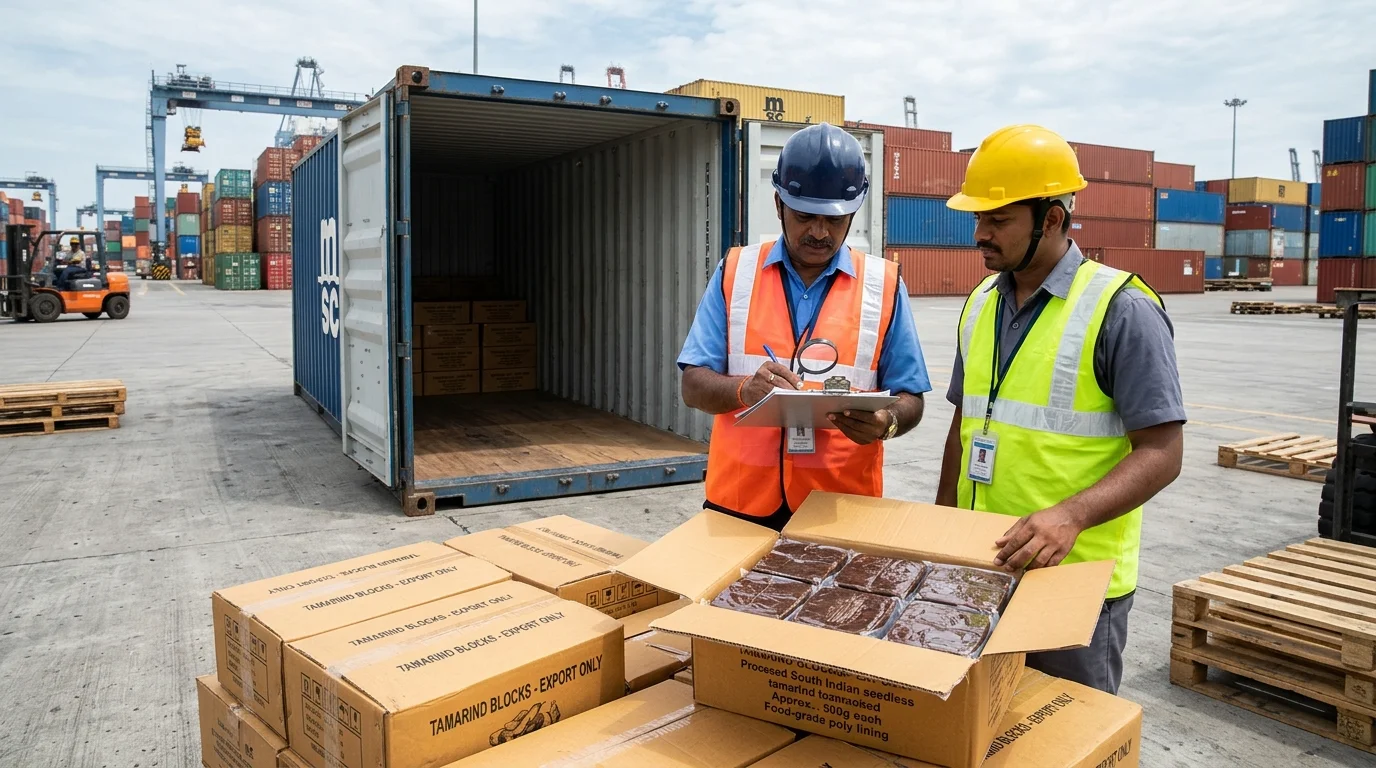
Navigating High-Strictness Customs (UAE & Mexico)
The United Arab Emirates and Mexico represent two of the world's most lucrative, yet regulatory demanding destinations for Indian bulk tamarind. While Middle Eastern buyers utilize tamarind pulp as an indispensable base for savory pastes, hot sauces, and traditional beverages, Mexican food manufacturers consume massive volumes for chili-coated tamarind candies and industrial confections. Both customs jurisdictions enforce distinct, zero-compromise border entry criteria that require flawless origin documentation.
Dubai Municipality Food Control Standards (UAE)
In the United Arab Emirates, agricultural food consignments are governed by the Dubai Municipality Food Safety Department through the computerized Food Import and Re-export System (FIRS). Importers must pre-register each specific product code, and all shipping documentation must correspond exactly with port customs declarations:
- Bilingual Arabic and English Master Labeling: Each master carton must display product identity, net weight, production date, expiry date, country of origin (India), manufacturer name, and batch code in both Arabic and English.
- Aflatoxin and Microbiological Caps: Total aflatoxins must test below 10 ppb (with B1 below 5 ppb). Total plate count, yeast, and mold counts must meet strict Gulf Standard (GSO) microbiological limits.
- Pesticide Residue Limits: Compliance with Codex Alimentarius and UAE national Maximum Residue Limits (MRLs).
- Origin Documentation Package: Commercial Invoice, Detailed Packing List, Certificate of Origin issued by authorized Chamber of Commerce, original Phytosanitary Certificate, and Health/Halal declaration where requested.
Mexico SAGARPA & SENASICA Regulations
Mexico's Secretariat of Agriculture and Rural Development (SAGARPA) and the National Service of Agro-Alimentary Public Health, Safety and Quality (SENASICA) enforce stringent phytosanitary import requirements (Módulos de Requisitos Fitosanitarios). Because Mexico produces indigenous agricultural crops, federal quarantine authorities aggressively guard against invasive tropical pests:
- Zero Live Pest Tolerance: Consignments must be completely free of live insects at all life stages, specifically targeting stored-product beetles such as Caryedon serratus (tamarind beetle) and Tribolium castaneum.
- Chemical Treatment Endorsement: The Phytosanitary Certificate issued in India must explicitly record the chemical treatment details in Section III, including fumigant name (Methyl Bromide), dosage rate (g/m³), exposure temperature, and exposure duration.
- Packaging Material Phytosanitary Compliance: All solid wood packaging materials and pallets must be ISPM 15 heat-treated (HT) or Methyl Bromide treated with clear, indelible IPPC stamps to prevent border delays.
Draba Ventures' compliance desk coordinates directly with buyer-appointed customs clearing agents in Dubai (Jebel Ali) and Mexico (Manzanillo / Veracruz), transmitting digitized advance copies of all shipping documentation prior to vessel berthing. This pre-clearance protocol guarantees instant customs release upon container discharge.
Mandatory Pre-Shipment Fumigation Protocols
Dried tamarind is naturally sweet, acidic, and organic, making it inherently vulnerable to pest infestation if left untreated during long ocean voyages through tropical maritime waters. Storage pests such as the tamarind seed borer, red flour beetle, and sawtoothed grain beetle can reproduce rapidly in warm cargo holds, leading to irreparable internal slab damage and immediate quarantine destruction at destination ports.

To ensure 100% pest-free cargo arrival, Draba Ventures enforces strict, standardized pre-shipment container fumigation protocols carried out by government-accredited pest control operators right at Indian port container freight stations:
1. Methyl Bromide (MBr) Fumigation
Methyl Bromide is an ultra-fast acting, deeply penetrative broad-spectrum gas fumigant. It is universally accepted by customs authorities across the Americas, the Middle East, and Asia. MBr penetrates dense, compressed tamarind slabs, neutralizing adult insects, larvae, pupae, and viable eggs within 24 hours. Treatments are executed at 32 g/m³ to 48 g/m³ at temperatures above 21°C in gas-tight sealed containers or under hermetic tarpaulins.
2. Aluminum Phosphide (ALP / Phosphine) Fumigation
Aluminum Phosphide releases hydrogen phosphide (phosphine) gas through atmospheric moisture reaction. It leaves zero chemical residue on organic fruit pulp, making it the preferred protocol for European and specialty food processors. ALP requires a minimum exposure duration of 5 to 7 days, allowing safe in-transit or pre-berth completion without compromising pulp flavor or volatile aromatic acids.
Standard Operating Degassing Protocol
Following required chemical exposure, containers undergo controlled degassing and aeration until ambient gas concentration drops below occupational safety limits (threshold limit value of 1 ppm for MBr, 0.3 ppm for phosphine). Once certified clear, the Indian Plant Quarantine Organization conducts a physical inspection and issues the official Phytosanitary Certificate.
SGS and Third-Party Quality Inspections
For new international food manufacturers and FMCG procurement directors, buying agricultural commodities overseas can present quality and counterparty anxieties. To eliminate trust barriers and provide absolute transparency, Draba Ventures integrates third-party pre-shipment quality inspections through globally recognized accredited agencies including SGS, Bureau Veritas, and Intertek.
Independent inspection teams are deployed to the container stuffing facility to execute rigorous sampling and laboratory assays in accordance with ISO 2859-1 standards:
- Net and Gross Weight Verification: Random carton sampling and digital scale calibration to ensure 100% billing accuracy across all master cartons and pallet configurations.
- Moisture Content Assay: Verified using calibrated halogen moisture analyzers. Industrial seedless slabs are kept strictly within the optimal 15% to 18% moisture window to prevent fungal growth while maintaining processing malleability.
- Seed and Fiber Tolerance Audit: Defibered seedless blocks are manually dissected and analyzed to verify residual seed content remains strictly under 1.0% by weight, safeguarding industrial puree grinders.
- Aflatoxin and Heavy Metal Testing: Independent HPLC testing confirming total aflatoxins below international limits and zero heavy metal contamination (lead, cadmium, arsenic).
- Container Pre-Loading Inspection & Security Sealing: Verification that container interior is dry, odor-free, structurally sound, and clean. Upon stuffing completion, high-security ISO 17712 certified bolt seals are affixed, with numbers documented directly on the SGS Certificate of Inspection and the Ocean Bill of Lading.
Securing Capital with LC at Sight
International agricultural trade demands dependable trade finance mechanisms that protect the financial liquidity of both buyer and seller. Draba Ventures executes bulk export contracts through Irrevocable Letters of Credit payable at sight (LC at Sight) issued by Tier-1 international commercial banks.
Under an Irrevocable LC at Sight, the importer's capital remains completely protected within the banking system until the supplier presents an exhaustive, legally verified documentation package that satisfies every contractual condition specified in the documentary credit (under ICC Uniform Customs and Practice for Documentary Credits - UCP 600):
| Compliance Document | Issuing Authority | Critical Verification Parameters |
|---|---|---|
| Ocean Bill of Lading (3/3 Originals) | Global Shipping Line (Maersk, MSC, CMA CGM) | Clean on board, freight prepaid, container and high-security seal numbers matching invoice exactly. |
| Phytosanitary Certificate | Directorate of Plant Protection, Quarantine & Storage (India) | Certified pest-free, chemical treatment endorsement (MBr/ALP dose, exposure, temp). |
| Certificate of Origin (COO) | Chamber of Commerce / Export Promotion Council | Authenticates South Indian agricultural origin, HS Code 0813.40.00 / 0813.40.10. |
| Original Fumigation Certificate | Government-Accredited Fumigation Operator | Chemical agent, dosage rate, exposure duration, and gas-clearance safety certificate. |
| SGS / BV Quality Certificate | Independent Inspection Agency (SGS / Bureau Veritas) | Certifies exact weight, moisture (15-18%), seed percentage tolerance (<1%), and seal integrity. |
| Commercial Invoice & Packing List | Draba Ventures Private Limited | Complete itemization of slab formats, net/gross weights, batch numbers, and CIF contract terms. |
By executing contracts under LC at Sight terms, international buyers maintain complete leverage: funds are never disbursed until our cargo has passed all statutory agricultural inspections, has been fumigated under sealed conditions, and is securely in maritime transit.
Need Certified Bulk Tamarind with Guaranteed Customs Clearance?
Speak with Draba Ventures' export compliance desk for tailored CIF quotations, complete sample phytosanitary dossiers, and custom slab packaging specifications.
Request Trade Compliance Consultation