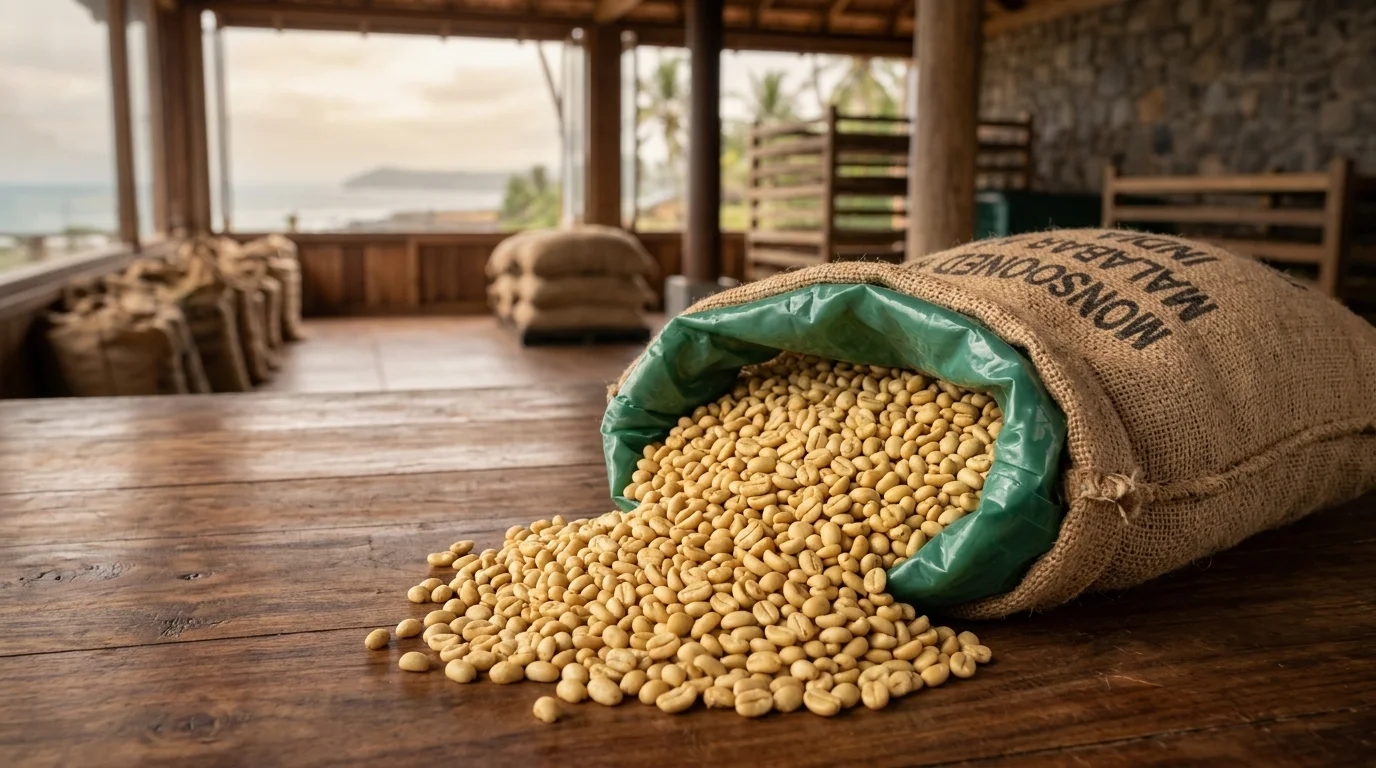
The Science of the Monsoon Process
Monsooned Malabar AA is globally recognized as one of the most chemically and physically unique coffees in international commodity trade. Protected by a Geographical Indication (GI) tag under Indian intellectual property law, authentic Monsooned Malabar is produced exclusively along the humid Malabar coastline of Karnataka and Kerala, utilizing high-grade Arabica Cherry AB harvested in the Western Ghats.
The monsooning process is a controlled, highly specialized 7-week post-harvest bio-physical transformation executed between June and September during the Southwest Monsoon. The process begins in open-sided brick and wooden curing warehouses situated directly along the Arabian Sea in coastal hubs such as Mangalore and Tellicherry. During this period, oceanic gale-force winds bring relentless ambient relative humidity exceeding 90% to 95%:
The technical continuum of the 7-week monsooning cycle involves strict manual and mechanical protocols:
- Controlled Yard Spreading and Aeration: Unwashed Arabica Cherry AB beans are evenly distributed across polished concrete floors in layers 4 to 6 inches thick. The beans are systematically raked and turned by hand every 2 to 3 hours to prevent local moisture stratification and eliminate mold hotspots.
- Equalizing Moisture Absorption: Over the initial 18 to 22 days, the porous seeds absorb moisture from moisture-laden marine winds, elevating green bean internal moisture from an initial 11.5% up to 15.5% to 16.5%.
- Bagging, Equalization Pyramids, and Restacking: The swollen beans are loosely packed into breathable gunny bags and stacked into tiered equalization pyramids with deliberate airflow alleys. Periodically, the bags are dismantled, aired out, and re-piled to ensure 100% homogeneous exposure across every single coffee lot.
- Enzymatic Acidity Eradication: As moisture migrates into the cellular endosperm, endogenous enzymes metabolize astringent chlorogenic acids and tart citric acids. Perceived acidity drops to near zero, shifting the bean brew pH from typical acidic thresholds (pH 4.8 - 5.2) to an extraordinarily smooth pH of 6.2 to 6.5.
- Volumetric Swelling & Density Shift: The absorption of marine humidity physically expands the bean structure by 50% to 60% in volume. Average bean length increases from 6.5 mm to over 8.5 mm, shifting screen calibration to Screen 19 (7.50 mm) or Screen 20, while bulk density drops from ~680 g/L down to 480-530 g/L, producing a delicate, puffy golden-yellow bean.
| Technical Quality Parameter | Pre-Monsoon Arabica Cherry AB | Monsooned Malabar AA (Final Export) | Standard Washed Specialty Arabica |
|---|---|---|---|
| Screen Size Calibration | Screen 17/18 (6.75 - 7.10 mm) | Screen 19 (7.50 mm+) >90% | Screen 17 (6.75 mm) >90% |
| Bulk Density | 670 - 700 g/L (Dense cellular core) | 480 - 530 g/L (Porous swollen core) | 610 - 645 g/L |
| Perceived Cup Acidity | Moderate to brisk malic acidity | Absolute Zero Perceived Acidity (pH 6.2+) | High, bright phosphoric / citric acidity |
| Visual Coloration | Jade green / bluish-olive | Golden-yellow / pale amber straw | Sage green to bluish-green |
| Cup Body & Mouthfeel | Medium-plus body | Extra-heavy, syrupy, velvet texture | Medium, tea-like to juicy body |
| Primary Flavor Descriptors | Toasted hazelnut, cocoa nib, dark cherry | Baker's chocolate, pipe tobacco, malt, clove | Bergamot, stone fruit, jasmine, brown sugar |
Cupping Profile and Wholesale Applications
For master roasters, boutique espresso blending houses, and commercial capsule manufacturers across Europe, North America, and East Asia, Monsooned Malabar AA serves as an irreplaceable functional tool in blend architecture. Rather than relying on synthetic additives or over-roasting to dampen astringency, coffee roasters incorporate Monsooned Malabar AA to naturally re-engineer the sensory balance of espresso formulations.
The sensory footprint of Monsooned Malabar AA is distinguished by heavy, syrupy viscosity and total lack of sharp acidity. The cup profile delivers deep, complex layers of bittersweet baker's chocolate, sweet cedar wood, aged pipe tobacco, malted cereal, and warm baking spices such as cardamom and nutmeg, accompanied by an unusually persistent, buttery finish.
Key B2B wholesale blending applications include:
- Neutralizing Hyper-Acidic Micro-Lots: In modern specialty espresso formulations featuring high-acid washed African coffees (such as washed Ethiopian Yirgacheffe or Kenyan SL-28), adding 15% to 25% Monsooned Malabar AA softens sharp fruit acids without compromising the delicate floral aromatics of the top notes.
- Thick Crema Expansion with Low Bitterness: While standard Robusta is often added to boost crema, it introduces significant bitterness. Monsooned Malabar AA achieves comparable crema volume, elastic tiger-striping, and micro-bubble longevity through its unique lipid-to-protein ratio, but with zero harshness and completely sweet, cocoa-driven notes.
- Comfort Blends for Acid-Sensitive Consumers: An expanding global consumer demographic suffers from gastric reflux or acid sensitivity. Single-origin Monsooned Malabar medium-dark roasts offer an exceptionally stomach-friendly, low-acid coffee experience that commands retail price premiums in specialty markets.
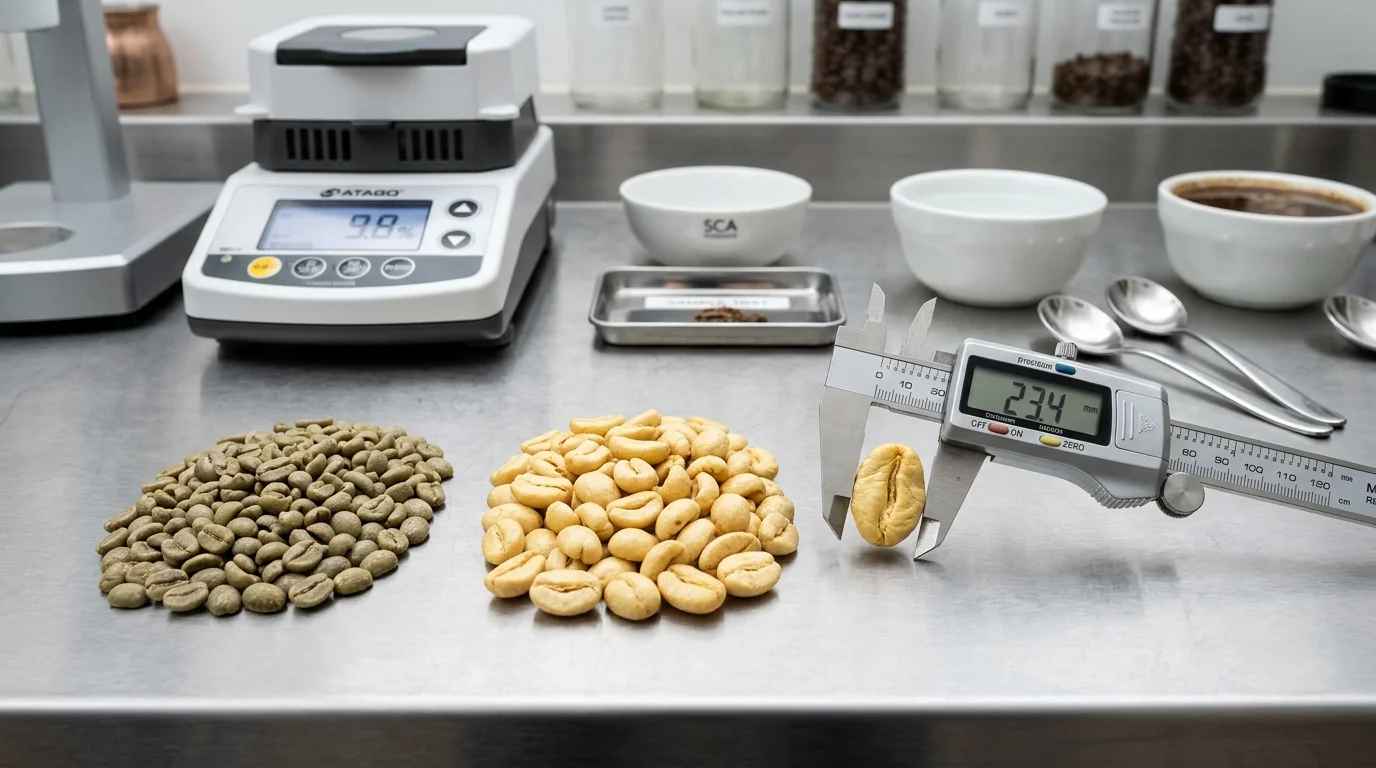
Quality Assurance and Optical Defect Extraction
The bio-physical transformations that create Monsooned Malabar also introduce critical supply chain vulnerabilities. Because the beans absorb high moisture levels over 7 weeks and swell physically, the cellular walls become softer, more porous, and structurally delicate compared to hard green coffee. Furthermore, sustained high humidity creates an ever-present hazard of fungal proliferation or internal black mould if curing yards are not managed with clinical discipline.
Draba Ventures enforces a multi-tier quality control protocol across our curing facilities in Karnataka to deliver flawless export consignments. Dried monsooned lots first undergo dual-stage mechanical destoning and gentle pneumatic aspiration to eliminate brittle fragments, dry husks, and atmospheric dust.
The lots then pass through our state-of-the-art VIS/NIR Hyperspectral Imaging (HSI) Sortex optical sorting systems. Calibrated to an industry-leading 94.63% optical sorting accuracy, high-frequency optical sensors identify microscopic discoloration and pneumatic ejectors instantly purge compromised beans:
- Fungal-Damaged and Mold-Infected Beans: Beans showing surface fungal mycelium or deep internal brown/black mould discolorations that survive initial washing.
- Hollow and Insect-Damaged Seeds: Swollen beans possessing internal cavities from coffee berry borers (Hypothenemus hampei) that compromise structural density.
- Bleached and Structurally Brittle Fragments: Chipped or mechanically sheared bean segments that roast erratically and cause scorched bitter notes in espresso.
- Residual Hull and Foreign Matter: Microscopic clay particles, dried pericarp fragments, and burlap threads that bypass vibrating screen sorters.
Post-Monsoon Moisture Control and Maritime Security
The most technically challenging phase of Monsooned Malabar production is the transition from moist curing to international ocean transit. Although the green beans are deliberately saturated with moisture up to 16.5% during monsooning, shipping beans at this moisture level across maritime corridors would cause catastrophic mould bloom, total consignment spoilage, and severe mycotoxin contamination.
When green coffee moisture exceeds 12.5% or water activity (aw) surpasses 0.65 in hot container holds, Aspergillus and Penicillium fungal strains rapidly germinate, synthesizing Ochratoxin A (OTA). Under stringent European Food Safety Authority regulations (EU 2022/1370), the statutory ceiling for OTA in green coffee is set strictly at 3.0 ug/kg (ppb). Consignments exceeding this tolerance face mandatory rejection, re-exportation, or border destruction at European ports.
Draba Ventures completely eliminates ocean freight moisture risk through three strict maritime protocols:
- Post-Monsoon Controlled Drying: Following the 7-week monsoon exposure, lots are transferred to specialized drying halls where dehumidified airflow gently reduces bean moisture content down to strictly between 11.0% and 11.5%, with certified water activity maintained below 0.60 aw.
- Multi-Layer GrainPro Hermetic Packaging: Stabilized Monsooned Malabar AA lots are immediately vacuum-sealed inside high-barrier, multi-layer GrainPro hermetic protective liners prior to outer encasement in heavy-duty 60kg jute bags, completely locking out humid sea air and locking in golden color.
- Container Desiccant Poles & Thermal Dressing: Ocean containers stuffed at New Mangalore Port (NMPT) are fully lined with moisture-barrier Kraft paper and outfitted with industrial calcium chloride desiccant poles absorbing up to 300% of their weight in condensation, preventing container rain.
Monsooned Malabar AA Importer FAQ
Source Authentic Indian Monsooned Malabar AA Direct from Origin
Partner directly with Draba Ventures for export-grade Monsooned Malabar AA (Screen 19+) with 94.63% optical Sortex defect extraction, guaranteed post-monsoon moisture under 12.0%, and GrainPro hermetic packaging.
