Indian Robusta Cherry AB green coffee wholesale represents the premier global formulation bean for commercial espresso roasters, instant coffee manufacturers, and private-label distributors. Harvested across Karnataka's Western Ghats, Screen 17/18 natural Robusta Cherry AB delivers high bulk density (690-720 g/L), an industry-leading soluble solids extraction yield of 28% to 32%, and a thick, persistent micro-bubble crema with elastic tiger striping. Draba Ventures guarantees 94.63% VIS/NIR Sortex defect extraction, direct-trade FOB Mangalore pricing, and GrainPro hermetic moisture stabilization strictly below 12.0%.
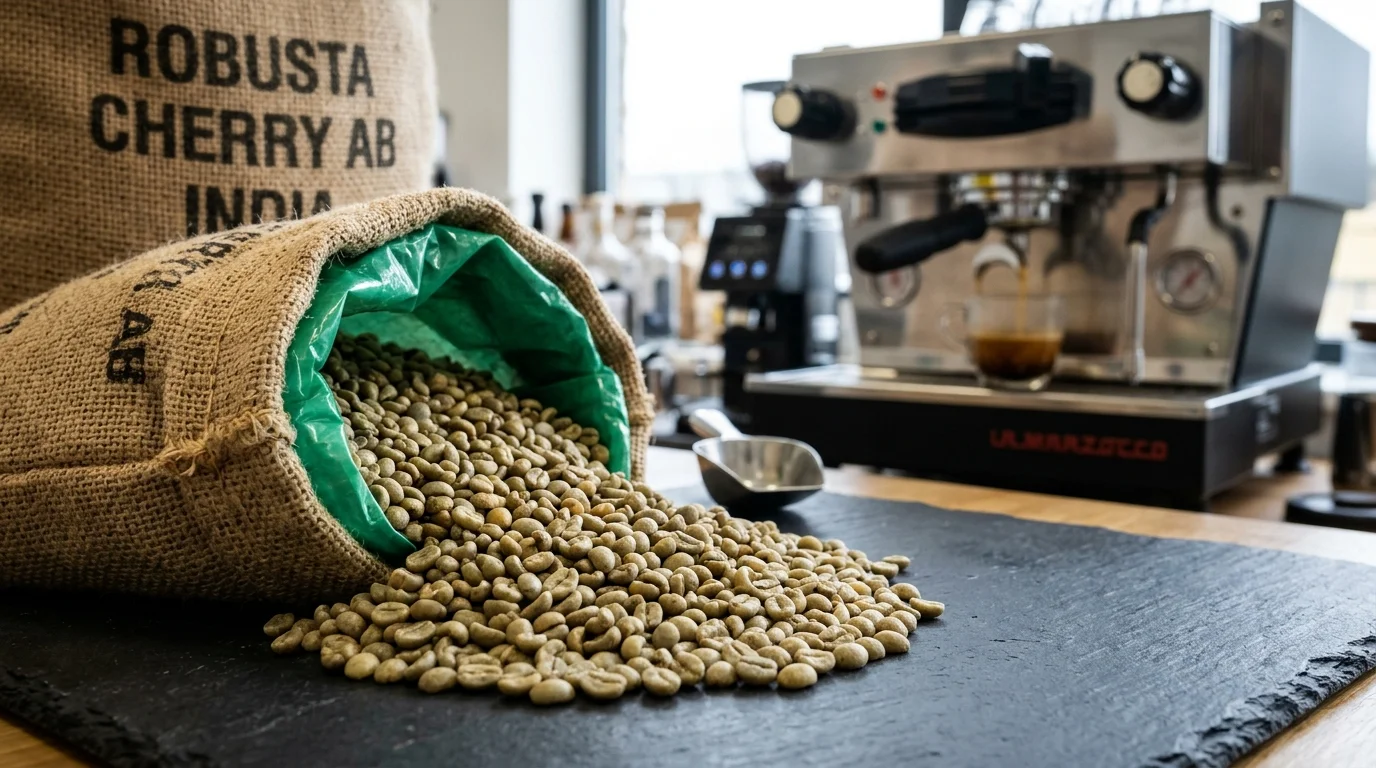
The Physics of Indian Robusta Cherry AB
In high-volume commercial coffee roasting and traditional European espresso formulations (particularly Italian 70/30 and 80/20 Arabica/Robusta blends), Indian Robusta Cherry AB (Coffea canephora) is an indispensable functional ingredient. While commercial commodity brokers often treat Robusta merely as a price-dampening filler, experienced roastmasters recognize that Indian shade-grown Robusta possesses unique physical and chemical characteristics that cannot be replicated by low-altitude sun-grown Robustas or washed Arabicas.
The primary mechanical driver is bulk cellular density. Sourced from the mist-covered slopes of Chikmagalur, Coorg, and Hassan at elevations between 600 and 1,100 meters above sea level, Indian Robusta matures under a diverse, two-tier forest canopy. This prolonged developmental timeline creates an exceptionally dense endosperm cellular matrix, with bulk density consistently registering between 690 and 720 g/L (compared to 600-640 g/L in typical commercial Arabica). During roasting, this dense cellular wall resists premature thermal collapse, allowing roasters to apply convective heat transfer deep into the bean core without scorching the exterior surface.
The chemical payoff of this dense matrix is extraordinary crema production and retention:
- Carbon Dioxide Micro-Bubble Entrapment: The rigid cellular structure of Robusta Cherry AB retains significantly higher volumes of carbon dioxide (CO2) during pyrolysis. When subjected to 9 bars of hydraulic pressure in commercial espresso portafilters, this trapped gas forms a dense emulsion of microscopic foam bubbles.
- Lipid-to-Protein Emulsification Balance: While Arabica contains approximately 15-17% lipids, Indian Robusta contains roughly 10-11% lipids and a higher proportion of surface-active soluble proteins. This lower free-oil concentration prevents the structural collapse of espresso crema, creating an elastic, long-lasting golden-hazelnut foam head with pronounced tiger striping that sustains for over two and a half minutes.
- Syrupy Viscosity and Full Body: Robusta Cherry AB delivers high concentrations of chlorogenic acids and galactomannans, providing a rich, heavy, syrupy mouthfeel and notes of dark chocolate, toasted walnut, and malted cocoa that cut cleanly through dairy in cappuccinos and lattes.
| Physical / Chemical Property | Indian Robusta Cherry AB (Natural) | Indian Robusta Parchment AB (Washed) | Commercial Arabica Plantation A |
|---|---|---|---|
| Screen Size Calibration | Screen 17/18 (6.75 - 7.10 mm) >90% | Screen 17/18 (6.75 - 7.10 mm) >90% | Screen 17 (6.75 mm) >90% |
| Bulk Density | 690 - 720 g/L (Highest cellular mass) | 670 - 700 g/L | 610 - 645 g/L |
| Soluble Solids Extraction | 28.0% - 31.5% (Maximum yield) | 25.5% - 28.0% | 20.0% - 24.0% |
| Crema Elasticity & Persistence | Maximum thickness, micro-bubble elasticity, >150s | Moderate thickness, clean foam, ~90s | Delicate, quick-dissipating foam, <60s |
| Primary Cup Characteristics | Heavy dark cocoa, roasted hazelnut, malt, dense body | Clean, toasted grain, cedar, balanced bitterness | Bright citrus, floral, caramel, delicate body |
| Commercial Application | Espresso blends, instant coffee, dark roasts | Premium espresso crema, single-origin Robusta | Filter coffee, specialty pour-overs, light roasts |
Natural (Cherry) vs. Washed Processing
In Indian coffee terminology defined by the Coffee Board of India, "Cherry" designates unwashed, dry-processed green coffee, whereas "Parchment" denotes wet-processed green coffee. For industrial food service roasters, institutional coffee packagers, and instant coffee processors, the decision between natural Cherry and washed Parchment directly impacts profitability, extraction yields, and flavor intensity.
During natural cherry harvesting, whole ripe Robusta cherries are gathered and immediately transferred to raised drying beds or clean concrete patios. For 12 to 15 days under Karnataka's intense post-monsoon sun, the cherries are turned hourly to achieve uniform dehydration. Throughout this slow desiccation, the mucilage sugars, fruit pectins, and natural organic acids remain in direct physical contact with the seed, gradually migrating through the parchment skin into the green bean endosperm.
This natural dehydration process unlocks vital B2B operational advantages:
- Higher Soluble Solids Extraction Yield: Natural Robusta Cherry AB yields between 28.0% and 31.5% total soluble solids during industrial brewing and extraction cycles, compared to 20% to 24% for washed Arabica. For spray-dried, agglomerated, and freeze-dried instant coffee manufacturers, this 25% higher extraction throughput translates directly to increased kilograms of finished soluble powder per ton of imported green beans.
- Broad Caramelization Window: Because sugars from the mucilage are locked inside the bean cellular matrix, Robusta Cherry AB exhibits a broad, forgiving roast curve. Roasters can push the bean into medium-dark and dark roast stages (Vienna to French roast) to develop rich pyrolytic dark chocolate notes without scorching or inducing harsh ash tones.
- Blended Cost Optimization: Incorporating 20% to 35% Robusta Cherry AB into commercial espresso blends stabilizes wholesale raw material unit costs, shielding roasters from volatile Arabica C-market spikes while dramatically enhancing cup viscosity.
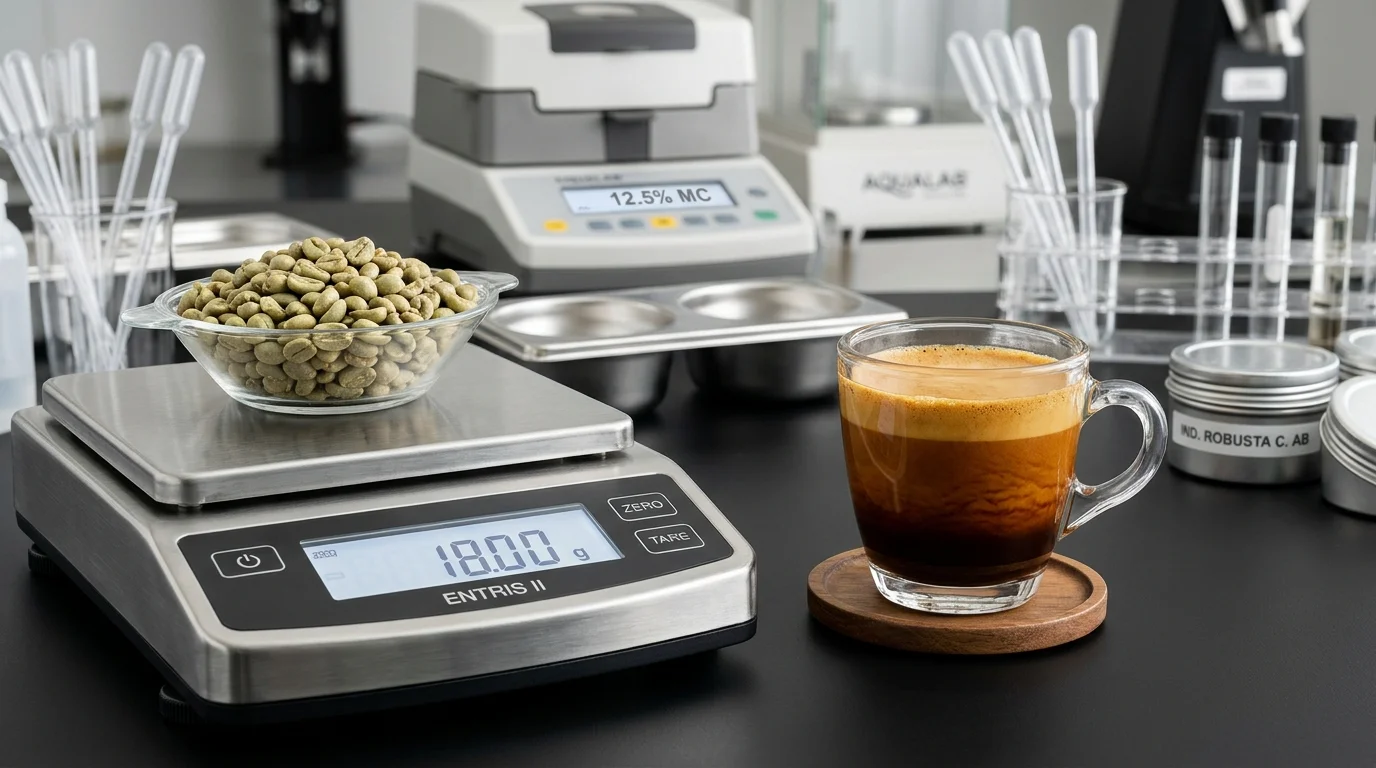
Quality Assurance and Optical Defect Extraction
Historically, natural dry-processed coffees carried the reputation of higher physical defect counts due to uneven patio drying and debris collection. Draba Ventures eradicates this legacy risk by deploying an automated, industrial-grade cleaning and sorting continuum at our dry curing mills in Karnataka.
Incoming dried cherries are first destoned, aspirated to remove dust and light husk flakes, and hulled through rubber-roller hullers that strip the dried outer pericarp without nicking or bruising the internal green beans. The raw green coffee is then routed across multi-deck vibratory screens, ensuring over 90% of beans are retained on Screen 17 (6.75 mm) and Screen 18 (7.10 mm), with 100% passing Screen 19.
Following mechanical grading, lots pass through our VIS/NIR Hyperspectral Imaging (HSI) Sortex optical sorting systems. Operating at an industry-benchmark 94.63% optical sorting accuracy, high-speed pneumatic ejectors isolate and purge defects across the visible and near-infrared spectrums:
- Black and Sour Beans: Fully black or partially sour beans caused by over-fermentation on drying yards, which impart foul vinegar notes if roasted.
- Insect and Berry Borer Punctures: Beans damaged by the coffee berry borer (Hypothenemus hampei), which degrade structural density and cup clarity.
- Broken and Chipped Beans: Mechanically damaged fragments that roast unevenly and burn during high-temperature roasting cycles.
- Residual Foreign Matter: Small silica stones, dried husk fragments, and twigs that escape gravity separator tables.
Moisture Control and Maritime Security
Ocean freight shipments of green coffee from New Mangalore Port (NMPT) or Cochin to European, North American, or Middle Eastern ports traverse maritime corridors characterized by intense ambient heat and high humidity. In standard 20ft ocean containers carrying 18 Metric Tons (300 bags of 60kg each), daily temperature shifts between daytime equatorial sunshine and nighttime sea breezes cause moisture migration inside the container walls (container sweat).
If green coffee is stuffed at moisture levels exceeding 12.5% or water activity (\(a_w\)) above 0.65, condensation cycles trigger the germination of dormant mold spores, notably Aspergillus ochraceus. This fungus synthesizes Ochratoxin A (OTA), a hazardous nephrotoxic mycotoxin strictly regulated by the European Food Safety Authority. Under Regulation (EU) 2022/1370, the statutory limit for Ochratoxin A in green coffee is set at 3.0 μg/kg (ppb). Any consignment testing above this ceiling is subject to mandatory rejection or destruction at destination ports.
Draba Ventures secures every export consignment against moisture degradation through three critical safeguards:
- Calibrated Moisture Stabilization: Prior to bagging, green beans are conditioned until moisture content is verified strictly between 11.0% and 11.5%, with water activity maintained below 0.60 \(a_w\) using calibrated digital moisture analyzers.
- Multi-Layer GrainPro Hermetic Liners: Lots are sealed inside high-barrier, multi-layer GrainPro hermetic protective liners before insertion into heavy-duty 60kg jute bags. This gas-tight seal establishes an independent micro-climate that blocks ambient humidity absorption and locks in natural bean density.
- Container Desiccation & Kraft Barrier Dressing: Ocean containers are lined with food-grade moisture-absorbing Kraft paper and equipped with high-capacity calcium chloride container desiccant poles capable of absorbing up to 300% of their weight in condensation.
Frequently Asked Questions (Robusta Cherry AB Wholesale)
Source Premium Indian Robusta Cherry AB Direct from Origin
Partner directly with Draba Ventures for export-grade Robusta Cherry AB (Screen 17/18) with 94.63% optical Sortex defect extraction, guaranteed moisture under 12.0%, and GrainPro hermetic maritime packaging.