L'esposizione giuridica e patrimoniale degli imballaggi tradizionali in fibra termoformata
For international food packaging distributors, import brokers, and restaurant chains, sourcing molded sugarcane bagasse has shifted from an environmental upgrade into a complex regulatory compliance minefield. Over the past decade, manufacturers across Asia turned to fluorochemical treatments - specifically per- and polyfluoroalkyl substances (PFAS) - to make porous sugarcane pulp resistant to hot cooking oils and boiling liquids.
Today, those same chemical additives represent catastrophic corporate liabilities. Customs agencies across North America and the European Union are actively detaining non-compliant containers at ports of entry, issuing severe civil penalties, and enforcing total product recalls on distributors holding non-compliant inventory.
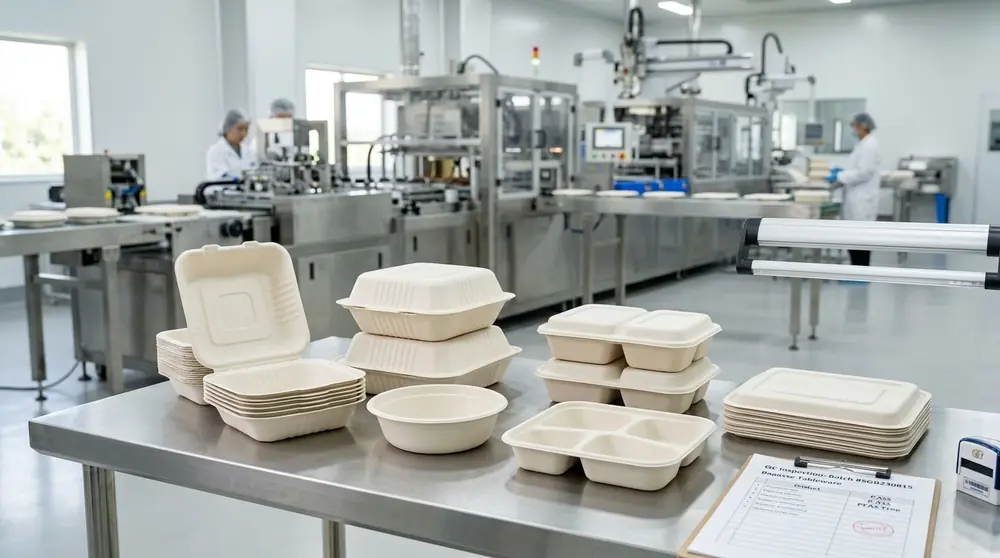
Regulatory Shift: The European Packaging and Packaging Waste Regulation (PPWR) Article 21 mandates an outright prohibition on food-contact packaging containing PFAS starting August 12, 2026. Simultaneously, over 12 US states, including California (AB 1200), New York, and Washington, have already enacted zero-tolerance thresholds prohibiting intentional PFAS additions.
Scienza dei materiali : Come operano le dispersioni barriera prive di PFAS
Sugarcane bagasse is the fibrous residue left after crushing stalks for juice extraction. While cellulose fibers naturally interlock under high hydraulic pressure and heat, raw pulp is inherently hydrophilic and oleophilic. Uncoated pulp absorbs frying oils and boiling liquids within seconds.
To eliminate forever chemicals without sacrificing high-heat grease barriers, modern advanced paper engineering utilizes water-based polymer dispersion coatings and certified biodegradable barrier films. Instead of blending synthetic fluorine salts into the raw pulp slurry, micro-thin aqueous barriers are applied uniformly during or post-thermoforming.
- Aqueous Dispersion Barriers: Ultra-fine acrylic or bio-wax dispersions create a continuous non-porous film that prevents fatty acids from penetrating cellulose capillaries.
- Mechanical Fiber Refining: Higher-density wet-press thermoforming increases fiber surface contact, reducing interstitial pore sizes and dramatically lowering grease ingress.
- Certified Biodegradability: Dispersion-coated containers break down completely in industrial composting facilities without leaving toxic chemical residues or microplastics.
Quadro comparativo internazionale dei limiti normativi sui PFAS
Foodservice distributors must distinguish between loose marketing claims and legally binding regulatory standards. The following matrix details the active standards governing food-contact fiber packaging across major global trade jurisdictions:
| Giurisdizione e Standard | Data di entrata in vigore | Soglia limite di conformita | Metodo di analisi riconosciuto |
|---|---|---|---|
| EU PPWR (Article 21) | August 12, 2026 | Zero intentional use; TF < 50 ppm | Combustion Ion Chromatography (CIC) |
| US California (AB 1200) | Active Mandate | Total Organic Fluorine (TOF) < 100 ppm | Oxygen Bomb Combustion / CIC |
| US New York (ECL 37-0209) | Active Mandate | Zero intentional PFAS addition | Batch Certificate of Analysis (CoA) |
| France (AGEC Law) | Active Mandate | Total prohibition in disposables | Third-party laboratory validation |
| Australia APCO Target | Phased Rollout | Zero trace targets in compostable packaging | AS 4736 / AS 5810 certification |
Economia logistica : Ottimizzazione del carico e pallettizzazione nei container 40ft HC
Switching to certified PFAS-free sugarcane packaging requires rigorous supply chain cost modeling. Importers must balance raw unit pricing against ocean freight density and container utilization. High-precision thermoformed bagasse nests tightly, maximizing unit density per cubic meter (CBM).
| Tipologia contenitore | Pezzi per cartone | Cartoni per 40ft HC | Unita totali / 40ft HC | Peso netto approx. (tonnellate) |
|---|---|---|---|---|
| 9x9-inch 3-Compartment Clamshell | 200 | 750 | 150,000 | 6.3 MT |
| 8x8-inch Single Clamshell | 200 | 920 | 184,000 | 6.8 MT |
| 32 oz Rectangular Bowl with Lid | 300 | 880 | 264,000 | 7.9 MT |
| 500 ml Round Soup Bowl | 500 | 960 | 480,000 | 8.2 MT |
Protocolli di audit : Come verificare la reale integrità delle fabbriche fornitrici
Procurement teams cannot rely on generic supplier promises. To protect your brand from border confiscations and regulatory sanctions, mandate the following documentation for every manufacturing lot:
- Combustion Ion Chromatography (CIC) Reports: Ensure Total Fluorine (TF) levels test below 50 mg/kg (ppm) from an ISO 17025 accredited laboratory.
- Specific Compound Screening: Demand LC-MS/MS testing confirming non-detectable levels for PFOA, PFOS, PFHxS, and short-chain fluorotelomers.
- Heavy Metal Migration Audits: Verify lead, cadmium, mercury, and hexavalent chromium test well below EU 94/62/EC limits.
- Traceability Dossiers: Secure lot-numbered pulp batch certificates confirming 100% agricultural virgin sugarcane fiber origin.
Frequently Asked Questions
I contenitori in bagassa di canna da zucchero sono automaticamente senza PFAS?
Quali sono le scadenze e i limiti del regolamento europeo PPWR sui PFAS?
Come possono i distributori accertarsi dell'assenza di PFAS?
Upgrade to Certified PFAS-Free Packaging
Protect your wholesale distribution network from international customs seizures and regulatory penalties. Draba Ventures coordinates direct mill-gate supply of rigorously tested, certified PFAS-free sugarcane bagasse containers.
Request Full Lab Dossier Contattaci su WhatsApp