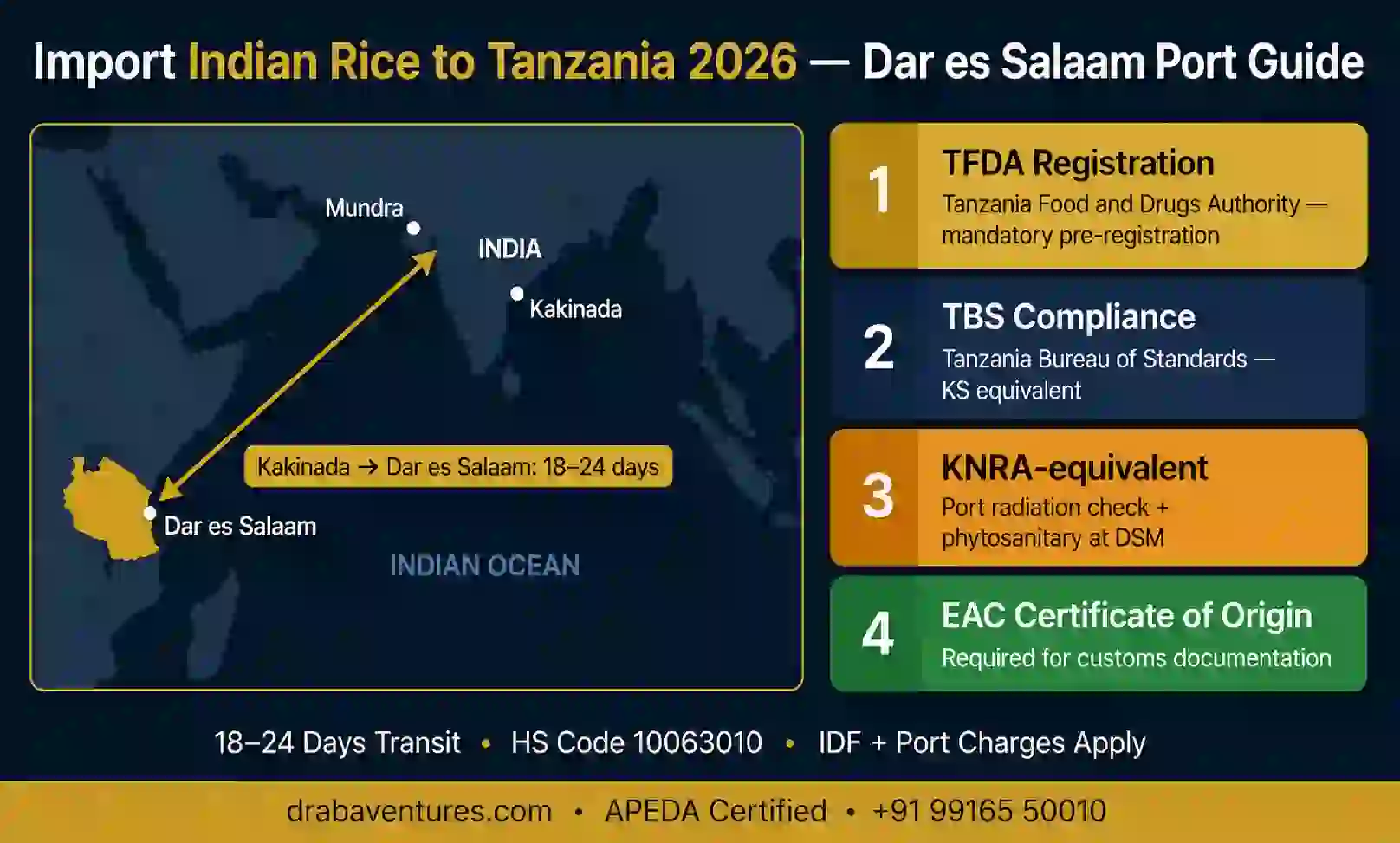
IR-64 Parboiled Rice (HS Code 10063010) is Tanzania's primary Indian rice import. Transit from Kakinada to Dar es Salaam: 18-24 days. Clearance at DSM: 5-8 days. Key requirement: TFDA product registration (Tanzania Food and Drugs Authority - one-time per product, obtained by Tanzanian importer before first shipment). TBS compliance verified at port. Indian long-grain parboiled is well-positioned as it does not compete directly with Tanzania's domestic aromatic varieties.
Tanzania Rice Market - Key Context for Indian Exporters
Tanzania is East Africa's third-largest rice importer after Kenya and Ethiopia, consuming approximately 300,000-400,000 MT annually. Unlike Kenya - where domestic production covers less than 30% of consumption - Tanzania has a more developed local rice industry. The Kilombero Valley (Morogoro), Mbeya, and Mwanza regions are significant domestic production zones, growing primarily aromatic varieties (Indica types with Tanzanian Supa and Mbeya varieties).
This domestic production context shapes how Indian rice should be positioned for the Tanzanian market. Indian long-grain parboiled rice (IR-64) is complementary, not competitive, to Tanzania's local aromatic production. Tanzanian consumers who eat local rice for home cooking also purchase Indian parboiled for institutional use - hotels, restaurants, school feeding programmes, and urban bulk buyers who prioritise consistent supply over local aroma.
The Tanzania government is protective of its domestic rice industry. Import volumes are sometimes managed through policy instruments - importers should monitor Tanzania Revenue Authority (TRA) and Ministry of Agriculture announcements before committing to large forward orders.
Regulatory Compliance - Tanzania 2026
Tanzania's regulatory framework for food imports is more administratively demanding than Kenya's. Three agencies are involved:
TFDA - Tanzania Food and Drugs Authority (Critical)
All food products imported into Tanzania must be registered with TFDA before the first shipment. This is a product registration - not a shipment-by-shipment inspection. The Tanzanian importer applies to TFDA with product specification, label details, country of origin, and intended use. Registration typically takes 2-4 weeks. Once registered, the TFDA product registration number must appear on every subsequent shipment's documentation. Without TFDA registration, rice will be held at Dar es Salaam Port.
TBS - Tanzania Bureau of Standards
TBS enforces quality standards for imported food products. For rice, TBS checks compliance with EAC harmonised rice standards - moisture content (<=14% for parboiled), broken grain percentage, foreign matter, and milling quality. TBS inspectors operate at Dar es Salaam Port and may conduct physical sampling. A valid Certificate of Conformity from an accredited inspection agency (equivalent to KEBS PVoC - SGS Tanzania can issue a compatible CoC) significantly smooths TBS clearance.
TOSCI - Tanzania Official Seed Certification Institute
TOSCI regulates seeds. For commercial rice destined for consumption (not planting), TOSCI inspection is not required. Ensure your commercial invoice and packing list clearly state the rice is for human consumption/food use, not for planting. Any ambiguity may trigger a TOSCI hold at the port.
PPRA - Plant Protection (Phytosanitary Clearance)
Tanzania's Plant Health Services conducts phytosanitary inspection at Dar es Salaam Port. Mandatory for all rice imports. Present original Phytosanitary Certificate from India (NPPO - must be valid on arrival) and original Fumigation Certificate. PPRA inspection fee applies per consignment.
TFDA registration is the longest lead-time item. It must be completed before the first shipment - not on arrival. Allow 3-4 weeks minimum for TFDA registration processing. First-time importers should initiate TFDA registration while their first shipment is being produced in India, so clearance at Dar es Salaam is not delayed. Your Dar es Salaam clearing agent can manage the TFDA application process.
HS Codes for Indian Rice - Tanzania
| Rice Type | HS Code | Description | India to TZ Positioning |
|---|---|---|---|
| IR-64 Parboiled | 10063010 | Rice, parboiled | Primary volume product - hotel, restaurant, institutional |
| IR-64 White (raw) | 10063090 | Rice, other | Wholesale commodity buyers |
| RNR Samba Masuri | 10063090 | Non-basmati, medium grain | Asian diaspora retail in Dar es Salaam |
| Basmati Rice | 10063020 | Long grain aromatic | Premium hotel and diaspora segment |
Logistics - India to Dar es Salaam
Sea Transit Times
| Indian Loading Port | Transit to DSM | Shipping Lines | Notes |
|---|---|---|---|
| Kakinada (INKAI) | 18-24 days | MSC, CMA CGM | Fastest for Karnataka/AP origin rice |
| Mundra (INMUN) | 20-26 days | MSC, Maersk | Good for Gujarat-origin spices alongside |
| Chennai (INMAA) | 18-24 days | MSC, Evergreen | Good for Sona Masoori / Ponni varieties |
Port of Dar es Salaam (DSM) - Key Facts
Dar es Salaam Port is Tanzania's primary container port. It handles approximately 80% of Tanzania's containerised trade. Key operational facts for rice importers:
- Free time: 7 days standard on most shipping lines. With TFDA and TBS inspection adding 2-3 days to normal clearance, this is tight. Request 10 days minimum when booking.
- Standard port clearance: 5-8 days for food commodities with complete documentation and TFDA registration in place.
- Port charges: THC approximately $180-$280 per 20ft FCL. TRA customs clearance fees apply. TFDA inspection fee per consignment. PPRA inspection fee per consignment.
- Tanzania Revenue Authority (TRA): TRA operates the customs clearance system - similar to Kenya's KRA iCMS. Your Dar es Salaam clearing agent files declarations via TRA's TRA@go system.
Tanzania vs Kenya - Key Differences for Indian Exporters
| Factor | Tanzania (DSM) | Kenya (Mombasa) |
|---|---|---|
| Pre-registration | TFDA product registration - mandatory, 3-4 weeks, one-time per product | No equivalent pre-registration - KEBS PVoC is per-shipment |
| Per-shipment inspection | TBS + PPRA at port | KEBS PVoC (origin) + KEPHIS (at port) |
| Transit time from Kakinada | 18-24 days | 16-20 days |
| Port clearance time | 5-8 days | 5-7 days (post-KNRA) |
| Domestic rice protection | High - active local industry | Moderate |
| Recommended rice positioning | Long-grain parboiled for institutional/urban - not competing with local aromatic | Full range - mass market and premium |
| IDF equivalent | Import permit (TRA) - rates vary | IDF - 2.25% of CIF |
Product Specifications for Tanzania Market
Tanzania buyers primarily source IR-64 Parboiled Rice for institutional channels (hotels, restaurants, school feeding, NGO food programmes) and urban wholesale. The specification is consistent with Kenya but with a stronger emphasis on 25% broken economy grade for institutional/food programme buyers:
- IR-64 Parboiled 5% broken: Premium hotel and restaurant supply in Dar es Salaam, Arusha, and Zanzibar. FOB Kakinada ~$355-375/MT.
- IR-64 Parboiled 15% broken: Standard wholesale market - Kariakoo Market in Dar es Salaam, Arusha wholesale. FOB Kakinada ~$340-360/MT.
- IR-64 Parboiled 25% broken: NGO/WFP food programmes, school feeding. FOB Kakinada ~$310-330/MT.
For detailed IR-64 Parboiled specifications, see: IR-64 Parboiled Rice - Full Specifications for East Africa 2026.
Document Checklist - Tanzania Rice Import
Tanzania Rice Import Document Checklist - 2026
Cost Breakdown - CIF Dar es Salaam (25 MT IR-64 Parboiled)
For live FOB pricing on IR-64 Parboiled for Tanzania, visit our Market Intelligence Hub. Tanzania import duty rates on rice should be confirmed with your TRA clearing agent - rates vary based on current government policy and EAC exemption status.
This guide is also available in Swahili. For Tanzanian traders who prefer reading trade content in Swahili, see our dedicated Swahili guide: Bei ya Mchele kutoka India Tanzania 2026. It covers TFDA compliance, payment terms, and how to contact Draba Ventures in plain Swahili.
Frequently Asked Questions
What is TFDA registration and is it required for importing rice into Tanzania?
What is the transit time from India to Dar es Salaam for rice?
Does Tanzania have a KEBS PVoC equivalent inspection system?
How does Tanzania's domestic rice industry affect import opportunities?
Is there a Swahili version of this guide?
Sourcing Rice for Tanzania?
Draba Ventures supplies APEDA-certified IR-64 Parboiled for Tanzania's institutional and wholesale markets. CIF Dar es Salaam available. We advise on TFDA registration documentation from the Indian side. First orders via LC at sight.
