In international agricultural commodity trading, cross-border counterparty risk represents the single greatest barrier to high-volume trade. For European specialty roasters, multinational blending houses, and merchant trading desks sourcing commercial green coffee from Southern India, capital allocation requires unyielding security. When deploying six-figure liquidity for 20-foot (18 to 19.2 MT) and 40-foot (26 to 27 MT) Full Container Loads (FCL), standard open accounts or telegraphic advance transfers expose procurement capital to severe delivery, default, or quality mismatch risks. The deployment of an Irrevocable Letter of Credit at Sight (LC at Sight) provides an ironclad, legally enforceable financial architecture that aligns buyer protection with exporter liquidity.
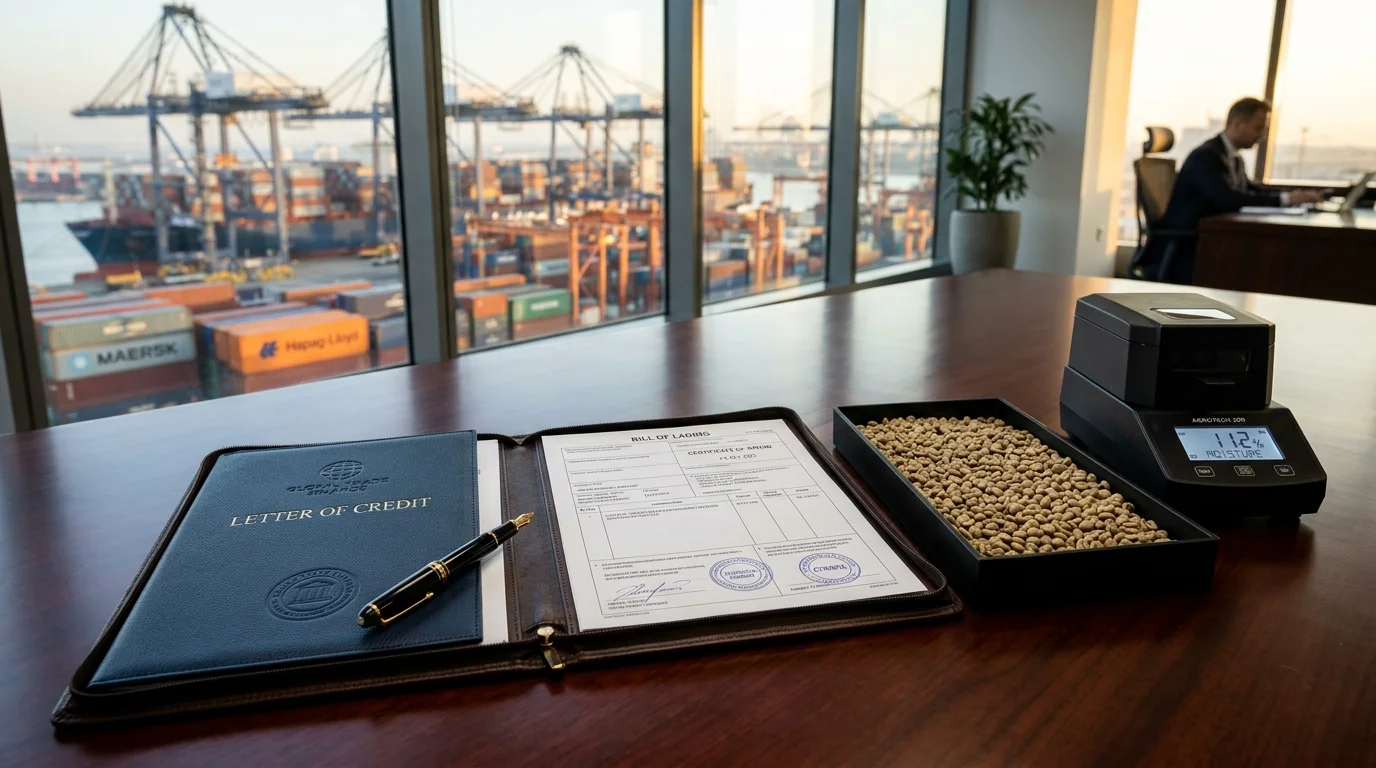
Irrevocable Letters of Credit (LC at Sight): Eliminating Counterparty Risk
An Irrevocable Letter of Credit (LC at Sight) is a binding financial commitment issued by a prime international commercial bank (the Issuing Bank) on behalf of the importer (the Applicant). It guarantees immediate payment to the exporter, Draba Ventures Private Limited (the Beneficiary), through an advising or confirming bank upon the exact presentation of verified, compliant shipping documents. Unlike an advance telegraphic transfer (T/T), where an overseas buyer surrenders working capital prior to container stuffing, an LC ensures funds remain entirely sequestered in the banking network until physical cargo has cleared pre-shipment inspections and crossed the ship's rail.
By routing trade finance through Tier-1 global correspondent institutions such as BNP Paribas, Deutsche Bank, HSBC, Standard Chartered, and the State Bank of India (SBI), counterparty risk is transferred from the individual trading partners to world-class banking balance sheets. Under Uniform Customs and Practice for Documentary Credits (ICC UCP 600), the issuing bank cannot unilaterally revoke, amend, or withhold settlement once an irrevocable LC is established.
For European buyers, the LC at Sight structure solves three critical procurement dilemmas:
- Default Elimination: The buyer avoids the catastrophic risk of paying cash advances to unvetted brokers who fail to procure raw parchment from curing mills.
- Cash Flow Predictability: The buyer's working capital is debited only after third-party verification that the ocean container has been loaded on board a deep-water ocean vessel.
- Dispute Neutralization: Because banks deal strictly in documents rather than goods (Article 5 of UCP 600), the transaction adheres to an objective, binary audit: either the shipping dossier strictly complies with the LC's contractual stipulations, or it does not.
| Payment Mechanism | Buyer Risk Profile | Exporter Working Capital | Default Protection | Best Suited For |
|---|---|---|---|---|
| Advance T/T (100% Upfront) | Extreme (Loss of capital before dispatch) | Immediate liquidity | Zero buyer protection | Small micro-lot samples (< 1 MT) |
| Documentary Collection (CAD / D/P) | Moderate (Cargo stranded at port if rejected) | Delayed until arrival | Weak legal recourse | Established multi-year partners |
| Irrevocable LC at Sight (UCP 600) | Minimal (Bank guarantees compliance) | Immediate upon BL presentation | Absolute (Tier-1 Bank Underwritten) | FCL Volume Contracts (19.2 to 500+ MT) |
| Usance LC (30/60/90 Days) | Low (Buyer achieves inventory turnover) | Requires discounting credit line | High (Acceptance contingent) | Large industrial roasters & distributors |
ECGC Coverage and Supply Chain Liquidity
While an LC protects the buyer against delivery default, the exporter must finance significant agricultural operations weeks before a container leaves Indian shores: purchasing raw washed parchment from highland estate auctions in Chikmagalur and Kodagu (Coorg), operating curing mills, conducting optical defect separation, and executing fumigation. To secure massive volume availability without liquidity bottlenecks, Draba Ventures seamlessly integrates with Indian pre-shipment trade financing structures under the sovereign backing of the Export Credit Guarantee Corporation of India (ECGC).
ECGC is a premier enterprise of the Government of India, operating under the Ministry of Commerce and Industry. It provides comprehensive export credit insurance that shields commercial export contracts against foreign buyer insolvency, political non-transfer embargos, or prolonged maritime disruptions. By securing ECGC Export Credit Insurance and Comprehensive Buyer Cover, Draba Ventures unlocks premier pre-shipment export credit facilities (Packing Credit in Foreign Currency - PCFC) from Indian state and private commercial banks at preferential institutional rates.
Institutional backing through ECGC credit lines allows Draba Ventures to lock in raw green coffee inventory at seasonal harvest peaks across Karnataka's Western Ghats. For European roasters, this means absolute pricing stability on annual multi-container supply agreements, immune to local market speculation, cash-flow crunches, or harvest price swings.
This financial synergy guarantees that when an international contract is signed and an LC is established, our curing facilities in Mangalore and Hassan operate at maximum velocity. Procurement, primary dry-milling, gravity table density separation, and container staging occur uninterrupted, ensuring our maritime schedules strictly meet the "Latest Date of Shipment" mandated in field 44C of your LC.
Quality Assurance and Optical Defect Extraction
In commodity trade finance, documentary compliance is legally detached from physical goods. However, if a shipment is technically compliant on paper but contains secondary bean defects, sour seeds, or insect damage upon arrival at Hamburg, Antwerp, or Genoa, the importer faces ruinous financial losses, cupping score downgrades, or prolonged commercial disputes. An LC protects monetary assets, but it cannot grind coffee. Physical precision must match documentary precision.
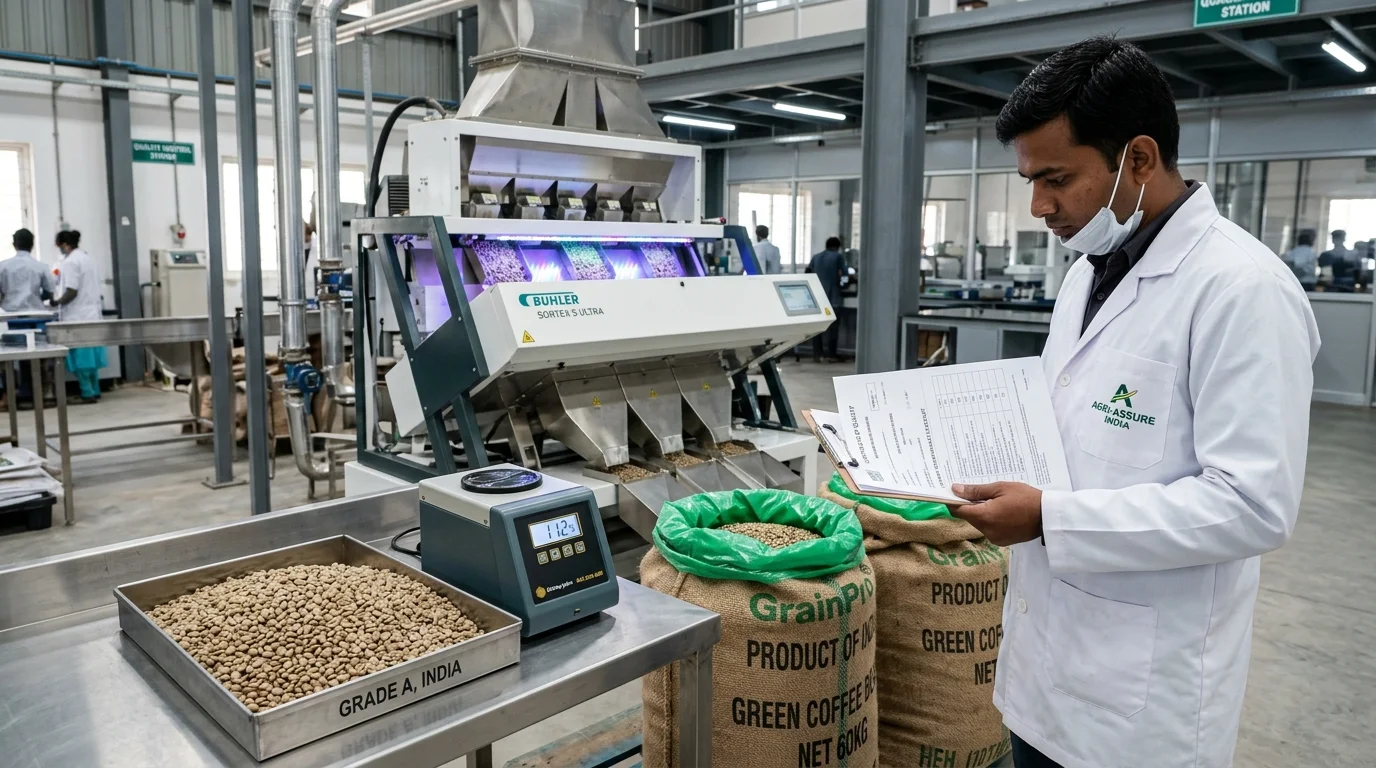
To eliminate destination quality discrepancies, Draba Ventures subjects 100% of export-grade green coffee to multi-stage mechanical and optical defect separation prior to packing. Following mechanical hulling and size grading over perforated shaker screens (Screen 19 for Mysore Nuggets Extra Bold, Screen 18 for Plantation AA, and Screen 15/16 for Robusta Parchment AB), all coffee passes through state-of-the-art VIS/NIR Hyperspectral Imaging (HSI) Sortex optical sorting systems.
Operating high-speed multi-chromatic sensor arrays, our optical sorting machinery achieves a verified 94.63% optical sorting defect extraction accuracy. This cutting-edge sorting technology extracts:
- Sour and Fermented Beans: Imperceptible under basic mechanical screening, these beans ruin clean-cup sweetness and acidity in washed Arabicas.
- Black and Stinkers: The primary drivers of harsh phenolic off-flavors in espresso roasts.
- Insect-Damaged and Borer-Punctured Seeds: Removing physical entry points that harbor mold spores and compromise roast integrity.
- Stones and Heavy Metallics: Triple-pass de-stoning prevents damage to commercial roasters.
By enforcing this technological standard, the physical coffee arriving in Europe matches the precise SCA physical defect count, screen retention profile, and sensory notes stipulated in the commercial contract. This guarantees that destination quality audits align perfectly with the original Pre-Shipment Sample (PSS), eliminating any commercial pretext for LC payment delays or price adjustments.
Moisture Control and Maritime Security: Safeguarding LC Payout
The final financial hurdle in green coffee importation occurs across the high seas. A shipment navigating from New Mangalore Port (NMPA) or Cochin through the Indian Ocean, the Red Sea, or around the Cape of Good Hope faces intense thermal transitions. Tropical ambient heat followed by temperate maritime cold creates extreme internal container humidity, leading to condensation, cargo sweat, mold colonization, and the synthesis of Ochratoxin A (OTA) - a toxic mycotoxin heavily regulated under European Commission Regulation (EU) 2023/915.
If containerized coffee tests positive for OTA exceeding statutory European maximum limits (5.0 mcg/kg for roasted coffee, 3.0 mcg/kg for raw coffee imports), European border inspection posts will order mandatory cargo destruction or immediate re-export. Such rejections trigger severe disputes, banking freezes, and insurance claims under trade credit policies.
Draba Ventures neutralizes maritime vulnerability through a rigorous, scientifically proven dual-barrier protocol:
- Strict Pre-Bagging Moisture Calibration: Raw green coffee is mechanically and sun-dried until cellular moisture measures strictly below 12% (calibrated across ISO 6673 and digital capacitive grain meters). Storing beans between 10.5% and 11.8% moisture stabilizes metabolic activity while preserving organic acids.
- GrainPro Hermetic Inner Liners: Before being packed into heavy-duty 60kg export jute sacks, all coffee is sealed within certified multi-layer gas- and moisture-tight GrainPro hermetic protective liners. The hermetic enclosure locks in internal relative humidity, starves aerobic mold spores of oxygen, and prevents external oceanic humidity from penetrating the beans.
- Container Desiccant Fortification: FCL containers are lined with heavy-duty Kraft paper and equipped with high-absorption calcium chloride desiccant dry-poles along sidewalls, capturing ambient container condensation during high-humidity transit corridors.
This protection ensures the cellular structure of the green coffee remains pristine. Upon docking at European ports, the cargo effortlessly passes phytosanitary and mycotoxin screenings, ensuring immediate customs release and enabling clean, seamless LC maturity without post-landing claims.
Documentary Checklist: Presentation Under UCP 600
A flawless Letter of Credit execution relies on zero document discrepancies. Under ICC UCP 600 Article 14, examining banks have a maximum of five banking days to audit presentation documents. Draba Ventures' trade compliance team generates an audit-ready dossier conforming to international standard banking practice (ISBP 745):
| Document Description | Issuing Authority / Standard | Required UCP 600 Verifications |
|---|---|---|
| Clean on Board Ocean Bill of Lading (B/L) | Tier-1 Shipping Line (Maersk, MSC, Hapag-Lloyd) | Marked 'Clean on Board', showing exact container/seal numbers, port of loading (Mangalore/Cochin), and consigned to bank order. |
| Commercial Invoice | Draba Ventures Private Limited | Matches LC description verbatim: HS Code 0901.11, contract numbers, screen grade, and unit FOB/CIF prices. |
| ICO Certificate of Origin | Coffee Board of India (Ministry of Commerce) | Official International Coffee Organization serial numbers verifying authentic regional origin (Chikmagalur / Coorg). |
| Export Phytosanitary Certificate | National Plant Protection Organization (NPPO India) | Certifies coffee is free from quarantine pests, Khapra beetle, and coffee berry borer, verifying methyl bromide/phosphine fumigation. |
| Certificate of Quality & Weight | Independent Inspection Agency (SGS / Bureau Veritas) | Confirms net weights (60kg jute + GrainPro), screen sizing (>90% on target screen), and moisture content strictly <12%. |
| Marine Insurance Policy / Certificate | Top-tier Maritime Underwriter | Required for CIF contracts: covers Institute Cargo Clauses (A) All Risks, Institute War & Strikes Clauses, valued at 110% of CIF value. |
Frequently Asked Questions: Coffee Trade Finance & Letters of Credit
An LC at Sight triggers immediate bank remittance upon documentary verification, allowing the exporter to settle mill accounts and the buyer to take prompt title to the ocean Bill of Lading. Usance terms (deferred payment) require additional credit discounting lines that inflate financing costs, whereas LC at Sight offers the leanest, most competitive FOB and CIF unit pricing.
Yes. For buyers working through secondary regional banks, we accept Confirmed LCs where a top-tier European or global correspondent bank (such as BNP Paribas, Deutsche Bank, or HSBC) adds its confirmation, providing double payment guarantees and total operational peace of mind.
Due to bank documentation handling fees and SWIFT transmission costs, Letters of Credit are typically structured for minimum order quantities (MOQ) of one Full Container Load: exactly 300 to 320 bags (18.0 to 19.2 Metric Tons) in a 20ft container, or multi-container annual supply contracts.
For specialty micro-lots and high-grade Arabicas, we integrate Pre-Shipment Sample (PSS) approval protocols directly into the LC covenants. An independent courier air-freights a sealed 250g PSS to your lab; once your Q-grader issues an electronic Approval Certificate, container dispatch and BL presentation commence.
Structure Your Green Coffee Import LC with Confidence
Connect with Draba Ventures' trade finance desk to review draft LC wordings, request FOB Mangalore / CIF European port price indications, and secure guaranteed volume contracts backed by ECGC underwriting.
