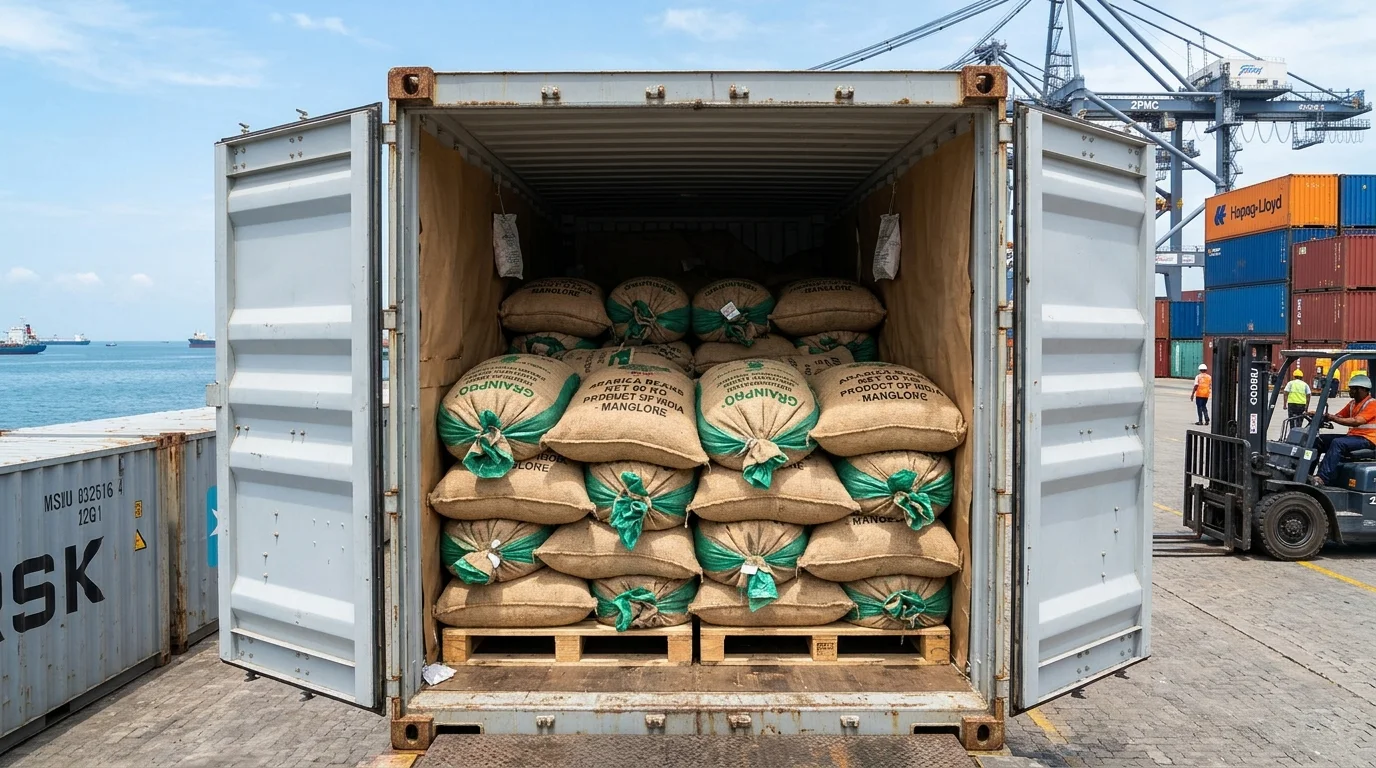
The Economics of 20ft FCL Container Loads (18 MT)
In the international green coffee commodity trade, the 20-foot Full Container Load (FCL) represents the universal operational benchmark and standard Minimum Order Quantity (MOQ) for direct-origin commercial sourcing. Understanding the precise volumetric and weight physics of a 20ft container is essential for import procurement directors, inventory managers, and green coffee buyers seeking to minimize landed costs per kilogram.
A standard 20ft ISO ocean container possesses an internal volume of 33.2 cubic meters (1,172 cubic feet) and a theoretical maximum gross payload rating exceeding 21 to 28 Metric Tons depending on shipping line equipment specifications. However, in green coffee logistics, legal road transportation weight limits in producing origins and destination port jurisdictions (such as European gross axle weight regulations) restrict the practical and legal export payload to exactly 18.0 Metric Tons (18,000 kg net weight):
The mathematics of the standard 18 MT coffee cargo unit are strictly standardized across global shipping lanes:
- Bags per Container: Exactly 300 export-grade natural jute or burlap bags at 60.0 kilograms net weight per bag (18,000 kg total net weight; approximately 18,300 kg gross weight including packaging materials).
- Stowage Configuration: Coffee bags are floor-loaded in 10 to 12 interlocking horizontal tiers across the container floor. Floor-loading eliminates pallet tare weight (saving 300 to 450 kg of cargo capacity) and maximizes cubic volume utilization.
- Headspace Clearance: The 300-bag stowage configuration occupies approximately 26 to 28 cubic meters of volume, leaving a critical 15 to 25 cm overhead airspace between the top bag tier and the container steel roof. This airspace is mandatory for convection airflow and desiccant pole installation.
- Landed Cost Optimization: Maximizing cargo payload to 18 MT dilutes fixed origin and discharge logistics fees - including customs clearance, Terminal Handling Charges (THC), Bill of Lading (B/L) issuance, and port drayage - reducing logistics overhead to approximately $0.14 to $0.22 per kilogram, compared to $0.48 to $0.75/kg in Less-than-Container-Load (LCL) consolidations.
| Cost Component | 18 MT 20ft FCL Load | 5 MT LCL Consolidation | FCL Efficiency Advantage |
|---|---|---|---|
| Nominal Cargo Weight | 18,000 kg Net (300 bags) | 5,000 kg Net (83 bags) | Full unit economies of scale |
| Ocean Freight Rate (Base) | $1,850 - $2,400 per container | $145 - $190 per W/M ($1,425 total) | Ocean freight amortized across 18 MT |
| Terminal Handling (Origin/Dest) | $420 - $550 flat per FCL | $380 - $520 CFS handling fees | Avoids CFS cargo deconsolidation surcharges |
| Customs & Documentation | $250 flat per B/L ($0.014/kg) | $250 flat per B/L ($0.050/kg) | 72% document cost reduction per kg |
| Total Landed Logistics Overhead | $0.14 - $0.18 per kg | $0.44 - $0.58 per kg | Logistics savings of $0.30 - $0.40 per kg ($5,400 - $7,200/FCL) |
CIF vs. FOB: Securing the Supply Chain
When contracting green coffee shipments from India, international buyers must navigate the strategic selection between Free On Board (FOB) and Cost, Insurance, and Freight (CIF) delivery terms under Incoterms 2020. While multinational trading houses with internal freight forwarding arms occasionally buy FOB, tier-1 European roasters, specialty importers, and regional distributors increasingly demand CIF terms to insulate their balance sheets from maritime freight volatility and transit liability.
Under FOB terms (e.g. FOB Mangalore, FOB Cochin, or FOB Nhava Sheva), the buyer assumes full commercial responsibility and risk the microsecond the container passes the ships rail at the Indian origin port. The buyer must negotiate ocean spot rates, manage vessel delays, absorb demurrage and detention charges if discharge terminals are congested, and independently file insurance claims if cargo suffers damage in transit.
In contrast, sourcing green coffee on CIF terms (e.g. CIF Hamburg, CIF Rotterdam, CIF Antwerp, CIF Genoa, CIF Le Havre) transfers operational complexity and ocean transport risk management directly to Draba Ventures:
- Direct Freight Slot Bookings: Draba Ventures maintains volume contracts with premier global container carriers (Maersk, MSC, CMA CGM, Hapag-Lloyd), ensuring guaranteed equipment allocation, priority vessel berthing, and stable contracted freight rates that protect buyers from sudden spot market surges.
- Origin Customs & Export Compliance: Draba Ventures executes origin customs clearance, port drayage, Coffee Board of India export inspection, mandatory phytosanitary certification, Certificate of Origin legalization, and European Union Deforestation Regulation (EUDR) geospatial parcel documentation.
- Comprehensive Marine Cargo Insurance: Under our CIF contracts, cargo is insured under Institute Cargo Clauses (A) - the gold standard of marine insurance providing all-risk coverage for 110% of the CIF contract value. This covers moisture sweating, vessel accidents, jettison, theft, and General Average declarations.
- Zero Transshipment Detention Risk: Draba Ventures manages container repositioning and tracking across transshipment hubs (such as Colombo or Salalah), mitigating transit bottlenecks before cargo reaches European gateway ports.
Quality Assurance and Optical Defect Extraction
A flawless logistics chain is worthless if the containerized coffee fails to meet stringent physical and cupping quality standards. At Draba Ventures, green coffee batches are never cleared for container stuffing based on manual visual inspection alone. Prior to bagging, all green coffee - whether Screen 18 Robusta Cherry AB, washed Arabica Plantation A, or Monsooned Malabar AA - undergoes automated optical defect extraction.
Our curing facilities deploy high-throughput VIS/NIR Hyperspectral Imaging (HSI) Sortex optical sorting machinery achieving a verified 94.63% optical sorting accuracy. Operating across dual visible and near-infrared spectral wavelengths, the optical sortex technology inspects every individual bean in freefall at speeds exceeding thousands of beans per second:
- Primary Defect Elimination: Optical ejection nozzles pneumatically extract black beans, sour and semi-sour beans, moldy seeds, and insect-damaged beans (including Hypothenemus hampei berry borer perforations) that cause off-flavors, astringency, and high defect count under SCA / ICO grading standards.
- Physical Foreign Matter Removal: Multi-frequency infrared sorting isolates and ejects non-coffee debris, stones, twigs, metal fragments, and dried cherry husks with 99.8% separation efficiency.
- Mechanical Density & Screen Calibration: Prior to optical passes, vibratory gravity separators and rotary grading screens isolate uniform bean size (Screens 17, 18, or 19) and eliminate low-density, hollow, or withered beans, ensuring uniform thermal heat transfer during industrial roasting.
- Pre-Stuffing Lot Verification: Representative composite samples from every 300-bag production run are cupped by certified Q-graders and subjected to laboratory moisture testing, bulk density measurement, and defect audits before bags receive final export stenciling.
Moisture Control and Maritime Security
The 30-day ocean voyage from Indian ports through the Arabian Sea, the Red Sea or Cape of Good Hope, and into northern European ports represents an extreme environmental gauntlet. Shipping containers traverse aggressive thermal gradients: internal container temperatures in tropical Indian loading bays can reach 35°C to 42°C with high ambient humidity, while arrival in northern European ports during autumn or winter plunges temperatures to 0°C to 8°C.
This sharp temperature drop creates a dangerous microclimate phenomenon known as container sweat or container rain. As the container steel shell cools rapidly, warm air inside the container drops below its dew point, condensing into water droplets on the ceiling and walls. If this moisture drips onto traditional raw jute bags, it rapidly triggers mold formation and the biochemical synthesis of Ochratoxin A (OTA) - a carcinogenic and nephrotoxic mycotoxin strictly regulated by European Commission Regulation (EU) 2023/915 to a maximum limit of 5.0 µg/kg in roasted coffee and strictly inspected in green coffee imports.
Draba Ventures eliminates maritime moisture and OTA risks through a rigorous, multi-tiered containerization security protocol:
- Strict Moisture Stabilization Below 12%: Green coffee is cured and mechanically stabilized to a certified moisture content between 10.5% and 11.5% (strictly under the 12.0% statutory export ceiling) verified via calibrated ISO 6673 oven drying and capacitance meters.
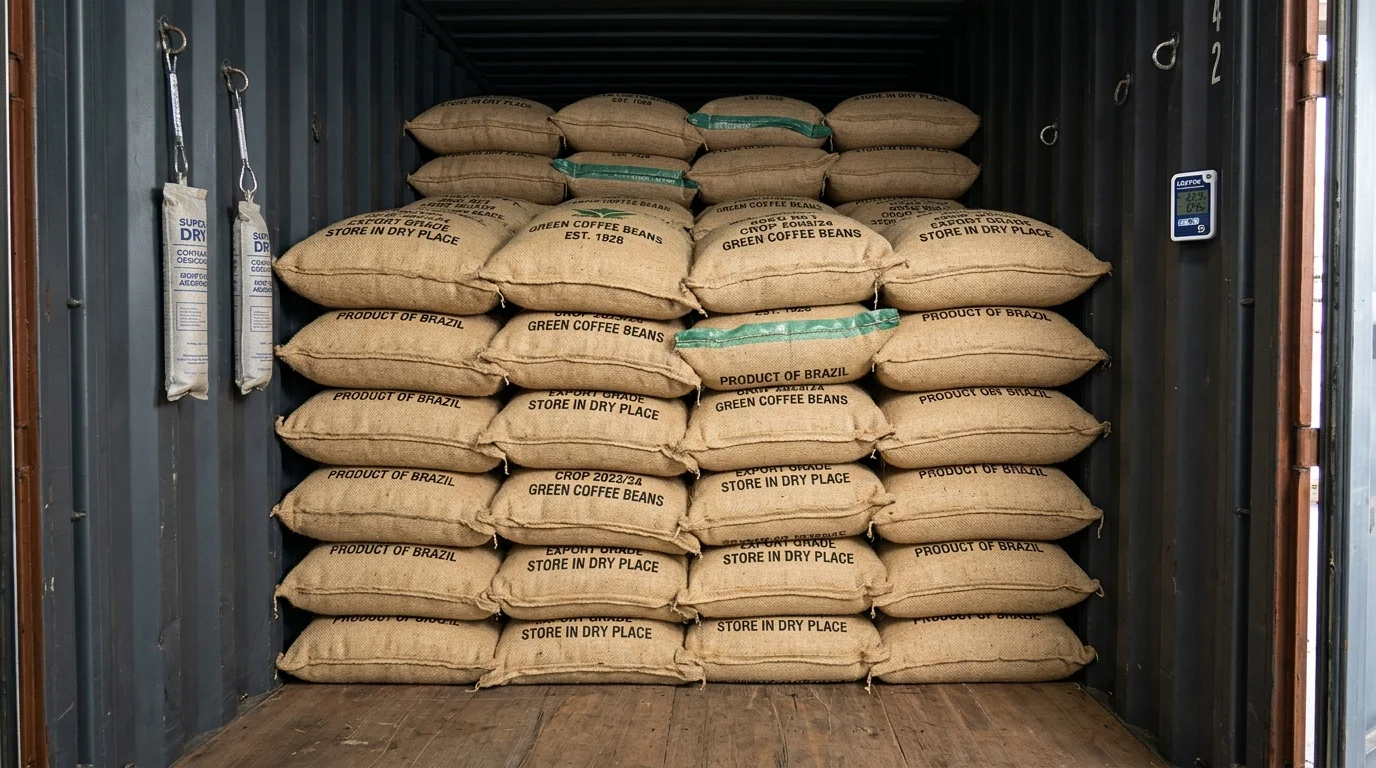
- Multi-Layer Hermetic GrainPro Liners: Every single 60kg jute bag is equipped with an inner multi-layer co-extruded hermetic GrainPro protective liner. GrainPro liners possess an ultra-low Water Vapor Transmission Rate (WVTR < 5 g/m²/day) and gas barrier properties that lock in bean freshness, prevent atmospheric humidity ingress, and asphyxiate insect pests by maintaining a natural modified atmosphere.
- Container Lining & Desiccant Dry Poles: The container floor and steel walls are fully lined with heavy-duty corrugated cardboard and kraft paper to isolate bags from condensation runoff. In addition, 4 to 6 high-capacity calcium chloride container desiccant dry poles (absorbing up to 200% to 300% of their weight in moisture) are suspended in the container corrugations.
- Digital IoT Environmental Dataloggers: For temperature-sensitive specialty and high-value commercial shipments, digital USB/IoT dataloggers are packed within the central bag tier to continuously record ambient temperature and relative humidity every hour throughout the 30-day maritime transit.
Frequently Asked Questions: Green Coffee 20ft Container Logistics & CIF Terms
The standard commercial Minimum Order Quantity (MOQ) is one 20ft Full Container Load (FCL), containing exactly 18 Metric Tons (18,000 kg net weight) packed in 300 heavy-duty jute bags at 60kg each with inner GrainPro hermetic liners. For specialty micro-lots or mixed container shipments, we can consolidate multiple coffee grades (e.g., 10 MT Robusta Cherry AB + 8 MT Monsooned Malabar AA) within the same 18 MT FCL container.
Our CIF (Cost, Insurance, and Freight) contracts include full origin procurement, 94.63% Sortex optical defect sorting, 60kg jute packaging with hermetic GrainPro liners, origin port drayage, Indian customs clearance, Coffee Board export documentation, phytosanitary certification, Certificate of Origin, ocean freight carriage to the designated discharge port (e.g., Hamburg, Rotterdam, Genoa, Antwerp), and comprehensive Institute Cargo Clauses (A) all-risk marine insurance covering 110% of cargo value.
We enforce a four-stage barrier defense: (1) Green coffee moisture is strictly stabilized between 10.5% and 11.5% prior to packing; (2) All beans are sealed in multi-layer hermetic GrainPro liners preventing moisture migration; (3) Container interiors are dressed with kraft paper and hung with calcium chloride desiccant dry poles to absorb condensation; and (4) Beans undergo 94.63% optical Sortex cleaning to eliminate fungal-damaged beans that harbor Aspergillus and Penicillium molds.
While 40ft containers are available, international coffee trade overwhelmingly utilizes 20ft containers because green coffee is a heavy, dense commodity. A 20ft container reaches the legal road haulage gross vehicle weight limit (approx. 24 to 26 MT total gross weight) at 18 MT of cargo payload. Loading green coffee in a 40ft container would exceed legal highway weight restrictions in both India and European overland routes without providing additional usable payload capacity.
Secure 20ft FCL Green Coffee CIF Contracts from India
Partner with Draba Ventures for reliable, end-to-end containerized green coffee supply. Direct-origin Indian Robusta Cherry AB, Monsooned Malabar AA, and Arabica Plantation A with 94.63% optical Sortex purity, multi-layer GrainPro moisture protection, and guaranteed CIF pricing to major European and global ports.
