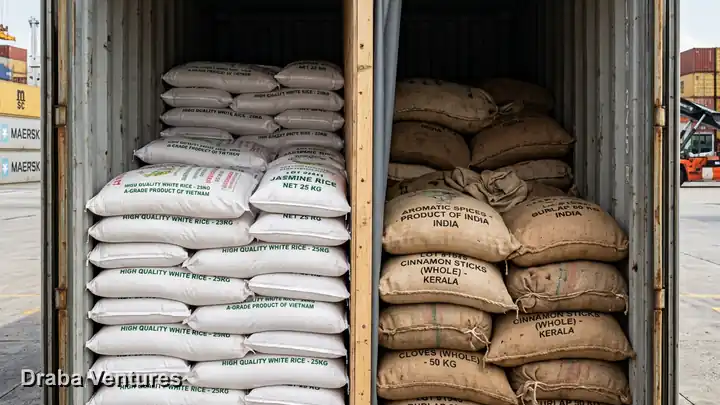
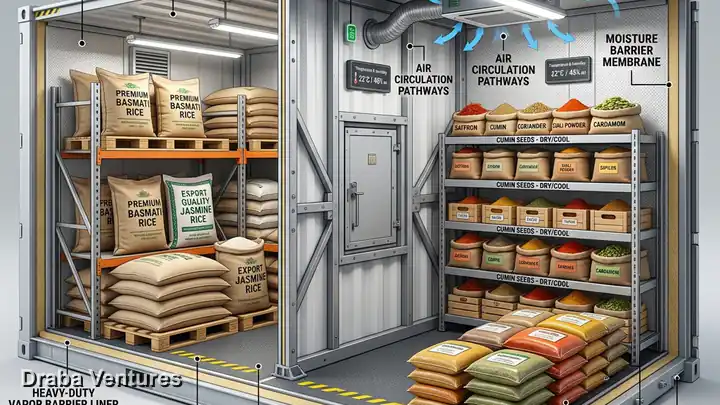
Executive Summary for Exporters & Procurement Teams: Pairing high-volume staples like Sona Masoori or RNR rice with high-value Indian spices in a single 20ft Full Container Load (FCL) delivers substantial freight savings, avoiding the inflated per-CBM tariffs and duplicate terminal fees of Less than Container Load (LCL) consolidation. Because rice is hygroscopic and spices release pungent essential oils, proper micro-climate barriers—including 200-micron polyethylene sheeting, desiccant poles, and physical plywood bulkheads—are mandatory to prevent aroma and moisture cross-contamination.
Calculate Consolidated Landed Costs & Container Margins
Estimate real-time FOB and CIF destination costs for combined rice and spice consignments from Karnataka milling clusters to Middle Eastern ports.
The Strategic Imperative of Cargo Consolidation
Expanding into competitive Middle East markets—particularly the UAE (Dubai), Saudi Arabia, and Qatar—requires rigorous supply chain optimization. Middle Eastern importers, from mid-sized wholesalers to supermarket chains, frequently prefer ordering diverse product portfolios rather than committing to a single-commodity 20ft or 40ft Full Container Load (FCL). For Indian agri-exporters, the strategic answer lies in consolidated cargo: pairing staple commodities like non-basmati rice with high-value Indian spices.
By executing a mixed-commodity FCL shipment, an Indian exporter leverages economies of scale, sidestepping the punitive per-CBM (Cubic Meter) pricing models of Less than Container Load (LCL) freight forwarding. However, combining non-basmati rice with pungent, aromatic spices introduces technical challenges: moisture migration and odor cross-contamination. Mastering this logistics strategy allows exporters to offer flexibility to buyers in Dubai or Doha without compromising grain purity.
Sourcing the Core Commodity: The Karnataka Hub Advantage
Before optimizing ocean freight out of Nhava Sheva or Mundra, domestic procurement economics must be perfected. The foundation of any Middle East-bound consolidated agri-shipment from India is typically premium non-basmati rice. The undisputed hub for sourcing varieties like Sona Masoori, RNR (Samba Masoori), and Kolam is the Tungabhadra irrigation belt in Karnataka, encompassing Sindhanur, Gangavati, Karatagi, and Raichur.
For domestic B2B buyers—wholesalers, distributors, HORECA, and supermarket consolidators—understanding ground-level mill pricing in INR (₹) is critical. Exporters structure their 26kg bag pricing directly from these milling metrics:
| Rice Variety | Milling Hub Source | Price per Quintal (₹) | Price per 26kg Bag (₹) | Price per MT (₹) |
|---|---|---|---|---|
| Sona Masoori (HMT) | Gangavati / Sindhanur | ₹3,400 | ₹884 | ₹34,000 |
| Kaveri Sona | Sindhanur / Karatagi | ₹3,600 | ₹936 | ₹36,000 |
| RNR (15048 / Low GI) | Sindhanur / Raichur | ₹3,200 | ₹832 | ₹32,000 |
| Kolam Rice | Raichur / Siruguppa | ₹3,300 | ₹858 | ₹33,000 |
| Bullet Rice (HORECA) | Sindhanur | ₹3,000 | ₹780 | ₹30,000 |
Note: The 26kg PP woven bag is the standard measurement unit for B2B trading across Karnataka, Andhra Pradesh, and Maharashtra. For export consolidation, these bags are containerized as-is or re-bagged under private label. Minimum order quantity (MOQ) direct from mills is universally 1 truckload (~10-12 MT).
The Technical Challenge: Moisture vs. Aroma Cross-Contamination
Combining rice and spices in the confined, unventilated space of a standard 20ft dry shipping container for a 10-15 day transit to Jebel Ali or Hamad Port is an exercise in atmospheric control. The two commodities have diametrically opposed physical characteristics:
1. The Hygroscopic Nature of Rice
Non-basmati rice is highly hygroscopic. It naturally absorbs atmospheric moisture and ambient odors. Export-grade rice is typically milled to a moisture content of 12% to 14%. If the container experiences severe temperature fluctuations during transit—such as dropping ocean temperatures at night—the resulting "container rain" or vapor pressure deficit causes moisture migration.
2. The Volatile Oils of Spices
Spices such as cardamom, cumin, turmeric, and dry red chilli (sourced from Guntur or Kerala) are intensely aromatic due to volatile essential oils. Furthermore, export-grade spices must be dried to very low moisture levels (typically 8% to 10%) to prevent aflatoxin contamination and mold growth. If moisture from the rice transfers to the spices, mold develops. Conversely, if volatile oils volatilize into trapped container air, the neutral, starchy rice permanently absorbs the aroma.
Quality Assurance Rule: Never stow aromatic spices directly against PP woven rice bags. The porous nature of standard polypropylene allows rapid gas exchange, ensuring that your 26kg bag of RNR rice will arrive in Dubai smelling distinctly of cumin or turmeric.
Commodity Compatibility & Contamination Matrix
| Spice Commodity | Primary Contamination Risk to Rice | Risk Level | Required Barrier Method |
|---|---|---|---|
| Turmeric (Whole / Powder) | Heavy odor absorption, micro-dust staining | High | Triple poly-lined bags + Physical Bulkhead |
| Cumin (Jeera) | Severe volatile oil transfer (aroma tainting) | Extreme | Hermetic spice packaging + 2m spatial buffer |
| Dry Red Chilli | Capsaicin dusting, moisture absorption from rice | Moderate | Kraft paper lining between pallets |
| Cardamom | Aroma transfer to starchy grains | High | Polyethylene sheet wrapping + vacuum pack |
Container Partitioning & Stowage Solutions
To safely consolidate these incompatible items, logistics providers implement strict container partitioning methodologies:
- Kraft Paper Lining: Heavy-duty corrugated kraft paper is stapled to container walls and placed on the floor to absorb minor container sweat and provide basic surface separation.
- Polyethylene Moisture Barriers: Industrial-grade plastic sheeting (minimum 200 microns) is taped across the container width, sealing off the spice cargo in the nose of the container from the rice cargo near the doors.
- Physical Plywood Bulkheads: A custom wooden timber wall constructed midway prevents physical shifting of 26kg rice bags into spice pallets during rough seas and anchors heavy-duty plastic barriers.
- Desiccant Poles: Calcium chloride desiccant poles are hung on container D-rings on the rice side to aggressively capture humidity, preventing container sweat.
Container Partition Materials & Cost Analysis (Per 20ft Container)
| Partition Strategy | Materials Used | Effectiveness against Aroma | Estimated Cost (₹) |
|---|---|---|---|
| Basic Separation | Kraft paper floor + 1m gap between pallets | Low | ₹1,500 - ₹2,500 |
| Standard Moisture Block | 200-micron Polyethylene sheet taped across width | Moderate | ₹3,500 - ₹5,000 |
| Rigid Bulkhead (Recommended) | Plywood framing + Poly lining + Desiccants | High | ₹8,500 - ₹12,000 |
The Mathematics: LCL vs Consolidated FCL
Why undertake container partitioning (spending up to ₹12,000) instead of shipping rice and spices as separate Less than Container Load (LCL) shipments? The answer lies in port tariffs and freight forwarding fees.
By absorbing the ₹10,000 bulkhead cost and securing an FCL, the Indian exporter bypasses LCL consolidator markups. Delivering a single 20ft container to Mundra or Nhava Sheva incurs a single flat THC (roughly ₹8,500) and generates one Master Bill of Lading, substantially reducing landed costs for B2B buyers in Dubai.
Middle East Customs & Documentation for Consolidated Cargo
Executing a consolidated shipment requires precise documentation. Middle Eastern customs authorities (such as Dubai Customs and SFDA in Saudi Arabia) require complete transparency for mixed loads:
- Commercial Invoice & Packing List: Must clearly delineate the rice (e.g., "10 MT Sona Masoori Rice in 26kg PP Bags") and spices, stating exact pallet positions.
- Phytosanitary Certificates: Because rice and spices are distinct agricultural commodities subject to separate pest inspections, exporters must obtain distinct Phytosanitary certificates referencing the same Master B/L and container number.
- Certificate of Origin (COO): Consolidated onto a single COO, provided all HS codes (1006.30 for rice, 0910 for ginger/turmeric, 0909 for cumin) are listed.
Frequently Asked Questions
Source Direct from the Karnataka Rice Hub
Whether you are a domestic distributor, HORECA supplier, or an exporter preparing a consolidated Middle East shipment, secure your rice directly from the source. We supply premium Sona Masuri, RNR, Kolam, and Bullet Rice in standard 26kg bags. MOQ 1 Truckload.
Request Bulk Wholesale Quote