Important Note
Demurrage risk refers to the extreme financial penalty exporters face when agricultural cargo remains at the port beyond the stipulated "free days" granted by shipping lines or port authorities. In India, primary export hubs like Kandla (Deendayal) and Mundra have vastly different ground rent escalation matrices. For high-volume commodities like rice, even a two-day vessel berthing delay can erode an entire shipment's profit margin due to compounding daily charges.
The Sourcing Baseline: Before Cargo Reaches the Port
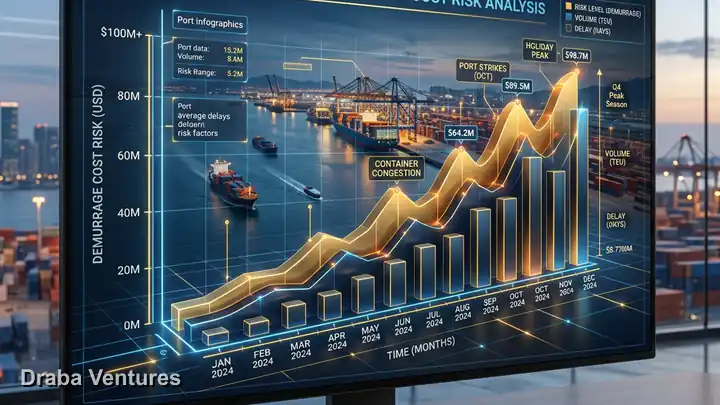
Before examining port logistics, it is imperative to establish the commercial baseline of the commodity. Draba Ventures Private Limited operates at the heart of South India's "rice bowl" - the Tungabhadra irrigation belt spanning Sindhanur, Gangavati, and Karatagi. While our core business is anchoring the massive domestic distribution network (wholesale mandis, HORECA, and modern retail), many of our B2B buyers operate as merchant exporters who subsequently move our rice through major ports on the West Coast.
A successful export operation requires securing the commodity at the lowest possible direct-from-mill cost to absorb downstream logistical shocks, such as port demurrage. Below is our current domestic ex-mill pricing matrix. For exporters, this represents the absolute base FOB component before inland haulage and terminal handling charges (THC) are applied.
| Variety (Sortex Clean) | Grain Specs | Price per Quintal (₹) | Price per 26kg Bag (₹) | Price per Metric Ton (₹) |
|---|---|---|---|---|
| Sona Masuri (HMT) | 5.2 - 5.7mm, <5% broken | ₹3,400 | ₹884 | ₹34,000 |
| Kaveri Sona (Hybrid) | 5.5 - 6.0mm, <5% broken | ₹3,600 | ₹936 | ₹36,000 |
| RNR Samba Masuri | 5.0 - 5.5mm, Low GI | ₹3,200 | ₹832 | ₹32,000 |
| Bullet Raw Rice | Medium-Bold, HORECA grade | ₹3,000 | ₹780 | ₹30,000 |
| Lachkari Kolam | 5.8 - 6.5mm, Slender | ₹3,300 | ₹858 | ₹33,000 |
Understanding Ground Rent Calculation at Indian Ports
When cargo arrives at the port, it is granted a grace period known as "free days." During this period, the shipper is not charged for occupying terminal space. However, once the free days expire, ground rent (demurrage) is levied. Ground rent is not a flat fee; it is structured as an escalating penalty intended to force cargo out of the terminal.
How Ground Rent Accrues
The calculation is typically based on TEUs (Twenty-foot Equivalent Units) or Metric Tons, depending on whether the cargo is containerized or break-bulk. The escalation matrix generally follows a tiered system:
- Tier 1 (Days 1-3 after free period): Base penalty rate. Often manageable but acts as a warning indicator.
- Tier 2 (Days 4-7): The rate doubles. For a 100-container shipment, this phase rapidly consumes operational margins.
- Tier 3 (Day 8 onwards): The rate triples or quadruples. At this stage, the demurrage cost can exceed the intrinsic margin of an agricultural commodity like rice.
For agricultural exports, the sheer volume of space required makes ground rent a lethal risk. A delay of one week on a 500 MT shipment can easily wipe out months of procurement optimization.
Vessel Berthing Delays: The Root Cause of Demurrage
The most common trigger for demurrage is not shipper negligence, but rather vessel berthing delays. When a vessel arrives at the port's outer anchorage, it must wait for a vacant berth. If the port is congested, or if draft limitations restrict entry during low tide, the vessel cannot dock.
Kandla vs. Mundra: Berthing Dynamics
Kandla (Deendayal Port) and Mundra (Adani Port) present two fundamentally different operational environments for exporters.
Deendayal Port (Kandla): As a major government port, Kandla handles massive volumes of break-bulk agricultural commodities. However, its infrastructure faces severe congestion during peak export seasons (e.g., post-harvest peaks for sugar, wheat, or rice). Vessel berthing delays of 3 to 7 days are not uncommon. Because of this known inefficiency, Kandla often provides a longer baseline of free days to compensate for structural delays.
Mundra Port: Mundra is a private, highly automated deep-draft port. It excels in containerized cargo and rapid turnaround times. Berthing delays are minimal (often under 24 hours). However, because terminal efficiency is their core product, their tolerance for stagnant cargo is extremely low. Free days are strictly enforced, and the demurrage escalation matrix is brutally steep.
| Operational Parameter | Deendayal Port (Kandla) | Mundra Port (Adani) |
|---|---|---|
| Ownership & Model | Government (Major Port) | Private (Adani Ports) |
| Primary Cargo Profile | Break-bulk, bulk agri-commodities, liquid | Containerized, RO-RO, general cargo |
| Average Berthing Delay (Agri) | 3-7 Days (High congestion during peak) | 1-2 Days (Deep draft, automated) |
| Standard Free Days (Ground) | 15-20 Days (Often flexible/negotiable) | 10-14 Days (Strictly enforced) |
| Demurrage Escalation Matrix | Moderate (Gradual step-up) | Aggressive (Sharp penalties post free days) |
🇮🇳 Direct-to-Mill Domestic Supply Desk
Sourcing for Indian distribution networks, supermarkets, or merchant export contracts? Skip urban broker layers. Track live mandi rates on our Market Intelligence Tracker, simulate freight values via our Cost Calculator, or tap the WhatsApp widget for immediate mill-gate pricing quotes.
Free Days Negotiation for High-Volume Shippers
Given the risks outlined, high-volume shippers cannot rely on standard tariffs. Negotiating extended free days is a critical pre-shipment activity.
Strategies for Merchant Exporters
- Volume Commitments (MQC): Shipping lines and terminal operators will only grant extended free days (e.g., pushing from 14 to 21 days at Mundra) in exchange for a Minimum Quantity Commitment (MQC). If you can guarantee 500 TEUs per quarter, lines will accommodate longer ground rent waivers.
- Split Sourcing Strategy: Smart exporters do not push their entire cargo into the port simultaneously. They utilize inland warehouses near the port, buffering their inventory. When the vessel berthing window is confirmed (within a 48-hour ETA), they execute a rapid "port-in" maneuver, ensuring the cargo only occupies terminal space for 3-4 days, well within the standard free period.
- Choosing Between Kandla and Mundra: If your export contract involves break-bulk loading (e.g., loading 50kg bags directly into the ship's hold), Kandla is the traditional choice, provided you factor in the berthing delays. If you are shipping high-value, containerized retail packs, Mundra's speed outweighs the strict demurrage policies, provided your supply chain is tightly synchronized.
Draba Ventures: Supporting the Supply Chain
Whether you are a domestic wholesaler managing a network of kirana stores, or a merchant exporter navigating the complexities of Mundra vs. Kandla, the quality and cost of your raw material dictate your resilience. By sourcing directly from Draba Ventures in Sindhanur, you bypass intermediary markups, securing Sona Masuri, RNR, and Kaveri Sona at true mill-gate rates. This upfront saving is often the exact financial buffer required to absorb unexpected logistical shocks at the port.
