The Genesis of the Crisis: Red Sea Bottlenecks
Important Note
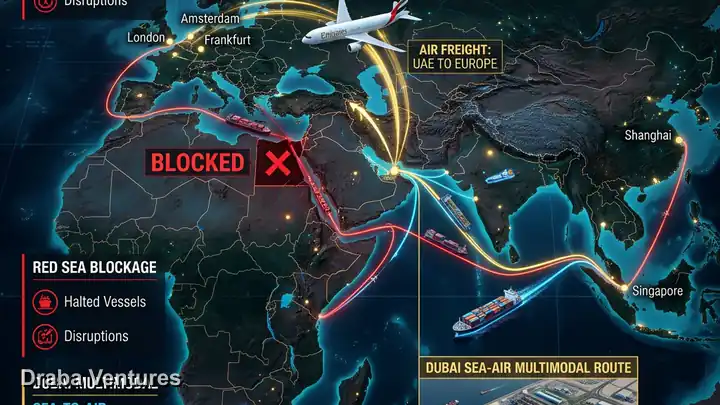
The architecture of global maritime trade has undergone a severe stress test over the past twenty-four months. The Bab-el-Mandeb Strait, a vital maritime chokepoint connecting the Red Sea to the Gulf of Aden and the broader Indian Ocean, has become a high-risk zone for commercial shipping. Historically, this corridor handles approximately 12% to 15% of total global trade, and specifically, over 30% of global container traffic transits through the Suez Canal.
Because of persistent geopolitical tensions and the looming threat to vessel security, all major ocean carriers - including Maersk, Hapag-Lloyd, MSC, and CMA CGM - have implemented comprehensive Red Sea avoidance shipping routes. Vessels departing from Indian ports (like Mundra, Nhava Sheva, and Kochi) that are bound for European, Mediterranean, and North American markets are now routinely diverted around the Cape of Good Hope, bypassing the Suez Canal entirely.
This massive detour adds an average of 14 to 20 days to standard transit times. The cascading effect on global logistics has been brutal: vessel turnaround times have plummeted, creating acute container shortages in Asian ports. Freight rates have surged, and the cost of capital tied up in floating inventory has skyrocketed. For the export of time-sensitive and high-value agricultural commodities, such as premium spices, perishables, and select basmati and non-basmati rice varieties, relying exclusively on pure ocean freight is no longer the default economic choice. Exporters are forced to adapt, giving rise to specialized multimodal logistics strategies.
Sea-Air routing is a hybrid logistics strategy designed to balance cost and speed. Cargo is shipped via conventional ocean freight from Indian gateway ports to Jebel Ali Port in Dubai (transit time: 3-5 days). The cargo is then rapidly unstuffed and moved via bonded trucks to Dubai's airports (DWC or DXB), where it is loaded onto cargo aircraft bound for final destinations in Europe or Africa. This method is roughly 40% to 50% cheaper than pure air freight and up to 15 days faster than the Cape of Good Hope ocean detour.
Understanding Sea-Air Multi-Modal Freight Dynamics
To circumvent the catastrophic delays caused by Red Sea disruptions, top-tier agri-commodity exporters have pivoted to the Sea-Air multimodal model, heavily leveraging the United Arab Emirates as the ultimate transit nexus. Dubai’s geographical positioning makes it an unparalleled logistics bridge between the Indian subcontinent and the Western Hemisphere.
The operational mechanics of this model are built upon speed and seamless customs integration. When a vessel departs Nhava Sheva laden with premium agri-commodities, it takes merely 3 to 5 days to reach Jebel Ali Port. Because the UAE operates an advanced, fully integrated logistics infrastructure, the cargo is not subject to standard import customs delays. Instead, it is processed under a transit bond. The containers are rapidly discharged from the vessel and immediately transported via a dedicated customs-bonded trucking corridor to either Al Maktoum International Airport (DWC) or Dubai International Airport (DXB).
At the airport cargo terminals, the agricultural commodities are palletized or loaded into Unit Load Devices (ULDs) for the next available freighter or belly-hold capacity on passenger wide-bodies heading to Frankfurt, London, or Amsterdam. The entire transshipment process in Dubai - from vessel discharge to aircraft departure - often occurs within 24 to 48 hours.
The Math of Transit Times: Sea vs. Air vs. Sea-Air
Understanding the viability of Dubai's transit hub operations requires an analysis of transit time math and cost structures. Let us evaluate a standard shipment of high-value agricultural commodities (e.g., premium spices or urgent food aid) moving from Western India to Northern Europe.
- Pure Ocean Freight (Via Cape of Good Hope): The transit time has inflated from the historical 24 days to approximately 40 to 45 days. While it remains the cheapest mode at roughly $3,000 to $4,500 per TEU, the extended transit time creates severe cash flow bottlenecks for exporters and risks quality degradation for sensitive cargo.
- Pure Air Freight: Taking only 2 to 3 days from Indian airports to Europe, this is the ultimate solution for speed. However, air freight costs hover between $3.50 to $4.50 per kilogram. For bulky agricultural commodities, this exorbitant cost completely erodes profit margins, making it unfeasible for all but the most critical shipments.
- Sea-Air Multimodal: Combining the two, the total transit time is reduced to 12 to 15 days. The cost drops significantly, usually landing between $1.50 and $1.80 per kilogram. This creates an optimal "middle ground" for urgent supply chain fulfillment.
| Logistics Mode (India to Europe) | Estimated Transit Time | Relative Cost Structure (Per KG) | Cargo Profile Suitability |
|---|---|---|---|
| Pure Ocean Freight (Cape Detour) | 40 - 45 Days | $0.15 - $0.25 / kg | Standard bulk grains, standard rice, long shelf-life staples. |
| Sea-Air Multimodal (via Dubai) | 12 - 15 Days | $1.50 - $1.80 / kg | Urgent food aid, premium spices, high-margin niche organics. |
| Pure Air Freight | 2 - 3 Days | $3.50 - $4.50 / kg | Highly perishable goods, critical pharmaceutical cargo. |
Dubai Transit Hub Operations: The Jebel Ali to DWC Corridor
The success of the Sea-Air model is fundamentally reliant on the operational efficiency of the Dubai logistics corridor. Jebel Ali Port, operated by DP World, is the largest man-made harbor in the world and the biggest port in the Middle East. It operates in perfect symbiosis with the Dubai South Free Zone and Al Maktoum International Airport (DWC).
When agricultural commodities arrive from India, they enter the Dubai Logistics Corridor - a single custom-bonded zone bridging the seaport and the airport. The Electronic Data Interchange (EDI) systems between DP World and Dubai Customs allow for paperless, instantaneous clearance. Transport companies utilize specialized fleets to move cargo across this 20-kilometer corridor without the need to unstuff and restuff cargo at multiple checkpoints.
For agri-commodities, controlling the environment is paramount. Both Jebel Ali and DWC feature state-of-the-art temperature-controlled transit facilities. If shipments experience short delays while waiting for aircraft capacity, they are stored in cold storage units or ambient-controlled warehouses, ensuring that moisture levels remain stable and the threat of aflatoxin or mold development is entirely neutralized.
The Ripple Effect: How Global Shipping Disruptions Secure Domestic Indian Supply
While the Sea-Air route provides a vital pressure valve for the most urgent export contracts, the stark reality is that standard, bulk agricultural exports - like non-basmati rice - cannot absorb Sea-Air freight costs. A $1.50/kg freight charge is entirely unworkable for a commodity like Sona Masuri rice, which itself trades at roughly $0.40 to $0.50/kg at the mill level.
Consequently, the Red Sea crisis has fundamentally altered the behavior of Indian rice millers and exporters, particularly in the prime Tungabhadra irrigation belt of Karnataka, encompassing Sindhanur, Raichur, Gangavati, and Karatagi. Faced with prohibitive ocean freight rates via the Cape, severe shortages of food-grade 20ft containers, and erratic vessel schedules, many top-tier export-oriented mills are choosing to mitigate risk by liquidating their premium inventories into the domestic market.
This dynamic has created a unique, highly favorable procurement window for domestic B2B buyers across India. Wholesale distributors, modern retail chains, large-scale catering businesses, and HORECA (Hotel, Restaurant, and Café) operators are now able to source premium, export-grade rice varieties - which would typically be locked into long-term contracts bound for West Africa or the Middle East - directly from the mills at highly stabilized local prices.
Capitalizing on the Export Shift: Stable Pricing for Domestic B2B
In standard years, high export demand exerts upward pressure on domestic pricing for premium varieties like Sona Masuri and RNR (Samba Masuri). However, the current global logistics bottleneck has effectively decoupled domestic pricing from international demand surges, trapping high-quality supply within the domestic borders.
For bulk buyers in urban consumption hubs like Bengaluru, Hyderabad, Chennai, and Mumbai, this means that securing massive, truckload volumes of perfectly Sortex-cleaned, double-polished rice is easier and more cost-effective than ever. Draba Ventures, operating directly out of the milling hub of Sindhanur, is currently facilitating large-scale domestic dispatches to major modern retail and kirana distribution networks.
Below is the latest real-time domestic wholesale pricing for our primary rice varieties, directly dispatched from Sindhanur mills. The standard operating procedure for domestic B2B transport utilizes 26kg Polypropylene (PP) bags, with a Minimum Order Quantity (MOQ) of one standard truckload (approx. 10 to 12 Metric Tons).
| Rice Variety (Domestic Grade) | Price per Quintal (100kg) | Price per 26kg Bag (B2B Standard) | Price per Metric Ton (MT) | Primary Domestic End-User |
|---|---|---|---|---|
| Sona Masuri (HMT) | ₹3,200 - ₹3,600 | ₹832 - ₹936 | ₹32,000 - ₹36,000 | Modern Retail, Premium Kirana, Households |
| Kaveri Sona (Hybrid) | ₹3,400 - ₹3,800 | ₹884 - ₹988 | ₹34,000 - ₹38,000 | Tamil Nadu/Andhra Wholesale Markets |
| RNR (Samba Masuri / 15048) | ₹3,000 - ₹3,400 | ₹780 - ₹884 | ₹30,000 - ₹34,000 | HORECA Chains, Hospitals (Low GI) |
| Kolam Rice (Long Slender) | ₹3,100 - ₹3,500 | ₹806 - ₹910 | ₹31,000 - ₹35,000 | Gujarat, Maharashtra Bulk Buyers |
| Bullet Rice (Medium Bold) | ₹2,800 - ₹3,200 | ₹728 - ₹832 | ₹28,000 - ₹32,000 | Canteens, Institutional Catering |
*Note: The above pricing is indicative of ex-mill rates for June/July 2026. Transport freight charges from Sindhanur to destination cities are calculated separately based on real-time trucking logistics.
Why Sindhanur is the Premier Hub for South Indian Rice Procurement
The geographical advantage of Sindhanur, situated in the heart of the Tungabhadra irrigation belt, cannot be overstated. This region benefits from uninterrupted water supply and exceptionally fertile soil, yielding grain profiles with ideal cooking characteristics, high head rice yields (low broken percentage), and excellent volumetric expansion upon cooking.
As the Red Sea crisis forces global trade to recalibrate, smart domestic buyers are skipping urban brokers and establishing direct, long-term procurement relationships with mills in Sindhanur and Karatagi. By purchasing direct truckloads (10-ton or 25-ton configurations), wholesalers eliminate multiple layers of middleman margins, taking full advantage of the export-grade surplus currently available in the region.
Secure Direct Truckload Supply Today
Are you a domestic wholesale distributor, HORECA procurement manager, or modern retail buyer looking to capitalize on current market stability? Procure export-grade Sona Masuri, RNR, and Kolam rice directly from our Sindhanur mills. We handle complete logistics and GST/E-Way bill compliance.
Message Our Domestic Sales Desk on WhatsApp