Hydraulic compression of defibered tamarind pulp into uniform slabs (500g, 1kg, 5kg, or 20kg) eliminates interstitial air pockets, preventing oxidation and premature fermentation during transoceanic shipping. Paired with shrink-wrapped food-grade polyethylene liners and heavy-duty 5-ply export cartons, this packaging provides an impenetrable moisture barrier that guarantees a shelf life exceeding 12 months. Crucially, the dimensional precision of compressed rectangular cartons maximizes 20-foot Full Container Load (FCL) payload up to 20 to 22 metric tons, reducing landed CIF ocean freight charges per metric ton by over 30% compared to loose bagged shipments.
Hydraulic Pressing and Block Formation: Industrial Compression Mechanics
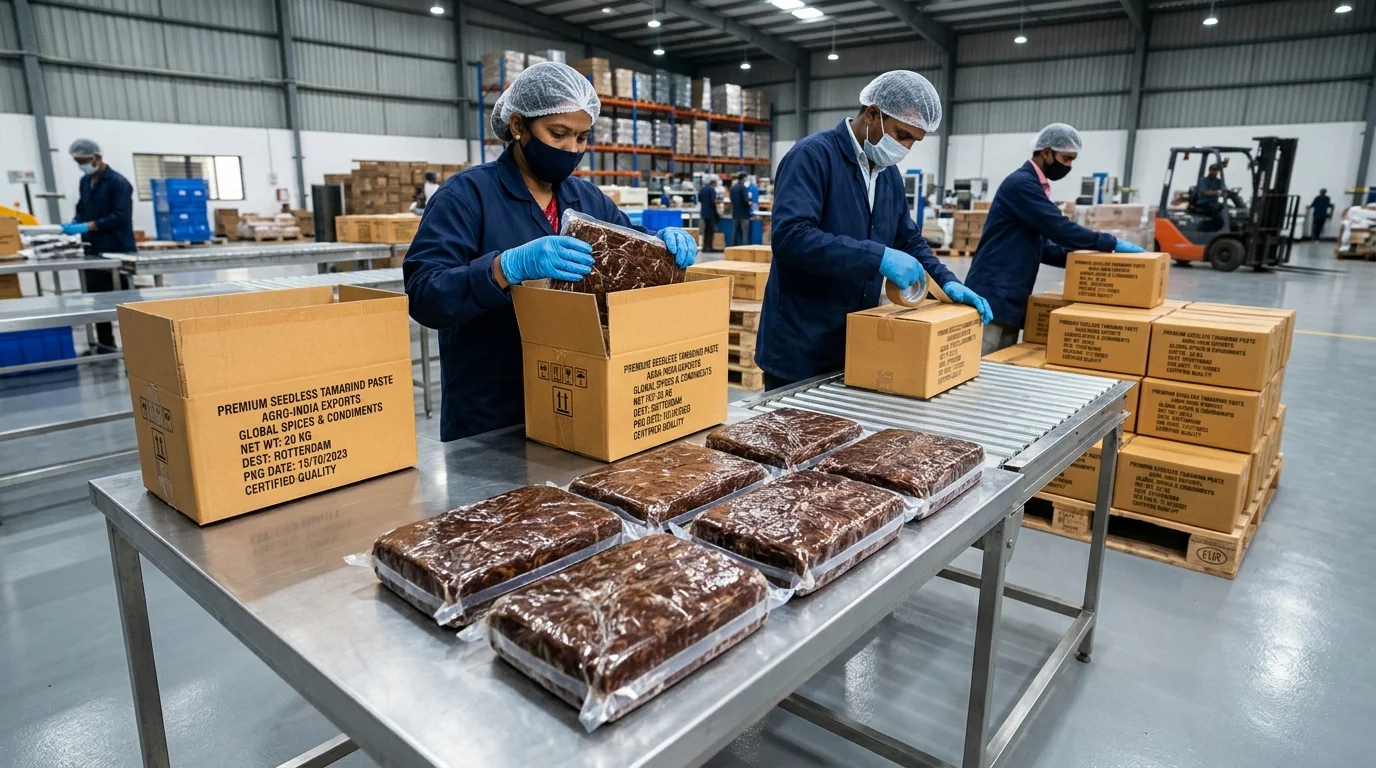
In the bulk export of tropical agro-commodities, post-harvest handling directly dictates commercial viability upon arrival. Cleaned, defibered tamarind pulp (Tamarindus indica) naturally possesses a tacky, viscoelastic consistency with microscopic void spaces. If packed loosely into bags or traditional round baskets, these internal air pockets expose the tartaric acid, sugars, and natural pectin to trapped oxygen.
Draba Ventures engineers the packaging line by utilizing automated industrial hydraulic presses calibrated to specific compaction ratios. The processing cycle follows rigid mechanical stages:
- Defibering & Destoning Calibration: Harvested tamarind from Karnataka and Tamil Nadu belts is sorted, deshelled, and passed through mechanical destoning rollers and manual fiber-stripping tables to ensure seed and shell fragments remain strictly below 5%.
- Precise Mass Metering: Cleaned pulp is precisely weighed on digital inline scales into specified batch weights: 500 grams, 1 kilogram, 5 kilograms, or institutional 20-kilogram slabs.
- Hydraulic Mechanical Compression: The metered pulp is placed inside hardened food-grade stainless steel (SS304) mold cavities. Heavy hydraulic rams exert uniform downward pressure (ranging from 120 to 180 bar depending on block thickness), compacting the viscoelastic pulp into dense, geometric rectangular bricks.
The primary chemical and biological benefit of hydraulic block formation is the total expulsion of oxygen. By forcing ambient air out of the cellular matrix of the pulp, hydraulic pressing effectively arrests aerobic microbial respiration and completely inhibits oxidative enzymatic browning. This prevents yeast activation and accidental fermentation during transit through equatorial ocean corridors, ensuring the imported slab retains its signature deep amber to dark mahogany hue and sharp tartaric acid potency.
Moisture-Barrier Cartons and Shelf-Life Maximization: Multi-Layer Barrier Engineering
Dried fruit commodities are inherently hygroscopic: they absorb ambient moisture when relative humidity exceeds their equilibrium moisture content. In ocean freight logistics, marine container environments undergo severe diurnal temperature swings known as "container rain" or container sweat, where condensing water vapor drips from the steel ceiling onto the cargo.
Without adequate multi-tier packaging protection, moisture condensation on tamarind leads directly to the formation of superficial white fungal colonization (primarily harmless but commercially disqualifying mold spores like Aspergillus and Penicillium strains). To counter this logistical vulnerability, Draba Ventures applies an engineered dual-barrier containment architecture:
The Dual-Layer Packaging Defense: Every compressed tamarind slab is first heat-sealed inside virgin food-grade polyethylene (PE) or biaxially-oriented polypropylene (BOPP) shrink film (60 to 80 microns thick). This creates an impenetrable vacuum-tight envelope around each individual block, preventing both internal moisture loss and external moisture ingress.
Following primary encapsulation, the wrapped blocks are nested into custom-engineered, heavy-duty 5-ply corrugated export master cartons manufactured from high-grammage virgin Kraft liner boards (ECT > 44, burst strength exceeding 14 kg/cm²). The inner and outer corrugated facings are treated with water-resistant sizing, enabling the cartons to withstand up to 90% relative humidity in tropical marine environments without structural buckling or compression failure.
This multi-layer packaging protocol guarantees complete physical, chemical, and organoleptic integrity, extending commercial shelf life to over 12 months at ambient warehouse conditions without requiring refrigeration or artificial chemical preservatives.
FCL Container Payload and Ocean Freight Math: 20ft Container Load Factor Optimization
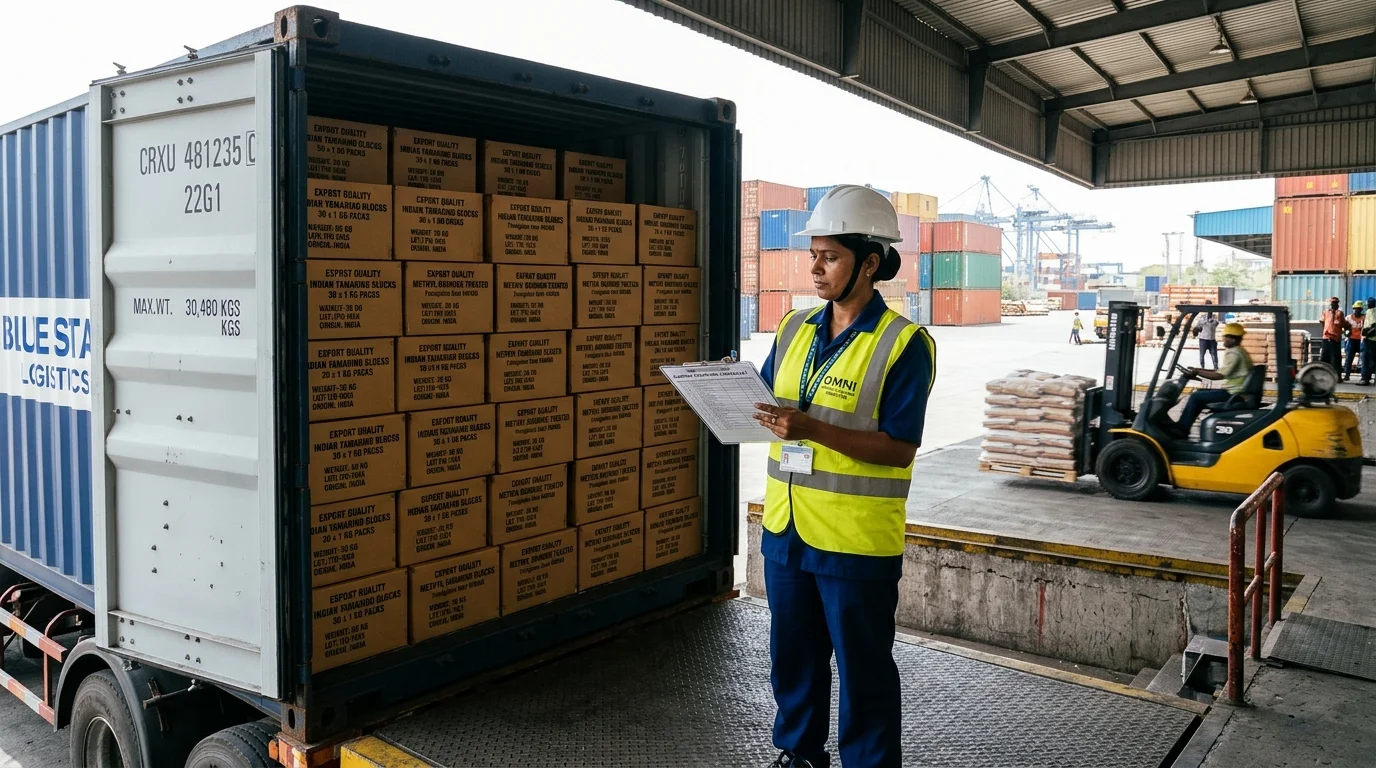
Ocean freight rates are quoted on a per-container basis rather than strictly per metric ton. Therefore, the single most powerful lever for reducing the landed Cost, Insurance, and Freight (CIF) price per kilogram is container volume utilization. Irregularly packed or bagged goods suffer from poor cubic efficiency, wasting up to 35% of a container's internal volume in unoccupied void spaces.
By transforming malleable tamarind into rigid, dimensionally uniform rectangular cartons, Draba Ventures achieves an extraordinary container load factor inside standard 20-foot dry freight containers (20ft FCL). The mathematical advantage of rectangular block packaging is clear:
| Packaging Configuration | Primary Slab Dimensions | Master Carton Net Weight | Cartons per 20ft FCL | Total Net Payload (MT) | Ocean Freight Dilution Factor |
|---|---|---|---|---|---|
| 500g Consumer Slabs | 120 x 85 x 40 mm (shrink-wrapped) | 20 kg (40 slabs x 500g) | 1,000 Master Cartons | 20.0 Metric Tons | Base Benchmark |
| 1kg Foodservice Slabs | 180 x 110 x 45 mm (shrink-wrapped) | 20 kg (20 slabs x 1kg) | 1,050 Master Cartons | 21.0 Metric Tons | -4.8% CIF Freight per MT |
| 5kg Institutional Blocks | 280 x 190 x 90 mm (poly-lined) | 20 kg (4 blocks x 5kg) | 1,100 Master Cartons | 22.0 Metric Tons | -9.1% CIF Freight per MT |
| 20kg Industrial Master Slab | 420 x 300 x 170 mm (hydraulic block) | 20 kg (1 solid block) | 1,100 Master Cartons | 22.0 Metric Tons | -9.1% CIF Freight per MT (Zero Labor) |
When an importer sources 22 metric tons of 20kg industrial slabs in a single 20ft box versus 16 metric tons of loose bagged tamarind, the fixed ocean carrier booking fee (for instance, $1,800 to Jebel Ali or $2,400 to Manzanillo) is divided across 37% more active product mass. This operational discipline yields an instant $25 to $40 per metric ton landed cost saving, providing commercial food manufacturers with an insurmountable margin advantage in their domestic markets.
Fumigation and Phytosanitary Customs Security: Mitigating Pest Risks for Gulf and Latin American Ports
Agricultural commodities derived from tree pods carry acute vulnerability to stored product pests, particularly the red flour beetle (Tribolium castaneum), the merchant grain beetle (Oryzaephilus mercator), and the cigarette beetle (Lasioderma serricorne). Destination customs authorities across the Gulf Cooperation Council (such as Dubai Municipality and Saudi Food and Drug Authority - SFDA) as well as Mexico (SENASICA) maintain absolute zero-tolerance policies for live insect infestation, insect boring damage, or non-compliant fumigation residues.
To ensure guaranteed phytosanitary acceptance upon arrival, Draba Ventures executes a multi-tiered compliance workflow at port-side Container Freight Stations (CFS) prior to vessel loading:
- Controlled CFS Stuffing: Containers are subjected to rigorous pre-stuffing sanitation inspections. Only clean, dry, odor-free shipping boxes free from floor oil stains or rust are accepted.
- Mandated Chemical Fumigation: Depending on the destination port's statutory guidelines, containers undergo professional, government-licensed fumigation:
- Methyl Bromide (MBr): Administered at 32g to 48g/m³ for 24 hours under gastight tarpaulins, mandatory for destination clearances requiring rapid, ovicidal pest eradication including Mexican and Australian ports.
- Aluminum Phosphide (ALP / Phosphine): Administered via slow-release formulation at 1.5g to 2.0g of phosphine gas per cubic meter over a 120-hour sealed exposure period, the preferred choice for Gulf ports demanding residue-free compliance for food processing ingredients.
- Independent Third-Party Verification: Independent inspection agencies including SGS, Bureau Veritas, or Cotecna draw random representative composite samples from stuffed cartons to independently verify moisture content (< 18%), seed and fiber tolerance (< 5%), carton gross weights, and absence of live insects.
- Phytosanitary Certification: Following aeration and degassing verification, the Directorate of Plant Protection, Quarantine & Storage (Ministry of Agriculture, India) issues the official Government Phytosanitary Certificate, accompanied by the licensed Fumigation Certificate and SGS Quality & Weight Certificate.
Optimize Your Bulk Tamarind Procurement Unit Economics
Source high-density 500g, 1kg, 5kg, or 20kg defibered seedless tamarind slabs packed in 5-ply export master cartons. Maximize your 20ft container payload with SGS pre-shipment certification and phytosanitary clearance guaranteed.
Request FCL Tamarind Quotation