The High-Stakes Procurement Requirements of Inflight and Institutional Dining
Procurement directors managing supply chains for commercial airlines, railway networks, and healthcare hospital systems operate under strict liability and performance boundaries. With single-use plastic cutlery bans firmly enacted across the EU (Directive 2019/904), the UK, Canada, and Australia, operators were forced to abandon conventional polystyrene cutlery sets virtually overnight.
However, selecting the correct bio-based replacement is not simply a matter of swapping plastic for wood. In healthcare settings, patient safety and mouthfeel are critical; a single splinter can lead to severe liability claims. In commercial aviation, every gram of deadweight translates directly into fuel consumption metrics and carbon emission calculations. The two primary candidates - FSC-certified birchwood and natural bamboo - offer vastly different operational and financial profiles.
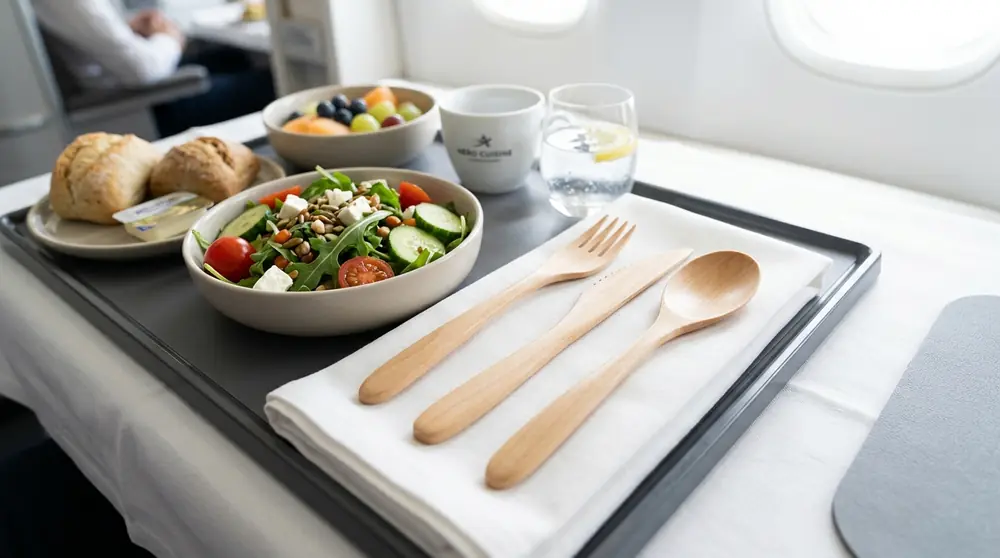
Aviation Weight Metrics: On a long-haul commercial aircraft serving 300 passengers with three meal services, switching from dense 4.2g bamboo cutlery to precision 2.8g birchwood saves over 3.7 kg per flight. Multiplied across an airline fleet operating 25,000 sectors annually, birchwood eliminates over 92,000 kg of payload weight, saving tens of thousands of dollars in aviation jet fuel.
Wood Anatomy: Tight Hardwood Grain vs. Fibrous Grass Bundles
Understanding why birchwood outperforms bamboo requires examining their cellular biology. Birch (Betula pendula) is a temperate hardwood characterized by dense, diffuse-porous vessels and fine, uniformly distributed cellulose fibers. When mechanically stamped and heat-formed, birchwood retains an isotropic grain structure that resists splintering.
Bamboo is not wood; it is a giant grass (Bambusoideae). Its anatomical structure consists of long, rigid longitudinal vascular bundles embedded in softer parenchymal tissue. When bent or subjected to biting pressure, bamboo tends to split parallel to its fibers, producing sharp, needle-like splinters that present unacceptable hazards in healthcare and institutional dining.
- Mechanical Tumble Polishing: Birchwood cutlery undergoes hours of dry mechanical tumbling, rounding all fork tines and knife serrations to deliver a smooth mouthfeel.
- Organoleptic Neutrality: Kiln-drying at 105°C purges natural plant tannins, ensuring zero bitter sap transfer into delicate soups, yogurts, or hot entrées.
- Automated Packaging Compatibility: Consistent thickness tolerances (+/- 0.1 mm) allow high-speed automated flow-wrapping into hygienic cutlery packs (fork, knife, napkin, toothpick).
Direct Technical Comparison: Birchwood vs. Bamboo
Review the comprehensive comparative performance matrix across critical institutional metrics:
| Evaluation Metric | FSC Birchwood Cutlery | Natural Bamboo Cutlery | Institutional Impact |
|---|---|---|---|
| Splinter Failure Risk | Near Zero (Diffuse tight grain) | Moderate to High (Long fibers) | Birchwood eliminates patient choking liabilities |
| Unit Weight (160mm Fork) | 2.6 - 2.9 grams | 3.8 - 4.5 grams | Birchwood saves critical airline fuel payload |
| Flavor / Odor Neutrality | 100% Taste-Neutral (Tumbled) | Can carry natural grass / sap aroma | Birchwood preserves chef meal flavor profiles |
| Manufacturing Process | Mechanical die stamping | Slicing, gluing, or machining | Birchwood utilizes zero adhesive glues |
| Unit Purchase Price | $0.012 - $0.018 / piece | $0.024 - $0.038 / piece | Birchwood is 40% - 50% more economical |
| Composting & Soil Breakdown | Backyard compost (90-120 days) | Slow breakdown (180+ days) | Birchwood degrades faster in waste streams |
Container Economics and Flow-Wrap Packaging Formats
For high-volume institutional caterers, packaging formats dictate warehouse storage efficiency and galley cart ergonomics:
| Cutlery SKU / Set | Packaging Format | Units per Carton | Cartons per 40ft HC | Total Units / 40ft HC |
|---|---|---|---|---|
| 160mm Birchwood Fork (Bulk) | 100 pcs x 50 polybags | 5,000 | 920 | 4,600,000 |
| 165mm Birchwood Knife (Bulk) | 100 pcs x 50 polybags | 5,000 | 980 | 4,900,000 |
| 160mm Birchwood Spoon (Bulk) | 100 pcs x 50 polybags | 5,000 | 900 | 4,500,000 |
| 4-in-1 Inflight Meal Set (F+K+S+Napkin) | Kraft flow-wrapped set | 500 sets | 1,100 | 550,000 sets |
| 110mm Birchwood Ice Cream Paddle | Paper banded 50s | 10,000 | 1,200 | 12,000,000 |
Frequently Asked Questions
Why is birchwood cutlery preferred over bamboo in hospital catering?
Does birchwood cutlery impart a woody or sap taste to food?
How does birchwood cutlery optimize airline payload weight and freight costs?
Procure Airline & Hospital Grade Cutlery in Bulk
Secure stable pricing, certified smooth splinter-free finishing, and customized hygienic flow-wrap cutlery sets. Contact Draba Ventures for wholesale export container rates.
Request Bulk Cutlery Samples Chat on WhatsApp