The QSR Delivery Dilemma: Preserving Food Integrity at Scale
For quick-service restaurant (QSR) chains, dark kitchens, and takeaway franchises, packaging is the primary physical interface with the consumer. Over the last three years, the surge in third-party delivery apps has lengthened the average transit duration to 30-45 minutes. Meals spend extended periods inside sealed, humid delivery bags where steam accumulation tests the structural limits of takeaway boxes.
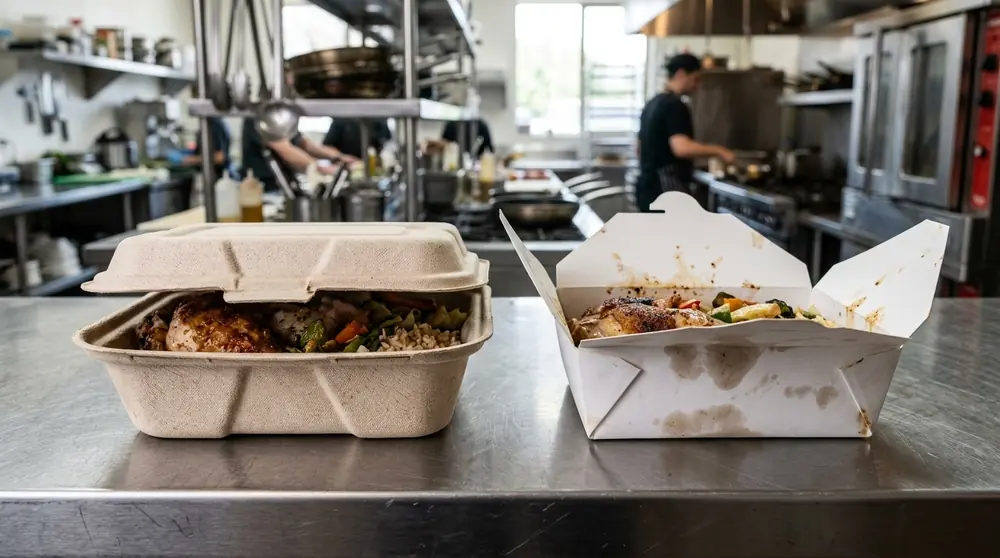
Procurement directors face a direct choice between two primary biodegradable substrates: traditional folded solid bleached sulfate (SBS) paperboard and thermoformed sugarcane bagasse. While paperboard historically offered cheaper unit pricing, its physical limitations under steam pressure frequently result in crushed burgers, leaking sauces, and brand damage.
Regulatory Tax Arbitrage: Under the UK Plastic Packaging Tax (£217.85/tonne) and European Extended Producer Responsibility (EPR) packaging fees, paperboard boxes laminated with thin polyethylene (PE) moisture liners are classified as composite multi-materials, triggering punitive recycling surcharges. Pure molded bagasse is 100% monomaterial bio-fiber, completely exempt from plastic taxes.
Structural Engineering: Three-Dimensional Molding vs. Scored Sheets
The difference in performance stems from manufacturing physics. Paperboard boxes begin as flat sheets of solid bleached sulfate (SBS) or kraft paperboard. To create a box, the sheet must be mechanically die-cut, creased, folded, and glued. These crease lines act as built-in stress concentrators that readily buckle under top-load weight.
In contrast, molded sugarcane bagasse is manufactured by wet-forming pulp directly into three-dimensional molds under high pressure. The cellulose fibers interweave in all directions, creating an integrated shell with molded structural ribs, reinforced radiused corners, and perimeter snap latches.
- Integrated Stiffening Ribs: Geometric embossing on bagasse lids and sidewalls dramatically enhances section modulus without adding excess weight.
- Ventilation Control: Bagasse containers allow controlled moisture vapor release while retaining sensible heat, preventing food from turning soggy.
- Unified Liquid Containment: Zero glued joints or folded corners means zero corner pinhole leaks from gravies, grease, and dressing.
Direct Technical Comparison: Bagasse Clamshell vs. SBS Paperboard
Review the comprehensive physical metrics governing takeaway food performance:
| Evaluation Parameter | Molded Sugarcane Bagasse | PE-Lined SBS Paperboard | Procurement & Brand Impact |
|---|---|---|---|
| Vertical Top-Load Strength | 18 - 24 kg force | 8 - 11 kg force | Bagasse allows 5-tier stacking in delivery bags |
| Steam & Condensation Behavior | Breathable fiber (Prevents sogginess) | Traps moisture (Soggy food result) | Bagasse keeps fried items crispy during transit |
| Grease Penetration Barrier | Certified PFAS-free dispersion barrier | Polyethylene (PE) plastic coating | Bagasse avoids non-recyclable plastic liners |
| Corner Seam Integrity | Continuous one-piece molded body | Glued / folded corner joints | Bagasse eliminates corner leakages |
| Microwave Reheating Safety | 100% Safe (Up to 120°C) | Risk of PE liner melting into food | Bagasse allows direct consumer reheating |
| Global EPR & Plastic Taxes | 100% Tax Exempt Monomaterial | Subject to composite plastic penalties | Bagasse reduces total annual tax liabilities |
Total Cost of Ownership: Container Economics
While standard paperboard may appear 5-10% cheaper per unit on an initial invoice, total operational accounting demonstrates that bagasse delivers lower net costs across high-volume QSR operations:
| Cost Component (1 Million Units) | SBS Paperboard Boxes | Molded Sugarcane Bagasse | Net Financial Difference |
|---|---|---|---|
| Base Packaging Purchase Cost | $72,000 | $78,000 | Paperboard appears $6,000 cheaper |
| Plastic EPR / Regulatory Tax Levies | $8,400 (Composite fees) | $0 (Fully exempt) | Bagasse saves $8,400 in statutory fees |
| Refunds & Crushed Meal Remakes (1.5% vs 0.2%) | $9,500 (Delivery refunds) | $1,200 | Bagasse saves $8,300 in customer reimbursements |
| Outer Plastic Liner Bags Required | $4,200 (To stop grease bleed) | $0 (Unnecessary) | Bagasse saves $4,200 in secondary wrap |
| Net Total Operational Cost | $94,100 | $79,200 | Bagasse Delivers $14,900 Total Savings (15.8%) |
Frequently Asked Questions
Why is molded sugarcane bagasse more rigid than folded paperboard?
Does sugarcane bagasse packaging escape single-use plastic taxes in the UK and EU?
How do stacking strengths compare between bagasse and paperboard during food delivery?
Upgrade Your QSR Packaging Supply Chain
Eliminate crushed food deliveries and reduce statutory packaging taxes. Contact Draba Ventures for direct factory container pricing on heavy-duty molded sugarcane clamshells and delivery boxes.
Request Factory Pricing Chat on WhatsApp