The Strategic Imperative of Custom Brand Embossing
Global fast-food franchises and supermarket chains lose brand equity when they rely on generic, unbranded eco-packaging that fails to differentiate their premium offerings. In an intensely competitive quick-service restaurant (QSR) environment, generic off-the-shelf takeaway clamshells signal commodity status to consumers. High-volume foodservice operators require branded packaging that reinforces corporate identity at the dining table without inflating operational overhead.
White-labeling molded fiber requires custom CNC-machined steel molds to emboss corporate logos directly into the cellulose structure during the high-heat thermoforming process. Unlike surface printing, which risks toxic ink migration into hot food and threatens ASTM/EN compostability, 3D embossing maintains 100% FDA food-contact safety. Sourcing proprietary tooling through direct Indian manufacturing partnerships secures exclusive branded presentation at highly competitive unit pricing.
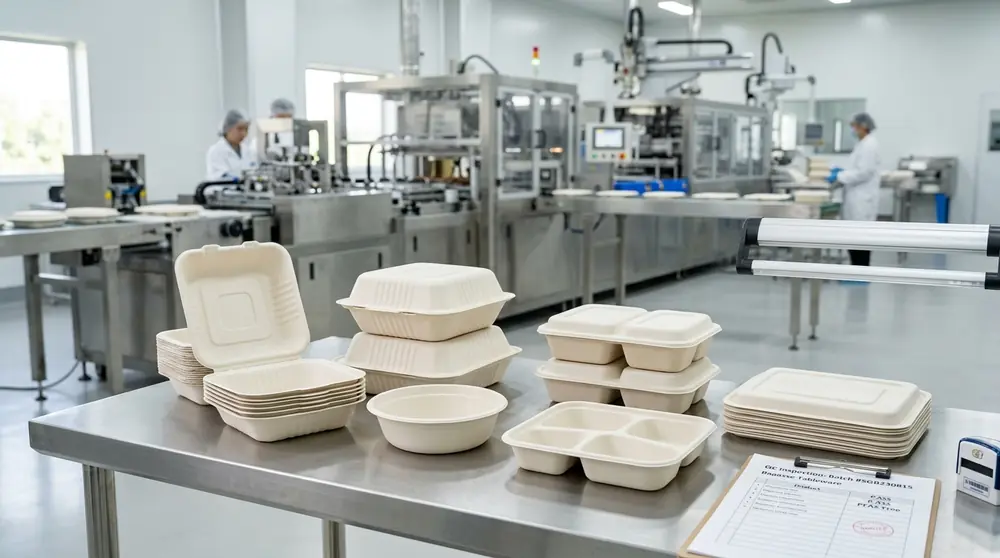
OEM Tooling Engineering: Draba Ventures designs and machines precision hardened-steel tooling for bespoke bagasse containers. From initial 3D CAD modeling and rapid additive prototyping to final multi-cavity thermoforming molds, our production cycle delivers fully customized packaging within 35 to 45 days.
Why 3D Embossing Outperforms Chemical Surface Printing
Printing graphics on fibrous, porous substrates like sugarcane bagasse creates severe chemical and regulatory liabilities:
- Zero Ink Leaching: Conventional solvent-based and flexographic inks contain volatile organic compounds (VOCs) and synthetic pigments. When hot, greasy food contacts printed surfaces, chemical inks migrate directly into the food matrix, violating FDA 21 CFR standards.
- Uncompromised Compostability: Heavy metallic printing inks leave non-biodegradable chemical residues in compost soil, causing failure under EN 13432 and ASTM D6400 heavy metal audits. Physical embossing alters fiber geometry without adding foreign chemical substances.
- Tactile Sensory Appeal: A precision-debossed or embossed logo creates a distinctive tactile texture that communicates environmental authenticity to the consumer far more effectively than flat ink printing.
Comparative Customization Matrix: Ink vs. 3D Embossing
Examine the operational, financial, and regulatory trade-offs between chemical surface printing and precision mold embossing:
| Customization Dimension | Chemical Ink Printing (Paperboard) | 3D Mold Embossing (Draba Bagasse) | B2B Distributor Margin Impact |
|---|---|---|---|
| Food Contact Safety Risk | High (Direct chemical ink migration) | Zero (100% Physical fiber molding) | Eliminates contamination liabilities |
| Compostability Certification | Degraded by chemical pigments & binders | 100% Retained (Pure natural fiber) | Preserves ASTM / EN compliance |
| Variable Unit Cost | Adds $0.008 - $0.015 per printed unit | $0.000 added unit production cost | Maximizes wholesale operating margin |
| Durability Under Hot Liquids | Inks bleed and smear under hot steam | Permanent permanent structural imprint | Pristine presentation in delivery |
| Standard Production MOQ | Varies widely (100,000+ units) | ~50,000 units per production run | Accessible initial capital barrier |
Tooling Amortization & Unit Economics
Investing in custom thermoforming tooling requires clear financial forecasting. While custom multi-cavity CNC molds require an upfront tooling investment ($3,500 to $6,000 depending on cavity count and depth), amortizing this fixed cost over production volume demonstrates immediate unit cost advantages:
| Production Volume (Units) | Tooling Amortization / Unit | Base Production Cost / Unit | Total Landed Unit Cost |
|---|---|---|---|
| 50,000 Units (Initial Run) | $0.0800 | $0.0420 | $0.1220 |
| 250,000 Units (Quarterly Volume) | $0.0160 | $0.0410 | $0.0570 |
| 1,000,000 Units (Annual Program) | $0.0040 | $0.0390 | $0.0430 (Direct Parity with Generic) |
| 3,000,000+ Units (Enterprise Franchise) | $0.0013 | $0.0375 | $0.0388 (Significant Margin Edge) |
Turnkey OEM Engineering: From CAD to Container
Draba Ventures manages the entire private-label engineering lifecycle. Our industrial design team works from your brand's vector artwork to generate parametric 3D tooling files, calculating draft angles, wall thicknesses, and structural ribbing to guarantee container rigidity. After rapid CNC mold fabrication, we dispatch physical pilot samples for client drop-testing and thermal evaluation before executing high-volume containerized production.
Frequently Asked Questions
Can you put a logo on sugarcane bagasse packaging?
How much does a custom bagasse mold cost?
How long does custom molded packaging take to manufacture?
Ready to Secure Certified PFAS-Free Biodegradable Packaging?
Click the WhatsApp icon in the bottom corner to request our lab test reports and live CIF pricing. Our procurement team is online.
Request Custom Mold Consultation Chat on WhatsApp