For high-capacity commercial toll roasters and rapid-growth private label coffee brands, raw material procurement is the single greatest determinant of operational profitability and customer retention. When a consumer purchases a retail coffee blend in London, Berlin, New York, or Dubai, they demand absolute sensory identity from their first sip in January to their replenishment bag in November. Draba Ventures operates as a dedicated private label green coffee supplier India, bridging high-elevation shade-grown origins with precision optical sorting and hermetic maritime security.
Sourcing for Toll Roasters and Private Label Brands
Contract roasting facilities (toll roasters) operate under extreme production constraints. Unlike boutique micro-roasters who roast small 5kg sample charges and frequently adjust roasting curves, commercial toll roasters run continuous 60kg to 300kg roasting drums (such as Loring, Diedrich, Probat, or Brambati) on automated PLC software profiles. In this high-throughput environment, raw material inconsistency is catastrophic:
- Density Drift: Unscreened green beans with variable bulk density cause erratic thermodynamic heat transfer in the roaster drum, leading to uneven roast color and internal bean underdevelopment.
- Moisture Gradients: Shipments with wide moisture dispersion within the same batch produce sporadic First Crack timestamps and erratic Rate of Rise (RoR) curves.
- Flavor Profile Divergence: Fragmented broker lots sourced from dozens of anonymous smallholders cause retail blends to taste astringent or bitter in subsequent distribution batches.
Draba Ventures solves these operational vulnerabilities through massive, estate-consolidated lot aggregation. We aggregate parchment coffee exclusively from audited, single-region partner estates in Karnataka that adhere to identical wet-milling fermentation standards, mechanical demucilagination protocols, and uniform raised-bed sun drying. When you contract 18 MT (a full 20ft container) or 100+ MT across an annual roasting program, every single 60kg jute sack originates from the same elevation bracket and processing run, ensuring your automated roast profiles run effortlessly from start to finish as your dedicated private label green coffee supplier India.
Target Roaster Base
Enterprise toll roasters, supermarket private label labels, HORECA chains, and commercial cold-brew manufacturers requiring uniform extraction yields.
Screen Calibrations
Plantation AA (Screen 18+, 7.1mm), Plantation A (Screen 17, 6.65mm), Robusta Parchment AB (Screen 15/16), and Peaberry (PB single round pearl).
Contract Flexibility
Quarterly, semi-annual, and full crop-year allocations with scheduled container dispatch increments aligned with roastery production schedules.
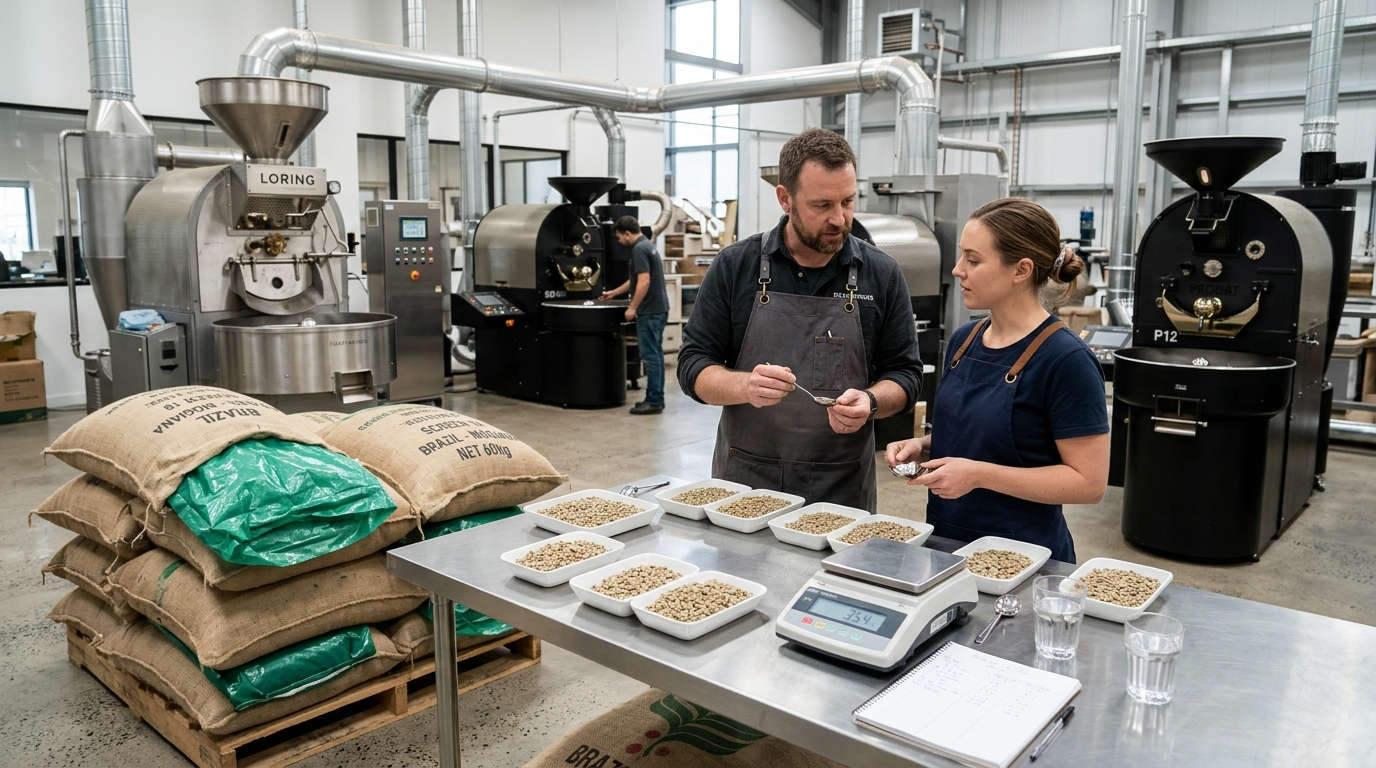
Cupping Uniformity and Volume Contracts
In the commercial private label market, margin protection is just as critical as cup quality. Roasteries that rely on spot-market commodity brokers or secondary European warehouse traders face substantial structural markups, ranging between 12% and 22% above export terminal parity. Furthermore, spot purchases force roasters to constantly swap green coffee components, forcing roast masters to spend hundreds of unbillable hours cupping, adjusting charge temperatures, and troubleshooting roast defects.
By establishing direct-trade volume contracts with Draba Ventures, roasteries secure long-term price certainty directly referenced to transparent New Mangalore Port Authority (NMPA) FOB economics. Long-term forward contracting locks in your raw material costs, insulating your business from speculative international terminal spikes while guaranteeing physical supply line security.
Direct Volume Contracting vs Spot Broker Trading
A 36 MT annual contract (2 x 20ft FCL) executed directly with Draba Ventures saves mid-sized commercial roasters between $24,000 and $48,000 annually in broker fee avoidance, while simultaneously reducing roast profile recalibration downtime by over 80%.
| Commercial Parameter | Spot Market Brokerage | Draba Ventures Direct Volume Contract |
|---|---|---|
| Intermediary Surcharge | 12% to 22% spot broker markup | 0% broker markup; transparent farmgate-to-FOB pricing |
| Sensory Uniformity | Variable (mixed estates, unpredictable lots) | Guaranteed 83+ to 85+ SCA consistent profile |
| Roast Profile Stability | Frequent profile resets due to density shifts | Identical RoR and thermal transfer across all batches |
| Packaging Standard | Traditional single-layer jute (breathable, unlined) | Multi-layer GrainPro hermetic protective liners standard |
| Supply Security | Subject to spot inventory stockouts | Guaranteed container call-offs reserved at curing mill |
Quality Assurance and Optical Defect Extraction
Roasting drum consistency is fundamentally an exercise in defect elimination. A single black, sour, or moldy bean in a 100g roast sample can taint an entire retail espresso blend, imparting phenol, vinegar, or harsh medicinal notes that ruin consumer brand loyalty. In high-speed packaging lines, foreign objects such as small stones or metal debris can damage commercial burr grinders and trigger costly product recalls.
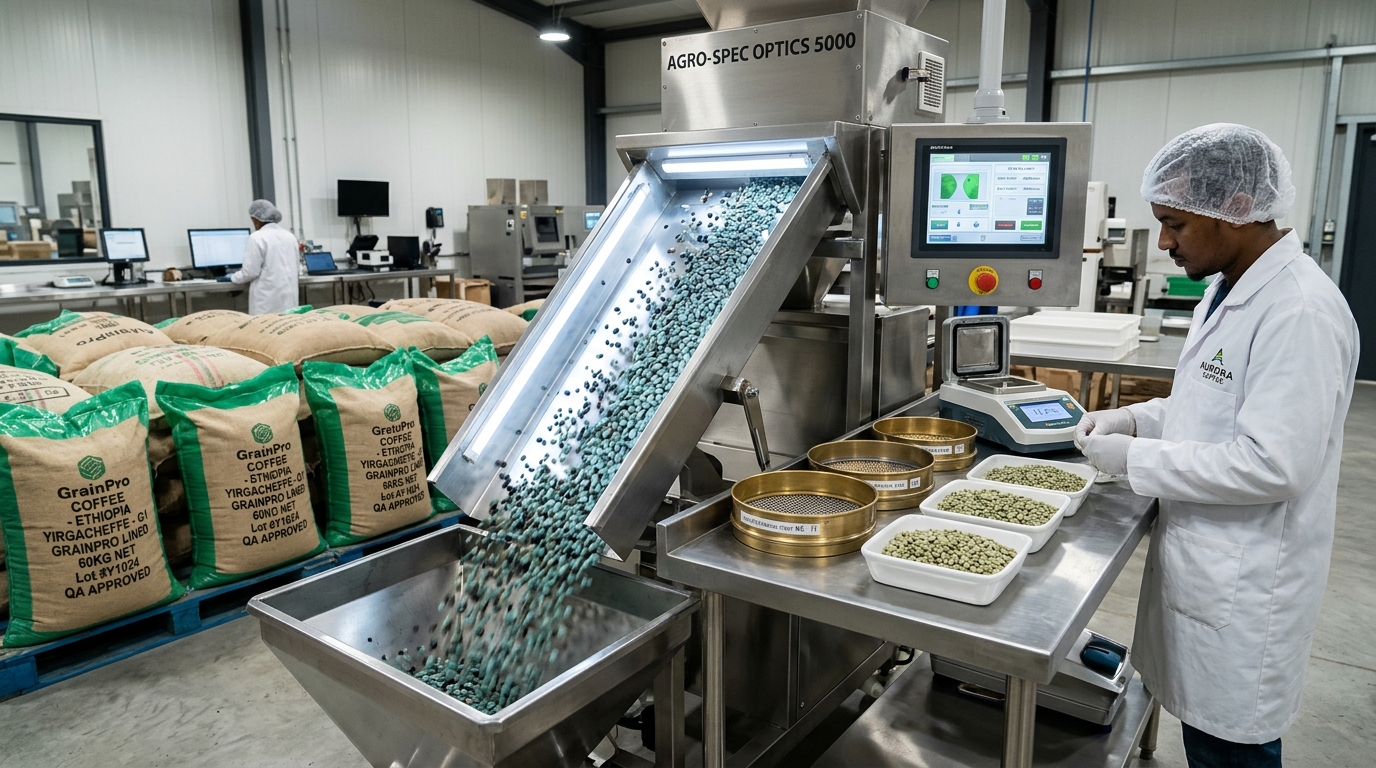
To eliminate this threat at the source, Draba Ventures subjects 100% of its private label green coffee export inventory to advanced VIS/NIR Hyperspectral Imaging (HSI) Sortex optical sorting chutes. Unlike conventional mechanical trichromatic sorters that only inspect visible color variations, our hyperspectral technology evaluates both visible wavelengths and near-infrared reflectance. This enables the optical sorting chutes to actively detect and eject defective beans with 94.63% sorting accuracy:
- Internal Sour Beans: Invisible to human hand-sorting, our optical cameras detect biochemical sugar fermentation within the bean embryo and eject sour beans before bagging.
- Immature & Insect-Bored Beans: Hyper-precise pneumatic ejectors remove light, hollow, and berry borer damaged seeds with zero collateral waste.
- Zero Primary Defects: Every contract lot complies strictly with Speciality Coffee Association (SCA) defect tolerances, ensuring zero primary defects and fewer than 5 secondary defects per 300g sample.
Moisture Control and Maritime Security
The highest quality green coffee can be permanently ruined within days of ocean shipping if moisture management is neglected. Ocean container vessels traveling from Indian ports (New Mangalore or Chennai) to European, North American, or East Asian discharge ports endure drastic ambient temperature swings, from 34 degrees Celsius at the equator down to sub-zero temperatures during winter port arrivals in Antwerp, Hamburg, or New York.
When unlined, standard jute bags are exposed to this thermal shock, warm interstitial air inside the bag releases moisture that condenses on the container ceiling and walls ("container sweat"). The resulting water droplets soak the top bag layers, creating localized relative humidity zones exceeding 75% RH. This provides the exact ecological trigger for Aspergillus ochraceus mold proliferation, leading to the rapid formulation of Ochratoxin A (OTA), a hazardous mycotoxin strictly regulated by the European Union (maximum 3.0 ppb in green coffee) and the US FDA.
Draba Ventures guarantees complete maritime integrity through a rigorous dual-barrier preservation protocol:
- Calibrated Mill Moisture Equilibrium: Prior to packaging, green coffee is stabilized at exactly 11.0% to 11.5% moisture content (strictly below the 12.0% Coffee Board threshold), ensuring cellular water activity remains below 0.60 aw.
- Multi-Layer GrainPro Hermetic Liners: Beans are immediately sealed inside food-grade, high-barrier EVOH hermetic GrainPro liners before being inserted into traditional 60kg export jute sacks. The gas-tight and moisture-tight seal creates a static micro-atmosphere that completely blocks external humidity, salt air, and condensation.
- Container Desiccant & Kraft Cladding: For North Atlantic and Baltic winter passages, shipping containers are lined with heavy Kraft paper cladding and fitted with industrial calcium chloride desiccant poles to absorb any ambient container humidity.
Frequently Asked Questions
Draba Ventures bridges direct-estate sourcing across Chikmagalur, Coorg, and the Biligirirangana Hills with export curing mill integration. We supply toll roasters and white-label coffee brands with container-scale, uniform lots of Screen 18+ Plantation AA and washed Robusta Parchment AB, verified by VIS/NIR Sortex sorting and sealed in multi-layer GrainPro liners.
In commercial drum roasting, density variations as small as 15 g/L or moisture fluctuations above 0.5% alter thermodynamic heat absorption, forcing roasters to recalibrate charge temperatures and burner settings. Draba Ventures guarantees cupping score uniformity (83+ to 85+ SCA) and tight bean density calibration across entire 18 MT to 36 MT contract volumes, eliminating batch-to-batch roast inconsistency.
Every green coffee lot destined for private label roasters undergoes VIS/NIR Hyperspectral Imaging (HSI) Sortex optical sorting chutes operating with 94.63% defect extraction efficiency. This process completely ejects black, sour, immature, insect-damaged, and hollow beans, guaranteeing zero primary defects and physical defect counts strictly under 5 per 300g sample.
During ocean container transit across tropical, Red Sea, or Atlantic shipping corridors, diurnal temperature swings create container condensation and interstitial humidity spikes above 70% RH, facilitating Aspergillus ochraceus fungal growth. Draba Ventures locks green coffee inside 5-layer EVOH GrainPro hermetic protective liners at 11.0% to 11.5% moisture, completely halting moisture migration and preventing OTA formation.
We offer annual forward allocation contracts from 18 MT (single 20ft container) up to 200+ MT multi-container programs. Shipments can be staggered in scheduled monthly or bi-monthly call-offs, allowing roasters to secure stable FOB Mangalore pricing while optimizing floor warehouse space and managing working capital.
