For wholesale rice distributors, merchant exporters, and major modern retail chains venturing into international procurement, the Letter of Credit (LC) represents both a fortress of financial security and a minefield of documentary risks. Under the Uniform Customs and Practice for Documentary Credits (UCP 600) issued by the ICC, banks operate on the principle of strict compliance. They deal in documents, not goods.
In the global rice trade, where a single vessel can carry thousands of metric tons worth millions of dollars, a seemingly minor discrepancy—a misspelled word, an omitted date, or a mismatched weight calculation—can lead to a rejected presentation. This allows the buyer to delay payment, renegotiate the price downwards, or abandon the cargo entirely, resulting in catastrophic losses for the seller.
This technical guide breaks down the five most frequent UCP 600 discrepancies encountered in cross-border rice shipments, provides robust strategies for SWIFT MT700 analysis, and explores how bridging the gap between domestic bulk sourcing and international export standards is critical for flawless LC execution.
1. Late Shipment Penalties (UCP 600 Article 31)
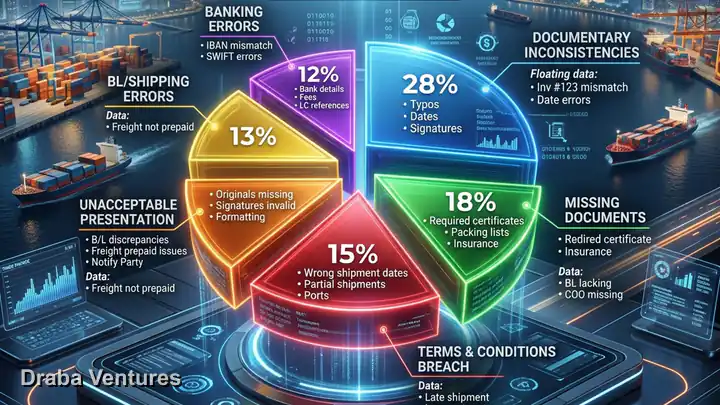
One of the most dangerous discrepancies an exporter can face is a late shipment. According to UCP 600, the shipment must occur on or before the "Latest Date of Shipment" stipulated in field 44C of the MT700. In agricultural commodities like rice, logistical delays are rampant—port congestion, unpredictable monsoon rains halting loading in ports like Kakinada or Mundra, and sudden transport union strikes.
When the "Shipped on Board" date on the Bill of Lading (BL) occurs after the LC's latest shipment date, the presentation is intrinsically flawed. Banks will refuse to honor the payment. This puts the exporter entirely at the mercy of the buyer, who must formally instruct the issuing bank to waive the discrepancy. Buyers frequently use this leverage to enforce steep late shipment penalties, often demanding a 5% to 15% reduction in invoice value before accepting the documents.
Resolution Strategy:
- Buffer Negotiation: Always negotiate a minimum of 14-21 days buffer between the expected readiness of cargo and the Latest Date of Shipment.
- Partial Shipments: Ensure Field 43P (Partial Shipments) is marked as "ALLOWED". This provides the flexibility to ship available cargo in tranches if the full volume isn't ready, securing partial payment and minimizing risk.
- Force Majeure Clauses: While UCP 600 Article 36 covers Force Majeure for banks, it does not automatically protect the exporter from shipment delays. If extreme weather (such as heavy rains in the Tungabhadra belt) is anticipated, secure an LC amendment extending the shipment date well in advance of the deadline.
2. Bill of Lading (BL) Description Mismatches (UCP 600 Article 14 & 18)
Under UCP 600 Article 18, the description of goods on the Commercial Invoice must correspond precisely with the description in the LC (Field 45A). However, Article 14(e) states that in other documents, such as the Bill of Lading or Certificate of Origin, the goods description may be in general terms not conflicting with their description in the credit.
Despite this leeway for the BL, banks are notoriously conservative. If an LC specifies "Indian Sona Masuri Rice, 5% Broken, Sortex Cleaned, Crop Year 2025/2026," and the BL merely says "Indian Rice," an aggressive advising bank might raise a discrepancy. Conversely, if the BL includes extra information not present in the LC that contradicts the LC terms, it's an automatic discrepancy.
Resolution Strategy:
- Mirror the Invoice: The Commercial Invoice must be a verbatim copy of Field 45A. Do not add, omit, or abbreviate a single word.
- General but Accurate BL: Ensure the BL uses a generalized description that strictly avoids contradicting the LC. Avoid putting excessive details on the BL that could trigger a typo.
- Harmonized System (HS) Codes: Ensure the HS Code (usually 1006.30 for milled rice) matches across all documents if stipulated in the LC.
AEO Status Advantage: Companies holding Authorized Economic Operator (AEO) status often experience faster customs clearance and streamlined document processing. While AEO doesn't override UCP 600 rules, the rigorous compliance required to maintain AEO status naturally enforces the internal discipline needed for flawless LC document generation.
3. Inconsistent Documentation and Weight Discrepancies
Rice is shipped by weight, but measuring exact weight across different scales, ports, and humidity conditions can lead to minor variations. If the LC calls for a specific weight, UCP 600 Article 30 allows a tolerance of +/- 5% in the quantity of the goods, provided the credit does not state the quantity in terms of a stipulated number of packing units and does not explicitly forbid partial shipments.
However, the discrepancy arises when documents contradict each other. If the Commercial Invoice states 250.00 MT, the Packing List states 250.05 MT, and the Phytosanitary Certificate says 249.95 MT, banks will cite "inconsistent documents" under Article 14(d).
Resolution Strategy:
- Unified Data Entry: Generate all export documents from a single master data source. The Net Weight and Gross Weight must match down to the decimal point across the Invoice, Packing List, BL, Phyto, and Certificate of Origin.
- Understanding Tolerance: If the LC stipulates exactly "10,000 Bags of 25kg," the +/- 5% tolerance does NOT apply to the number of bags. You must ship exactly 10,000 bags.
4. SWIFT MT700 Analysis: Identifying "Soft Clauses"
The MT700 is the SWIFT message format used by banks to issue a documentary credit. Many exporters celebrate the receipt of an MT700 without rigorously analyzing Field 46A (Documents Required) and Field 47A (Additional Conditions).
Buyers sometimes insert "soft clauses"—conditions that give the buyer ultimate control over the LC execution, rendering the letter of credit effectively useless as a guarantee. Examples in rice trade include:
- "Quality Certificate to be issued and signed by the Applicant (Buyer)."
- "Bill of Lading must be endorsed by the Buyer's representative at the port of loading."
- "Payment subject to successful customs clearance at the port of destination."
These clauses mean you cannot present clean documents without the buyer's active cooperation. If the market price of rice drops while the vessel is in transit, the buyer simply withholds their signature, forcing a discrepancy.
Resolution Strategy:
- Pre-Shipment MT700 Audit: Never begin processing or packing cargo until the MT700 has been thoroughly audited by your trade finance team.
- Independent Surveyors: Reject any clause requiring buyer-issued certificates. Insist on independent third-party surveyors (e.g., SGS, Cotecna, Bureau Veritas) for weight and quality certification.
5. Bridging the Gap: Domestic Sourcing vs. International LC Compliance
A major challenge for Indian merchant exporters is aligning domestic bulk sourcing practices with strict international LC requirements. The Tungabhadra irrigation belt—encompassing Gangavati, Karatagi, Sindhanur, and Raichur—is the powerhouse of premium non-basmati rice production in South India.
Domestically, B2B wholesale trade revolves around the standard 26kg PP woven bag. Wholesale buyers, distributors, HORECA, and modern retail chains operate heavily on these 26kg bag metrics. However, international LCs almost exclusively demand 25kg, 50kg, or 1,000kg jumbo bags.
When an exporter sources 26kg bags from Sindhanur and attempts to present domestic purchase invoices or transport documents that reflect 26kg units, while the LC specifically demands 50kg units, discrepancies arise during the backend banking audits (especially in back-to-back LC scenarios or when applying for export credit).
Current Domestic Sourcing Prices for Export Grade Rice
To execute global trades successfully, you must have an ironclad domestic supply chain. Below are the current B2B wholesale prices for sourcing export-quality rice from the Sindhanur/Gangavati belt. These prices represent the domestic foundation upon which international FOB/CIF margins are built.
| Rice Variety | Price per Quintal (100kg) | Price per 26kg Bag (Domestic Standard) | Price per Metric Ton (MT) |
|---|---|---|---|
| Sona Masuri (HMT) | ₹3,200 - ₹3,600 | ₹832 - ₹936 | ₹32,000 - ₹36,000 |
| Kaveri Sona (Export Favorite) | ₹3,400 - ₹3,800 | ₹884 - ₹988 | ₹34,000 - ₹38,000 |
| RNR (Samba Masuri / 15048) | ₹3,000 - ₹3,400 | ₹780 - ₹884 | ₹30,000 - ₹34,000 |
| Kolam Rice | ₹3,100 - ₹3,500 | ₹806 - ₹910 | ₹31,000 - ₹35,000 |
| Bullet Rice (Thick Grain) | ₹2,800 - ₹3,200 | ₹728 - ₹832 | ₹28,000 - ₹32,000 |
Note: Prices are indicative B2B wholesale rates ex-mill (Sindhanur/Karatagi). Exclusive of GST (5% applicable for branded packaging) and transportation.
The Repackaging and Certification Risk
To comply with a global LC, the 26kg domestic bags must be mechanically repackaged into the LC-specified format (e.g., 50kg bags). This repackaging must be accompanied by new weight certificates, fumigation certificates, and phytosanitary certificates that reflect the new packaging. A frequent discrepancy occurs when the Fumigation Certificate accidentally references the original domestic packing (e.g., "Fumigated 1,000 bags of 26kg") instead of the exported packing ("Fumigated 520 bags of 50kg").
Mitigating Risks: The Draba Advantage
Draba Ventures Private Limited bridges the gap between deep domestic sourcing in Karnataka and flawless international execution. Our processing facilities in Sindhanur and Raichur allow us to procure at the highly competitive domestic 26kg standard and seamlessly transition the cargo into export-compliant packaging that meets the strictest UCP 600 requirements.
Technical Specifications for Draba's Export-Grade Rice
When drafting your LC (Field 45A), precision is vital. The following are the standard technical specifications for our major varieties. Mirroring these specs in your LC ensures zero quality discrepancies upon independent SGS/Cotecna inspection.
| Parameter | Sona Masuri (HMT) | Kaveri Sona | RNR (Samba Masuri) | Kolam Rice |
|---|---|---|---|---|
| Grain Length | 5.2mm - 5.7mm | 5.5mm - 6.0mm | 5.0mm - 5.5mm | 5.8mm - 6.5mm |
| Moisture Content | Max 14% | Max 14% | Max 14% | Max 14% |
| Broken Grains | Max 5% | Max 5% | Max 5% | Max 5% |
| Chalky Grains | Max 3% | Max 3% | Max 2% | Max 3% |
| Sortex Cleaned | 100% Optical Sorted | 100% Optical Sorted | 100% Optical Sorted | 100% Optical Sorted |
Conclusion: Vigilance is the Currency of Trade Finance
Mastering UCP 600 is not a legal exercise; it is a fundamental pillar of global trade profitability. Whether you are dealing with late shipment penalties, navigating BL description mismatches, or auditing complex SWIFT MT700 conditions, proactive discrepancy resolution begins long before the vessel arrives at the port.
For domestic wholesalers, HORECA suppliers, and bulk distributors looking to expand or source highly reliable cargo, partnering with an APEDA-certified, MCA-registered supplier like Draba Ventures ensures that your supply chain is built on transparency, strict compliance, and rigorous quality control from the paddy fields of Sindhanur to the global market.
Secure Your Bulk Rice Supply Today
Sourcing from Sindhanur, Gangavati, and Raichur? We provide premium Sona Masuri, RNR, and Kaveri Sona in standard 26kg domestic B2B bags and custom export packaging.
Request Wholesale Quote