The Capital Drain of Excessive Domestic Warehousing
Holding excess inventory in expensive Tier-1 commercial warehouses drains capital and destroys gross margins for packaging distributors. In primary logistics hubs like Newark, Rotterdam, Antwerp, and Sydney, modern pallet storage fees range from $18 to $28 per pallet-month, excluding drayage, in-and-out handling, and inventory financing interest. When wholesale distributors over-order to compensate for unreliable overseas shipping, warehouse rent rapidly absorbs product profitability.
Just-In-Time (JIT) procurement requires absolute certainty in maritime transit timelines to prevent out-of-stock penalties with high-volume HORECA clients. If a supplier operates behind unpredictable feeder networks or congested hub ports, procurement managers are forced to maintain 60 to 90 days of safety stock. Sourcing through direct, non-congested Indian maritime corridors eliminates this operational buffer, restoring lean cash flow velocity.
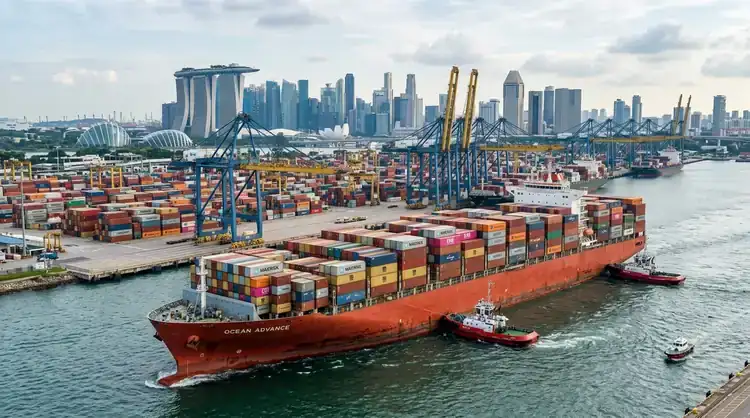
Coromandel Gateway Performance: The Port of Chennai (CCTPL & CITPL terminals) provides direct mainline mother-vessel calls connecting Indian manufacturing hubs directly to Europe, Southeast Asia, and North America, bypassing East Asian transshipment bottlenecks entirely.
Chennai Port: High-Frequency Ocean Transit Corridors
India's Coromandel Coast, specifically the Port of Chennai, serves as a hyper-efficient gateway offering direct sailing routes that completely bypass Chinese port congestion. Situated strategically on major Bay of Bengal and Indian Ocean shipping lanes, Chennai enables factory-sealed containers from Karnataka and Tamil Nadu manufacturing centers to reach international destination ports with remarkable speed and schedule integrity.
A container of bagasse clears Chennai customs and discharges at PSA Singapore in 6 to 8 days, or reaches the Port of Rotterdam in just 22 to 24 days. Draba Ventures synchronizes manufacturing production schedules with these direct-vessel departures, allowing global buyers to accurately forecast arrivals and drastically reduce their domestic warehousing footprint.
| Destination Port & Market | Average Ocean Transit (from Chennai) | Strategic Route Advantage |
|---|---|---|
| PSA Singapore (Southeast Asia Hub) | 6 - 8 Days | Direct sailing, zero transshipment, daily feeder connectivity |
| Port of Rotterdam (EU Gateway) | 22 - 24 Days | Direct Suez mainline service; rapid customs bonded clearance |
| Port of Felixstowe / Southampton (UK) | 24 - 26 Days | Fast North European corridor access without feeder relays |
| Port Botany - Sydney (Australia) | 18 - 22 Days | Efficient direct Australasian shipping lane |
| Port of Newark / New York (US East Coast) | 28 - 32 Days | Predictable transatlantic routing via Mediterranean corridor |
| Port of Long Beach (US West Coast) | 32 - 38 Days | Direct trans-Pacific vessel scheduling |
Financial Comparison: JIT Flow vs. 90-Day Safety Stockholding
Evaluate the working capital and carrying cost impact of shifting from legacy safety-stock hoarding to Draba synchronized JIT fulfillment on a 10-container annual program:
| Cost Metric (Per 40ft HC Basis) | Legacy Safety Stock Model (90-Day Buffer) | Draba JIT Flow Model (25-Day Buffer) | Financial Advantage |
|---|---|---|---|
| Inventory Capital Tied Up | $48,000 per cycle | $16,000 per cycle | $32,000 capital liberated |
| Domestic Pallet Storage Cost | $3,600 (3 months @ $1,200/mo) | $1,000 (Cross-docked distribution) | $2,600 storage saved per container |
| Inventory Financing Expense (8%) | $960 per container | $270 per container | $690 financing cost avoided |
| Carton Humidity Degradation Risk | Moderate to High (Prolonged storage) | Negligible (Direct client dispatch) | Zero damaged box write-offs |
Synchronized Factory-to-Berth Logistics Execution
Draba Ventures integrates production lines directly with export shipping schedules. Our freight operations desk tracks container booking confirmations, pre-clears documentation with customs brokers, and coordinates bonded container transport from our manufacturing facilities to Chennai container freight stations (CFS) within a 48-hour gate-in window. This eliminates port dwell penalties and guarantees container loading on the designated outbound vessel.
Frequently Asked Questions
What is the ocean transit time from Chennai to Singapore?
How long does it take to ship from India to the Port of Rotterdam?
How does Indian eco-packaging support Just-In-Time (JIT) inventory?
Ready to Secure Certified PFAS-Free Biodegradable Packaging?
Click the WhatsApp icon in the bottom corner to request our lab test reports and live CIF pricing. Our procurement team is online.
Review Vessel Schedules Chat on WhatsApp