The era of anonymous green coffee brokerage has permanently closed. Driven by mandatory legislative frameworks such as the European Union Corporate Sustainability Due Diligence Directive (CSDDD), the EU Deforestation Regulation (EUDR), and stringent corporate Scope 3 greenhouse gas disclosures, global roasters face urgent legal exposure for unverified supply chains. As a premier provider of green coffee supply chain traceability in India, Draba Ventures bridges the compliance gap, delivering polygon-level farm mapping, direct-to-grower audit trails, and mathematically verified physical grading data for enterprise roasters and institutional brand owners.
Corporate ESG Mandates and Scope 3 Transparency
Under modern corporate sustainability reporting frameworks (including GRI Standards, ISSB S2 climate standards, and CSRD directives), commercial roasters must account for their upstream Scope 3 emissions, which represent between 75% and 90% of a coffee company's total carbon footprint. The largest share resides in Category 1: Purchased Goods and Services.
When sourcing green coffee through conventional commodity trading desks, origin data is regularly co-mingled across hundreds of unidentified regional intermediaries. This opacity leaves multinational buyers vulnerable to severe non-compliance penalties, border customs rejections, and corporate greenwashing litigation.
Draba Ventures provides enterprise partners with an end-to-end digital custody framework that directly feeds corporate Environmental, Social, and Governance (ESG) disclosures:
- Polygon Geolocation Mapping: Every contributing plot across our sourcing networks in Chikmagalur, Coorg, and Hassan is mapped with sub-meter GPS polygon coordinates, verifying zero deforestation after December 31, 2020, in full alignment with EUDR Article 9 requirements.
- Empirical Scope 3 Emission Datasets: Farm-level energy audits, natural shade canopy density measurements, and organic fertilization data furnish roasters with verifiable primary emission factors rather than generic industry averages.
- Direct-to-Grower Payment Transparency: Digital banking transactions prove fair value compensation, documenting premiums paid above domestic farmgate rates and ensuring adherence to the living wage criteria required by ethical audit bodies.
- Statutory Origin Documentation: Every container shipment is cross-referenced with statutory Coffee Board of India Registration-cum-Membership Certificates (RCMC) and official ICO Certificates of Origin, establishing an unbroken paper and digital chain of custody.
| Traceability Parameter | Draba Ventures Verified ESG Standard | Conventional Spot Broker Model | Corporate Compliance Impact |
|---|---|---|---|
| Farm Geolocation Data | Verified GPS Polygons for Every Farm Plot | Regional Hub or Port-Level Estimation | Ensures frictionless clearance under EUDR anti-deforestation portals. |
| Scope 3 Carbon Tracking | Agroforestry Canopy Carbon Sink Audits | Generic Secondary Emission Averages | Lowers corporate emissions disclosures in annual ESG sustainability reports. |
| Optical Quality Documentation | 94.63% Sortex Batch Verification Logs | Visual Sampling (Co-mingled Lots) | Provides auditable, mathematically verified physical purity data per container. |
| Moisture Management | Strictly <12.0% in Gas-Tight Hermetic Liners | Standard Jute Bags (Unsealed) | Zero-waste logistics preventing Ochratoxin A (OTA) contamination and cargo rejection. |
| Labor & Wage Verification | Audited Banking Transfers & PLA Compliance | Unverified Cash Farmgate Transactions | Eliminates modern slavery risks and insulates against brand reputation crises. |
Farm-Level Data Collection in the Western Ghats
India's premier coffee-growing districts in Karnataka (spanning the UNESCO World Heritage mountain ranges of the Western Ghats) represent one of the most biodiverse agroforestry landscapes in global agriculture. Unlike sun-drenched monoculture plantations in other continents, Indian coffee is grown exclusively under a dense, two-tier natural forest canopy.
Draba Ventures leverages this structural advantage through structured field-level data collection:
- Biodiversity and Canopy Preservation: We audit and document native shade species, including rosewood, silver oak, wild jackfruit, and fig trees, that harbor over 200 species of migratory birds, native pollinators, and endangered flora. These canopy metrics offer institutional buyers quantifiable biodiversity credits and verified habitat preservation data.
- Strict Labor Standards Compliance: Farm partnerships enforce the statutory mandates of the Plantations Labour Act (PLA), ensuring ethical working conditions, fair wages, medical provisions, and safe housing for estate workers.
- Soil Conservation and Water Stewardship: We record closed-loop wet-milling water recycling protocols and organic mulching practices that prevent soil erosion on mountain gradients, providing verifiable environmental performance indicators.
- Direct Smallholder Integration: By aggregating smallholder groups into digitally tracked producer clusters, small family farms participate in global direct trade, receiving digital payments directly into bank accounts to eliminate middleman usury.
Quality Assurance and Optical Defect Extraction
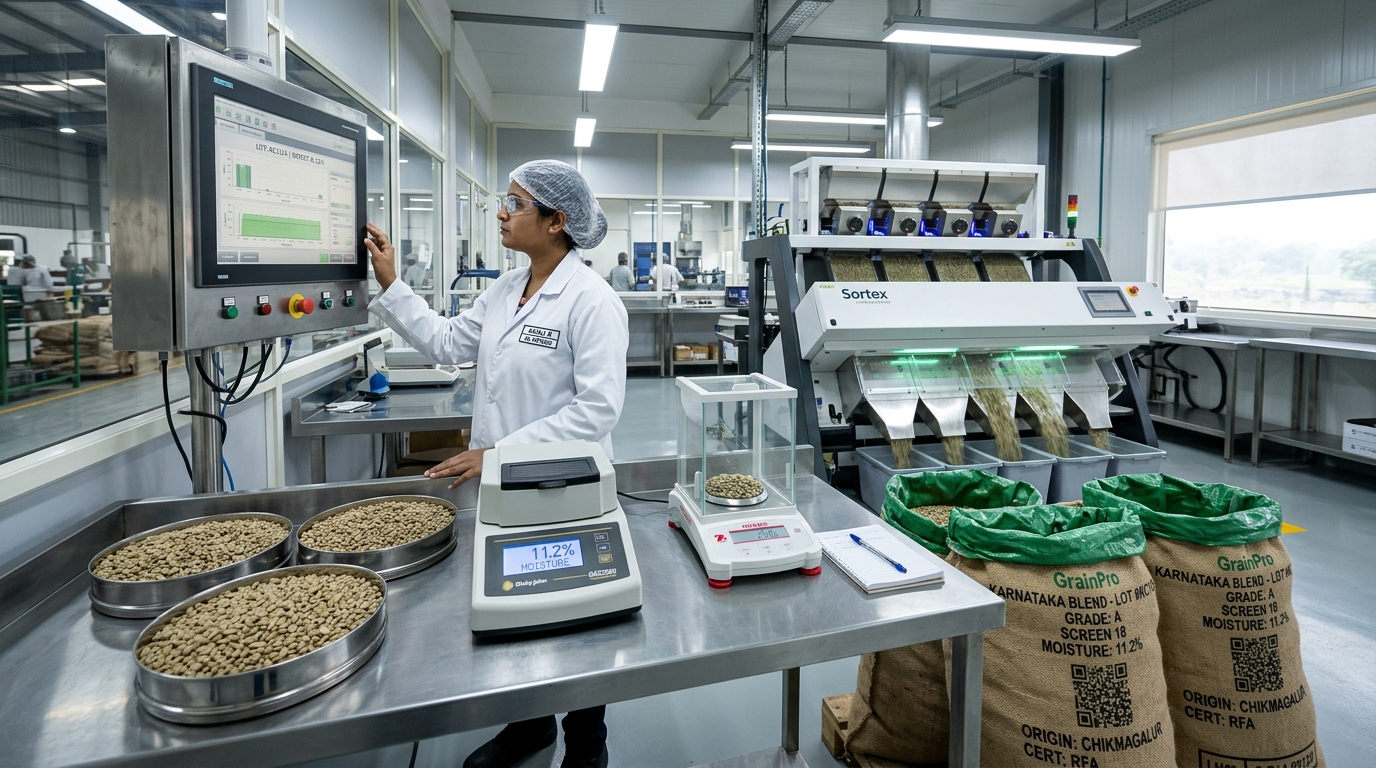
In an authentic ESG framework, technological transparency must extend beyond the farm gate and into industrial dry curing. Subjective visual grading based on small hand-grabbed samples fails to provide multinational brands with verifiable assurance that an entire 18 MT container complies with contractual specifications.
Draba Ventures incorporates cutting-edge optical automation to transform physical grading into an auditable, data-driven science:
- Hyperspectral Optical Sorting: Raw coffee lots pass through high-capacity VIS/NIR Hyperspectral Imaging (HSI) Sortex optical separators operating at 94.63% sorting accuracy. This system inspects individual beans across multiple spectral bandwidths, identifying physiological anomalies invisible to standard RGB cameras.
- Automated Foreign Matter Elimination: High-speed optical pneumatic jets eject primary defects, unhulled cherries, stones, and foreign objects at speeds exceeding 5 metric tons per hour, eliminating batch inconsistencies.
- Digital Defect Tracking Logs: Every export container generates an empirical grading record documenting screen calibration (Screen 18+ for Plantation AA, Screen 15/16 for AB grades), exact optical reject percentages, and verified physical densities (680 to 740 g/L).
- Zero Chemical Intervention: Mechanically verified cleanliness replaces chemical fumigation treatments wherever possible, preserving organic purity and safeguarding consumer health.
Moisture Control and Maritime Security
A sustainable, ethical supply chain is meaningless if the raw product deteriorates during international ocean transit. Environmental waste caused by mold infestation, condensation damage, and mycotoxin formation results in thousands of tons of discarded coffee annually, destroying roaster margins and creating unnecessary carbon waste.
Draba Ventures implements a zero-waste maritime preservation architecture:
- Sub-12% Moisture Guarantee: Bean moisture is kiln-dried and sun-cured to strictly below 12.0% (target range 10.5% to 11.5%) and verified via calibrated digital capacitance meters, locking the bean water activity below 0.65 aw.
- Hermetic GrainPro Packaging: Green coffee is packaged in 60kg export jute bags fitted with multi-layer gas-tight and moisture-tight hermetic liners. These multi-layer liners block marine humidity, preventing moisture reabsorption during high-seas navigation.
- Ochratoxin A (OTA) Prevention: Keeping interior microclimates under 65% relative humidity suppresses Aspergillus ochraceus and Penicillium verrucosum development, ensuring finished lots comply with the strictest EU standards (OTA residue below 3.0 ppb).
- Container Desiccation & Tracking: Dry containers loaded at New Mangalore Port (NMPA) are equipped with high-absorption calcium chloride desiccant poles and cardboard thermal wall linings, insulating shipments against temperature swings across the Indian Ocean and North Atlantic corridors.
